Investing in financial products involves risk. Losses may exceed the value of your original investment.
Quick answer
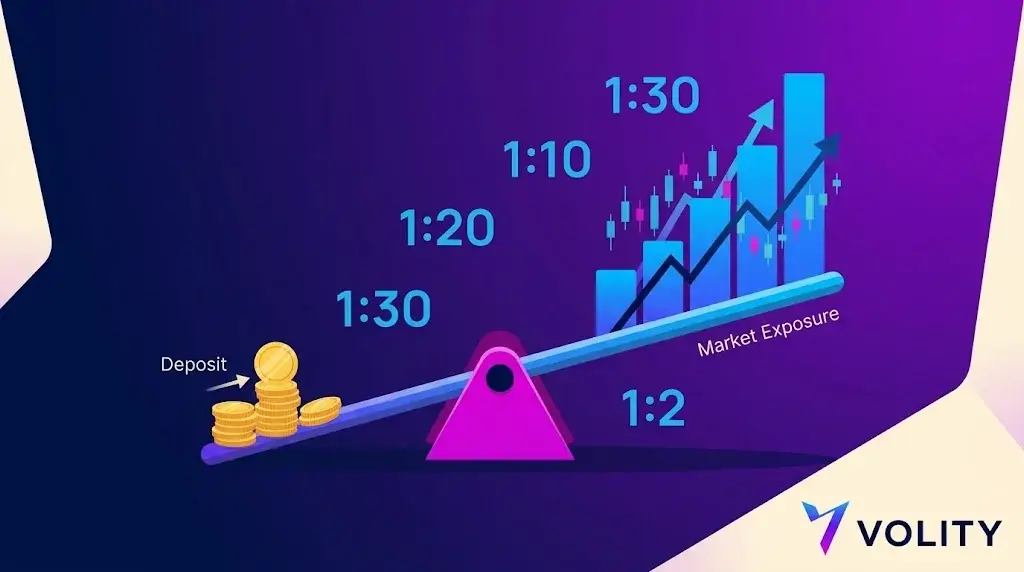
CFD leverage trading uses borrowed capital from the broker to control a position larger than the trader’s deposit. EU retail leverage is capped at 1:30 on major FX, 1:20 on indices and gold, 1:10 on minor commodities, 1:5 on stocks, and 1:2 on crypto. Falling below maintenance margin triggers a margin call; below the stop-out threshold the broker auto-closes positions.
CFD leverage trading is the practice of using a small deposit (margin) to control a much larger market position via a contract for difference. The broker funds the rest of the notional, and your profit or loss scales with the full position size, not just your deposit. Leverage of 1:30 means a $1,000 deposit controls $30,000 of notional exposure. The mechanism amplifies both gains and losses; this is the entire point and the entire risk.
How leverage actually works
- You deposit cash into a CFD account.
- You open a position. The broker requires a percentage of the position’s notional as margin.
- The broker funds the rest of the notional. Profit and loss accrue on the full notional.
- Overnight financing is charged on the funded portion (long positions typically pay; short positions vary by asset).
- You close the position. The broker debits or credits the P&L to your account.
ESMA retail leverage caps
European retail clients trade under harmonised product-intervention rules. The maximum leverage by asset class:
- 1:30 on major currency pairs (EUR/USD, GBP/USD, USD/JPY and similar).
- 1:20 on non-major currency pairs, major equity indices, and gold.
- 1:10 on other commodities and non-major equity indices.
- 1:5 on individual equities and other reference values.
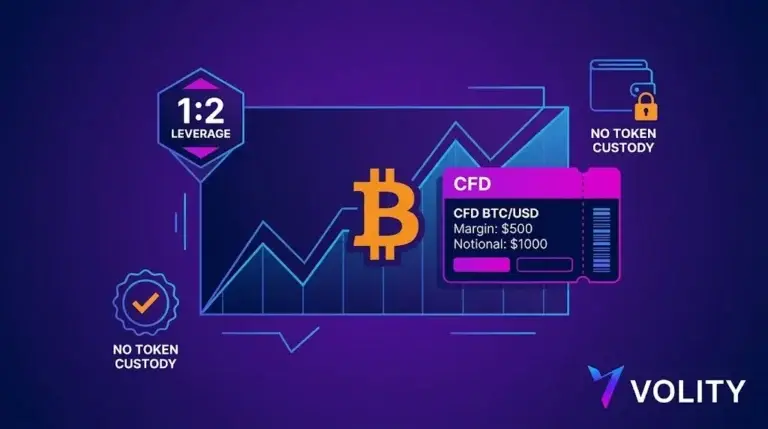
- 1:2 on cryptoassets.
Negative balance protection applies to retail accounts: your loss is capped at the funds you have deposited, regardless of how the market moves.
Leverage in real numbers
Long Apple CFD at $200, position size 100 shares. Notional: $20,000.
- Equity retail leverage: 1:5. Initial margin = 20% = $4,000.
- Apple rises 5% to $210. P&L = +$1,000. Return on margin = 25%.
- Apple falls 5% to $190. P&L = -$1,000. Return on margin = -25%.
- Apple falls 20% to $160. P&L = -$4,000. Margin wiped; broker auto-closes around the 50%-of-margin threshold; negative balance protection prevents further loss.
The same 5% spot move in Apple is a 25% move on the leveraged position. Symmetry.
When does leverage make sense?
- Short-term trades. Days, not months. Overnight financing eats away at any directional edge over long holding periods.
- Capital-efficient hedges. Hedging a $100,000 equity portfolio with a $5,000 CFD margin deposit on an index short.
- Pre-defined risk. Stop-loss in place before entry. Position sized so a stop-out is no more than 1-2% of account equity.
- Pairs and relative-value. Two offsetting positions where the directional risk cancels and the residual exposure is the basis you want.
What goes wrong
- Maxing out leverage on day one. The cap is a ceiling, not a target. Most experienced traders run a fraction of the cap. Risking 1% of account per trade often means using 10-30% of available leverage, not 100%.
- Forgetting overnight financing. A 1:5 long equity position carries financing on 4x your margin. Over 90 days that adds up.
- Gap risk on weekends. Equity CFDs and indices can gap 3-5% on Monday open. Stops do not fill at advertised prices. Negative balance protection covers the catastrophic case but does not stop a margin wipe.
- Compounding losers. Adding to a losing leveraged position is the single most reliable way to blow up an account.
Leverage at Volity
Volity offers CFD exposure across forex, indices, gold, commodities, equities, and cryptoassets at full ESMA retail leverage caps. Negative balance protection applies on retail accounts. Eligible clients may apply for elective professional status under MiFID II suitability rules; professional accounts may access higher leverage but lose certain retail protections including the 50% margin close-out floor and negative balance protection guarantees in some scenarios. Trading is executed by UBK Markets Ltd, a Cyprus Investment Firm authorised by CySEC under licence 186/12. Eligible retail clients are covered by the Cyprus Investor Compensation Fund up to EUR 20,000 per client per firm.
Volity operates a trading platform and also publishes educational and analytical content about trading. The content on this page is for educational purposes only and should not be considered financial advice. Volity may benefit commercially when readers open trading accounts through links on this site.
Our content is produced and reviewed under documented editorial standards; see our comparison and review methodology.
Frequently asked questions
How is CFD leverage capped for retail clients?
Regulators in several jurisdictions set maximum leverage by asset class, with major currency pairs at the top of the range and more volatile assets such as crypto much lower. The applicable cap depends on the entity you are contracting with.
Does higher leverage increase my profit potential?
It increases position size for a given deposit, which magnifies both outcomes. It also moves the liquidation level closer to the entry, so a normal retracement is more likely to close the position before the move you expected occurs.
How does leverage interact with overnight financing?
Financing is charged on the full notional value of the position, not on the margin you deposited. Higher leverage therefore means a larger notional and a larger nightly cost for the same amount of capital committed.