Investing in financial products involves risk. Losses may exceed the value of your original investment.
Quick answer
To open a CFD trading account: pick a CySEC- or FCA-regulated broker, submit KYC documents (photo ID + proof of address), wait 24 to 72 hours for verification, fund the account via SEPA, card, or crypto, and start on the demo before going live. Most retail accounts open with $1 to $250 minimum and accept negative-balance-protected EU clients by default.
Opening a CFD trading account at a CySEC-regulated broker is a one-hour process if your documents are ready. The friction is regulatory: KYC under AML rules, plus the MiFID II appropriateness assessment that all EU brokers must run on retail CFD applicants. Here is the seven-step process, with the checks that matter and the timeline you should expect.
Why CySEC matters
The Cyprus Securities and Exchange Commission (CySEC) regulates Cyprus Investment Firms (CIFs) under MiFID II. A CySEC-regulated broker:
- Holds client funds in segregated accounts at tier-1 banks
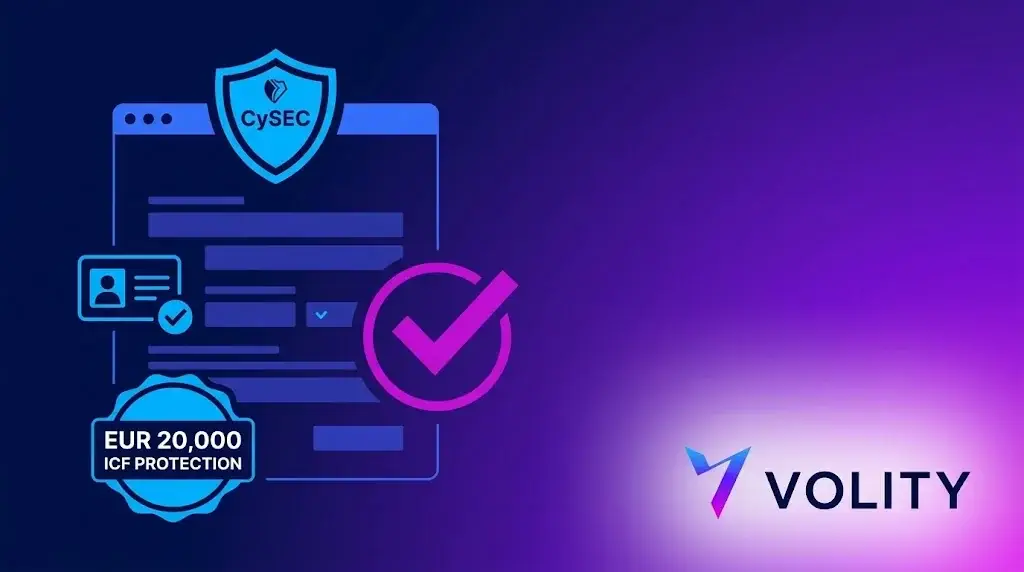
- Participates in the Cyprus Investor Compensation Fund (ICF), which covers eligible retail clients up to EUR 20,000 per client per firm in the event of broker insolvency
- Applies ESMA product-intervention measures: retail leverage caps, negative balance protection, standardised risk warning
- Submits to regular CySEC supervision, audits, and capital adequacy reporting
The CySEC public register lists every regulated firm and its licence number. Volity’s trading is executed by UBK Markets Ltd, licence 186/12, on the register.
Step 1: prepare your documents
Three documents close 95% of CySEC KYC requirements:
- Government photo ID: passport, national ID card, or driver’s licence. Must be valid (not expired). Both sides if double-sided.
- Proof of address: utility bill, bank statement, or government tax document, dated within the last three months. Must show your full name and current residential address. P.O. boxes are not accepted.
- Proof of source of funds: payslip, employer letter, bank statement showing salary deposits, or accountant statement for self-employed clients. Required for higher deposit tiers and standard for AML compliance.
Have these as PDF or high-resolution photos before you start. The most common rejection reason is a blurred or cropped photo of the ID.
Step 2: complete the application form
Expect 15-20 minutes. The fields cluster into four areas:
- Identity and contact: name, date of birth, nationality, tax residency, tax identification number, address, phone, email.
- Financial profile: annual income band, net worth band, employment status, source of funds. These feed AML risk scoring; answer accurately.
- Trading experience: years of experience, products traded (equities, FX, CFDs, options, crypto), trade frequency. Feeds the appropriateness assessment.
- Politically exposed person (PEP) declaration: required by AML directive. Tick honestly.
Step 3: pass the MiFID II appropriateness assessment
This is mandatory under EU rules for any retail client trading complex products. CFDs are complex products. The assessment is a 10-15 question multiple choice covering:
- What leverage means and how it amplifies both profits and losses
- What a margin call is and how to respond
- What negative balance protection covers and what it does not
- How CFD pricing relates to the underlying asset
- The typical loss rate among retail CFD traders
Read the broker’s risk disclosure document before starting. Everything in the assessment is in there. If you fail, the broker may either decline the application or accept it with a written warning that CFDs are not appropriate. The latter is regulator-permitted but uncomfortable; better to study, then re-take.
Step 4: identity verification
Most CySEC brokers run automated ID verification through providers like Onfido or Sumsub. The process:
- Upload photos of the ID document
- Take a live selfie that the system matches against the ID photo
- Upload proof of address
Approval typically lands within 1-24 hours during business days. Reasons for delay: blurry photo, cut-off corners, expired document, address mismatch with the application.
Step 5: fund the account
CySEC brokers typically offer four funding rails:
- SEPA bank transfer: 0-1 business day, no broker fee, your bank’s standard SEPA fee (usually free).
- SWIFT international transfer: 1-3 business days, $10-30 fee depending on banks.
- Card: instant, may carry a 1-2% fee depending on issuer.
- Crypto: where supported (BTC, ETH, USDT, USDC), 10-60 minutes for on-chain confirmations.
Funds are deposited into segregated client money accounts at tier-1 banks, separate from the firm’s own funds, as required under MiFID II.
Step 6: install the platform
CySEC brokers typically support MT4 and MT5 across desktop, web, and mobile (iOS, Android). For CFD trading specifically, MT5 has more order types and faster strategy testing; MT4 has the deeper legacy EA library. Pick based on your strategy.
Configuration after install:
- Connect to the broker’s live server (credentials sent by email)
- Add your trading symbols to Market Watch
- Set up your default chart template
Step 7: place a small first trade
The first live trade is 0.01 lots, held under an hour, with a defined stop. The point is verification: order fills at expected price, stop triggers correctly, P&L reports in account history, withdrawal works (test a small withdrawal too). Once verified, scale to your strategy size.
Timeline summary
- Application form: 20 minutes
- Appropriateness assessment: 15 minutes
- ID verification: 1-24 hours
- Funding (SEPA): same day to next business day
- Total realistic time to first trade: 1-2 business days
Opening a CFD account at Volity
Volity’s CFD trading is executed by UBK Markets Ltd, a Cyprus Investment Firm authorised by CySEC under licence 186/12. Eligible retail clients are covered by the Cyprus Investor Compensation Fund up to EUR 20,000 per client per firm. ESMA leverage caps apply: 1:30 on majors, 1:20 on indices and gold, 1:10 on other commodities, 1:5 on equities, 1:2 on crypto. Negative balance protection applies. Account opening completes within 24 hours of document submission for most clients.
Volity operates a trading platform and also publishes educational and analytical content about trading. The content on this page is for educational purposes only and should not be considered financial advice. Volity may benefit commercially when readers open trading accounts through links on this site.
Our content is produced and reviewed under documented editorial standards; see our comparison and review methodology.
Frequently asked questions
What does CySEC regulation mean for my account?
It means the firm operates under the Cyprus Investment Services Law and EU-derived conduct rules, including client money segregation, leverage limits for retail clients and access to a formal complaints process.
What documents are required to open the account?
A government-issued photo identification, a proof of address dated within the accepted window, and completion of a suitability questionnaire. Source-of-funds evidence may be requested for larger deposits under AML rules.
Can I check the firm's licence myself?
Yes, and you should. CySEC publishes a public register of licensed Cyprus investment firms, searchable by name and licence number, which shows the firm's current status and permissions.