Investing in financial products involves risk. Losses may exceed the value of your original investment.
Quick answer
CFD gold trading is a leveraged contract-for-difference position on spot gold (XAU/USD) without taking physical delivery. Retail spreads typically run 0.2 to 0.5 dollars per ounce, with 1:20 retail leverage under EU rules. CFDs beat spot when capital efficiency matters; futures beat CFDs on commission cost above $50,000 position size.
A gold CFD is a contract on the price of XAU/USD (gold against the US dollar) settled against the broker. You never take delivery of physical gold, never store it, never insure it. You post margin, the broker tracks the spot price, and your profit or loss is the price move multiplied by your contract size. For active traders, the structure is materially cleaner than physical gold or gold ETFs. For long-term store-of-value, physical or ETF is the right tool.
The contract specification
One standard XAU/USD CFD contract is 100 troy ounces, mirroring the COMEX 100 oz futures contract. A USD 1 move in the gold price is USD 100 P&L on a one-lot position. Mini lots (10 oz) and micro lots (1 oz) are available for finer position sizing.
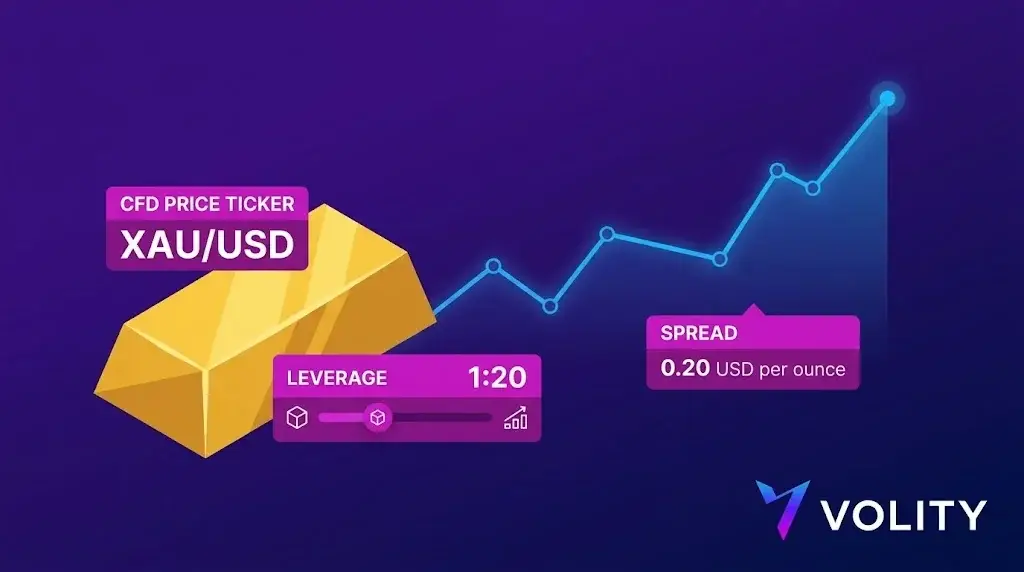
Quote: XAU/USD 2,400.50 / 2,400.70. Spread is 20 cents per ounce, or USD 20 on a one-lot contract. On Volity, gold spreads typically run 20-35 cents per ounce in liquid sessions, widening during off-hours and major news.
Leverage under ESMA
Retail leverage on gold CFDs is capped at 1:20 under ESMA. Initial margin is 5% of notional. To take USD 100,000 of gold exposure (one standard lot at USD 1,000 per ounce equivalent), you post USD 5,000.
Gold is grouped with major indices and minor FX pairs at the 1:20 tier (above the 1:10 tier for other commodities like oil). The reasoning: gold’s volatility is structurally lower than oil’s, and the deepest spot gold market clears 200+ billion USD per day, comparable to major FX.
Negative balance protection applies. You cannot lose more than the equity in your account.
Gold CFD vs gold ETF vs physical gold
| Feature | Gold CFD | Gold ETF | Physical gold |
|---|---|---|---|
| Ownership | None (contract) | Fund unit, with allocated bullion | Direct title |
| Leverage | Up to 1:20 retail | 1:1 (cash) or 1:2-1:4 (margin) | 1:1 |
| Storage cost | None | Fund expense ratio (0.15-0.40%) | Insurance, vault fees |
| Spread / fee | 0.20-0.35 USD per ounce | Bid-ask + ETF expense | Dealer spread (1-3% retail) |
| Overnight financing | Yes, daily | None | None |
| Two-way exposure | Long or short | Long mostly; some inverse ETFs | Long only |
| Liquidity | 24/5 (FX-style hours) | Exchange hours | Dealer hours |
| Tax treatment | Varies | Capital gains in most jurisdictions | Capital gains; sometimes higher rate |
When a gold CFD beats spot
- Active trading. Day and swing traders need precise sizing, two-way exposure, and tight spreads. Gold CFDs deliver all three. Physical and ETF do not.
- Hedging. A short gold CFD can hedge an inflation-correlated portfolio without selling physical or ETF holdings.
- Capital efficiency. 1:20 leverage frees 95% of capital for other instruments while still controlling the same notional. The cost is overnight financing on the leveraged portion.
- Tactical macro. A view on real rates, USD strength, or geopolitical risk often resolves in days to weeks. CFDs match that horizon.
When physical or ETF gold beats CFD
- Long-term store of value. Holding gold for years to decades. CFD financing erodes returns; physical and ETF do not.
- Crisis allocation. A portfolio sleeve held against systemic financial risk. Counterparty exposure to a broker is the wrong wrapper for that thesis.
- Estate planning. Physical gold can be passed directly; CFDs cannot.
The mechanics of an XAU/USD trade
Long entry: 2,400.70. Stop: 2,395.00. Target: 2,412.10.
- Risk per ounce: 5.70 USD.
- Reward per ounce: 11.40 USD.
- R:R: 2:1.
- Position size on a 10,000 USD account at 1% risk: 100 USD risk / 5.70 USD per ounce = 17.5 ounces. Trade 1 mini lot (10 oz) and round down for safety.
- Margin required at 1:20: 17.5 oz x 2,400 USD x 5% = 2,100 USD.
If the trade hits target, P&L is 17.5 x 11.40 = 199.50 USD. If it hits stop, loss is 17.5 x 5.70 = 99.75 USD.
What goes wrong
- News-driven gaps. Major US data prints (NFP, CPI, FOMC) move gold 20-50 USD in seconds. Stop-losses may slip. Size accordingly or sit out the print.
- Overnight financing on long-held positions. A long gold CFD held for two months can accrue 1-2% of notional in financing, comparable to a year of ETF expenses.
- Spread widening. Asia-session gold trading sees wider spreads (40-80 cents per ounce on some venues). Active sessions are tighter.
Spreads, commission and overnight financing differ from one provider to the next, so the cheapest gold CFD depends on how long you hold. Our comparison of the best gold trading platforms prices the same trade on seven platforms.
Gold CFD trading at Volity
Volity offers XAU/USD and XAG/USD (silver) CFDs alongside 70+ FX pairs and 20+ indices. Retail leverage on gold is capped at 1:20 under ESMA. Spreads from 0.20 USD per ounce in liquid hours. Negative balance protection applies. Execution is by UBK Markets Ltd, a Cyprus Investment Firm authorised by CySEC under licence 186/12.
Volity operates a trading platform and also publishes educational and analytical content about trading. The content on this page is for educational purposes only and should not be considered financial advice. Volity may benefit commercially when readers open trading accounts through links on this site.
Our content is produced and reviewed under documented editorial standards; see our comparison and review methodology.
New to the metal? Start with our gold trading guide.