Investing in financial products involves risk. Losses may exceed the value of your original investment.
Quick answer
Profiting from CFD trading requires a real edge over the round-trip spread plus financing cost. Three honest edges: cost arbitrage (using CFDs where commissions undercut futures), directional trend-following on liquid instruments with strict stop-losses, and volatility-event positioning around scheduled releases. Random discretionary trading without an edge typically loses to the cost structure.
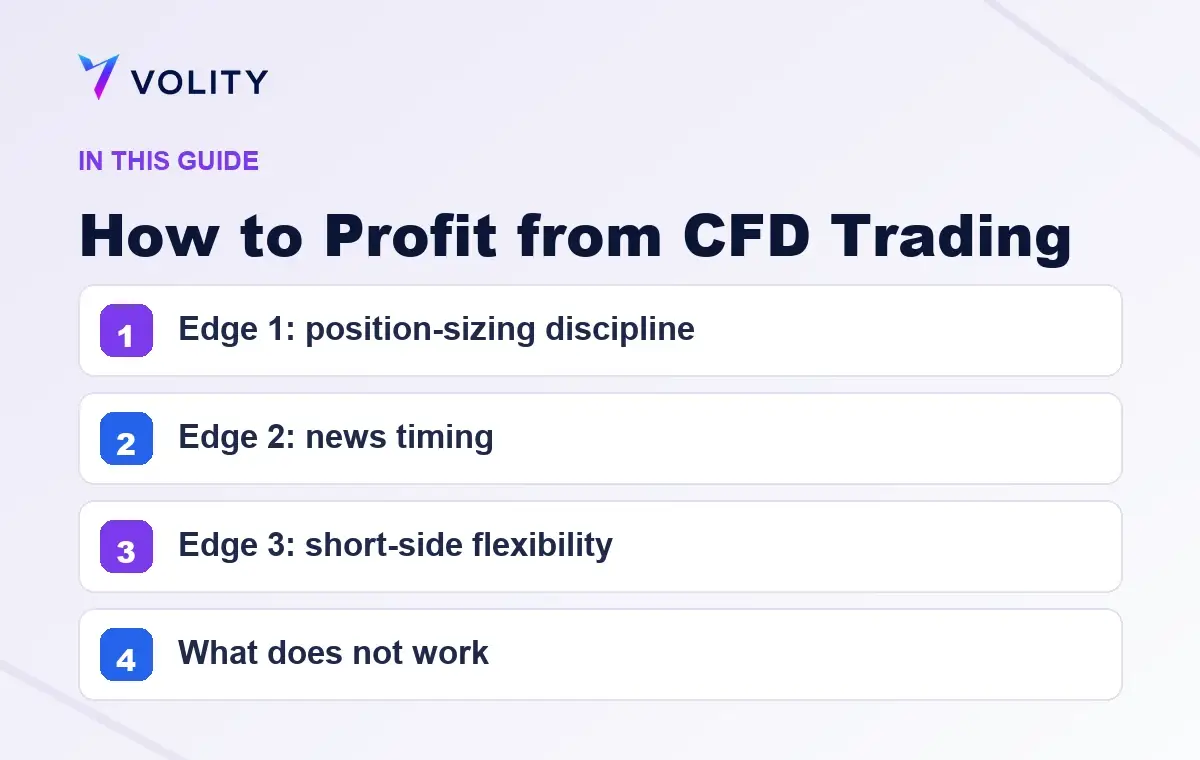
Profit in CFD trading is structurally hard. Between 70% and 80% of retail accounts lose money. The 20-30% who profit are not smarter; they have a real, defensible edge applied with mechanical discipline. Three edges are accessible to retail without a Bloomberg terminal or a co-located server. Here they are, with honest framing on what each one delivers and what it does not.
Edge 1: position-sizing discipline
This is the unglamorous edge that explains most of the divergence between profitable and unprofitable retail accounts. It is not a strategy; it is a constraint.
The rule: risk no more than 1% of account equity per trade, position-sized off a structural stop.
The math: at 1% risk per trade, a 50% win rate at 1.5R average reward, you compound at roughly 0.25% per trade gross. Over 200 trades a year that is 65% gross before fees and slippage. Realistic net: 25-40% per year.
Now invert it. At 5% risk per trade, the same statistics give you a 25%+ chance of a 50% drawdown within the first 100 trades. Most accounts do not survive a 50% drawdown psychologically. The trader changes systems, doubles size after a loss, or quits.
Position sizing is not a setup. It is the floor that lets the setup work. CFD traders who get sizing right outperform CFD traders with better setups but worse sizing. The data on this is consistent across 30 years of retail FX and equity studies.
Edge 2: news timing
Volatility concentrates around scheduled events. The flow:
- Federal Reserve FOMC decisions: 8 per year, 18:00 UTC on decision day. The Fed publishes the dot plot quarterly. Volatility on the dollar index, equity indices, and gold compresses pre-release and explodes for 30-90 minutes post.
- US CPI: monthly, 13:30 UTC. Most market-moving macro release of the month in 2024-2026.
- ECB monetary policy decisions: 8 per year, decision and press conference. Big mover for EUR pairs and European indices.
- OPEC+ meetings: production decisions move WTI and Brent 3-7%.
- NFP (US Non-Farm Payrolls): monthly, first Friday, 13:30 UTC. Less reliable than CPI in 2026 but still moves rates and FX.
The retail edge is not predicting the print. It is sizing exposure correctly around the print and avoiding the dead time between events. Many profitable retail traders only trade two or three sessions per week, anchored to scheduled releases.
The data: average daily range on EUR/USD is 60-80 pips in normal conditions and 150-250 pips on FOMC days. The same setup pays 2-3x in a high-volatility window.
Edge 3: short-side flexibility
This is the structural edge of CFDs over plain equity ownership. CFDs let you go short with the same friction as going long. No share borrow, no locate fees, no special account permissions.
Why this matters:
- Markets fall faster than they rise. Average bear-market drawdown velocity is 2-3x the average bull-market run.
- Most retail traders are structurally long-biased. Removing the bias unlocks 30-40% of the trading universe.
- Short setups during regime shifts (rate-hike cycles, earnings disappointments, commodity-glut cycles) historically pay outsized R-multiples.
The honest caveat: short-side trading is psychologically harder. Crowds push the wrong way longer than expected. Stop discipline must be tighter. Most retail short-sellers fail not because the thesis is wrong but because they hold through the squeeze. The risk-per-trade rule (1%) does the work here too.
What does not work
Three categories that do not deliver consistent retail edge in 2026, despite the marketing:
- Over-the-counter signal services. The good ones charge $500+/month and the math rarely closes; the cheap ones run at random.
- Naive scalping. Sub-5-minute scalping on retail spreads loses to the spread itself in the long run. Institutional scalpers operate at near-zero fees and millisecond latency. Retail does not.
- Black-box EAs. The marketplace is full of curve-fit MT4/MT5 expert advisors that backtest perfectly and lose live. The tell: any EA showing a smooth equity curve in backtest with no drawdowns is overfit.
How to combine the three edges
A workable retail playbook:
- Trade 2-4 scheduled news windows per week (Edge 2).
- Take both long and short setups (Edge 3).
- Risk no more than 1% per trade, sized off a structural stop (Edge 1).
Expected: 50-70 trades per year, 50-55% win rate, 1.5-2R average winner, 12-25% net annual return after fees and slippage. This is not a get-rich-quick number. It is what the data supports for a disciplined retail trader. Compounded over five years, it is meaningful.
CFD trading at Volity
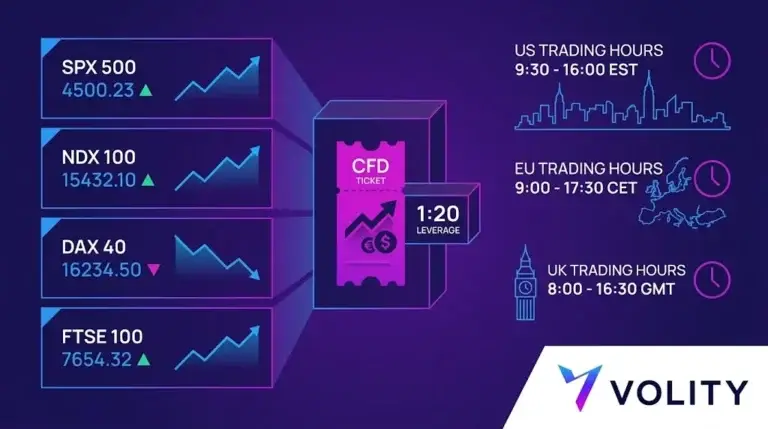
Volity offers CFD exposure across forex, indices, commodities, equities, and crypto on MT4 and MT5. Retail leverage caps follow ESMA: 1:30 majors, 1:20 indices and gold, 1:10 other commodities, 1:5 equities, 1:2 crypto. Negative balance protection applies. Trading is executed by UBK Markets Ltd (CySEC 186/12).
Volity operates a trading platform and also publishes educational and analytical content about trading. The content on this page is for educational purposes only and should not be considered financial advice. Volity may benefit commercially when readers open trading accounts through links on this site.
Our content is produced and reviewed under documented editorial standards; see our comparison and review methodology.
Frequently asked questions
Is it realistic to profit consistently from CFD trading?
It is possible but uncommon, and it depends far more on cost control and risk management than on prediction. Leverage means costs and mistakes compound quickly, which is why most measurable edges are small and repeatable rather than large.
Where do the realistic edges come from?
Three places in practice: paying less than others through tighter costs and better execution, holding a position for a duration most participants will not, and applying a defined risk rule consistently when others do not.
Does a higher win rate mean higher profit?
No. A strategy winning three trades in ten can be profitable if the winners are large relative to the losers, and a strategy winning nine in ten can lose money if the single loss is bigger than the nine gains combined.