Quick answer
The best crypto trading tips are about discipline, not secret strategies: risk only a small percentage per trade, always use a stop-loss, avoid leverage until you are consistent, do not chase hype, and keep a trading journal. Most beginners lose by overtrading and oversizing. Protecting capital and following a tested plan is what separates survivors from the rest.
The Crypto Trading Starter Kit
A plain-English PDF: what to check before you trade, how orders and risk really work, and the mistakes to skip. Get it free.
The most useful crypto trading tips share one trait: they target behaviour and habit, not stock picking. The honest difference between profitable and unprofitable retail crypto traders is not market timing. It is twelve practical habits practised consistently. This page lists each, why it matters, and how to apply it on Volity.
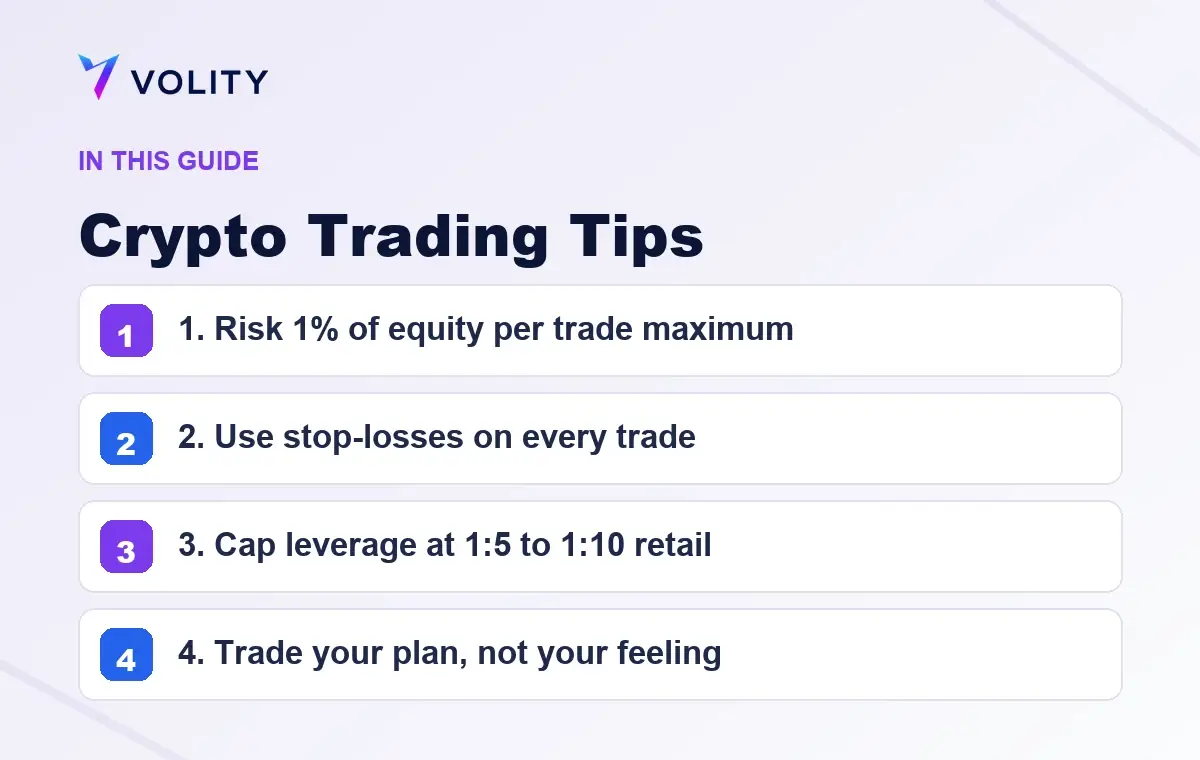
1. Risk 1% of equity per trade maximum
A losing trade should reduce your equity by at most 1%. On a $10,000 account, that means risking $100 per trade. This single rule prevents most blow-ups.
2. Use stop-losses on every trade
A stop-loss converts a “I think it will recover” emotional hold into a planned exit. Without stops, single bad trades destroy weeks of progress.
3. Cap leverage at 1:5 to 1:10 retail
Volity supports up to 1:50 on crypto. Most retail strategies work better at 1:5 to 1:10 with proper position sizing. Higher leverage is for proven strategies on small position sizes only.
4. Trade your plan, not your feeling
Define entry, stop, target before placing the trade. Execute the plan. If feelings during the trade pull you to deviate, the plan was wrong (rebuild it after) or your discipline failed (practise more).
5. Keep a trade journal
Every trade: entry, exit, reason, outcome, what you learned. Review weekly. Patterns emerge that no backtest reveals.
6. Demo first, live second
Open a Volity demo account. Practise for 4-8 weeks. Track results. Move to live only when demo results are stable and positive.
7. Start small live
After demo, open live with the smallest position size that lets you feel real stakes. $50-$200 per trade is fine. Real money psychology is different from demo psychology. Bridge with small live before scaling.
8. Take losses early
A trade going against you should be closed at the stop-loss, not held in hope. Holding losers + cutting winners is the inverse of profitability.
9. Take profits in tranches
Instead of one all-or-nothing target, take partial profits as price moves in your favour. Move the stop to breakeven on the rest. Lock in gains while keeping upside exposure.
10. Limit positions to your capacity to monitor
Five open positions is hard to monitor; ten is impossible. Cap based on your actual attention bandwidth, not your fantasy of multitasking.
11. Stop trading after a bad day
A 3% account drawdown should end your trading day. Tilt is real; revenge trading is the fastest path to a worse outcome. Walk away. Come back tomorrow.
12. Review monthly
Once a month, sit with your journal, your P&L, and your equity curve. What worked? What failed? Adjust the strategy or the discipline. Repeat.
How Volity supports these habits
- Demo account for habits 6-7
- Stop-loss orders native in Volity MT for habit 2
- Position-size calculator in the order ticket for habit 1
- Trade history export for journal-building (habit 5)
- Account-level alerts for daily loss limits (habit 11)
The platform helps; the habits are yours.
What does NOT work (anti-tips)
- Following Twitter calls without verification
- Doubling down on losing positions
- “It will come back” reasoning instead of stops
- Maximum leverage on every trade
- Trading multiple strategies simultaneously without separation
- Trading without a journal
- Trading after sleep deprivation, alcohol, or emotional stress
- Trading immediately after a major life event
- Chasing yesterday’s winner
- Borrowing money to fund a trading account
Avoiding the anti-tips is at least as important as following the tips.
Sources
Related Volity crypto guides
- Benefits of Crypto Trading: 7 Real Advantages
- Crypto Trading Meaning: What It Is, 5 Forms
- Live Crypto Trading: Real-Time Execution on Volity
- Crypto Trading Volume Explained
- Crypto Day Trading Platform on Volity MT
- Crypto Trading Charts Guide: How to Read Them
- Crypto Trading Books: 10 Recommendations
- Can You Make Money Trading Crypto?
- Contract for Difference Trading Crypto: How CFDs Work
Frequently asked questions
What is the most important crypto trading tip?
Risk 1% of equity per trade maximum. Stop-losses on every trade. These two habits prevent most retail blow-ups. Everything else builds on these.
How do I start trading crypto safely?
Open a Volity demo account, practice for 4-8 weeks with the position-sizing and stop-loss discipline. Move to live with the smallest position size you can size sensibly. Scale up only after live results match demo results.
Should I use leverage as a beginner?
No. Beginners benefit most from 1:1 or 1:2 leverage while building discipline. After 6 months of profitable trade journal data, modest leverage (1:5 to 1:10) can amplify a working strategy. Maximum leverage is for proven strategies on small position sizes only.
How do I avoid common crypto trading mistakes?
The five most common: skipping stops, doubling down on losers, using maximum leverage, revenge trading after losses, and trading without a journal. Avoid all five and you have already outperformed most retail accounts.
How many trades per week is good?
Quality over quantity. A profitable trader can take 1-3 trades per week on swing-trading horizons, or 5-15 per week on day-trading horizons. Forcing more trades than your setup conditions allow degrades win rate.
When should I stop trading for the day?
After a 3% account drawdown. Tilt is real, and the next trade after a bad streak is statistically the worst trade most traders take. Walk away, journal what happened, restart tomorrow.