Quick answer
Contract for difference trading in crypto, or crypto CFD trading, lets you speculate on a coin’s price without owning it, going long or short with leverage. You profit from the difference between the open and close price. Crypto CFDs avoid wallets and custody but carry funding costs and liquidation risk, so leverage and stops must be managed carefully.
The Crypto Trading Starter Kit
A plain-English PDF: what to check before you trade, how orders and risk really work, and the mistakes to skip. Get it free.
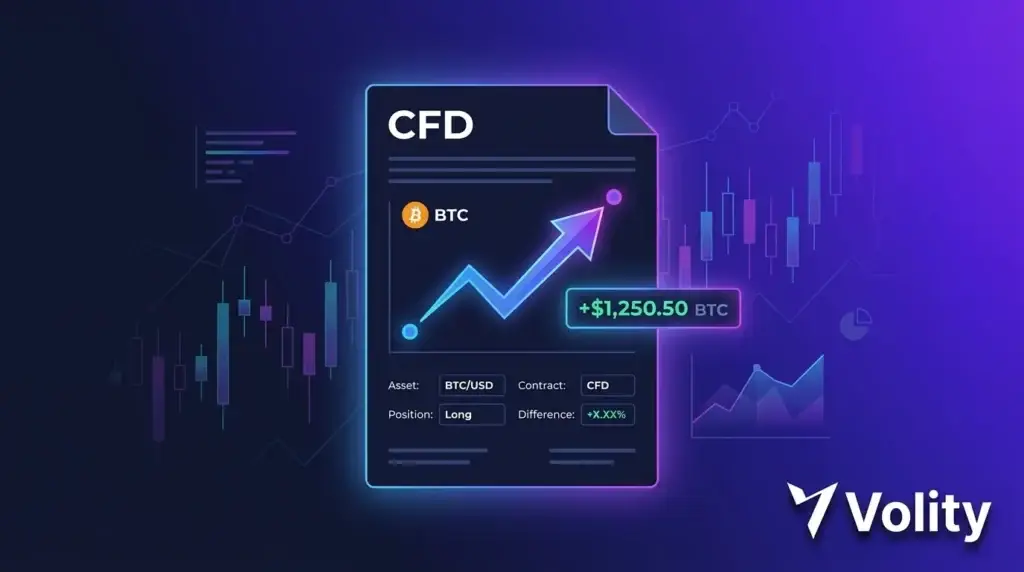
Contract for difference trading on crypto uses agreements to exchange the difference in price between when you open and close a position. You speculate on price movement without owning the underlying coin. Volity offers crypto CFDs on 20+ pairs with leverage up to 1:50 under CySEC 186/12 via UBK Markets.
CFD mechanics in plain terms.
Suppose BTC is $70,000. You open a long CFD position at that price. BTC moves to $72,000. You close at $72,000. Your profit is the $2,000 difference per contract. Volity pays this from its hedging position; no actual BTC changes hands.
If BTC moves to $68,000 instead, your loss is the $2,000 difference. Volity collects from your margin.
Key features:
- No ownership of underlying. You do not have a BTC wallet, you do not manage keys, you do not pay gas fees
- Leverage available. On Volity, up to 1:50 on selected crypto products. Smaller deposit controls larger position
- Both directions. Open long (profit if price rises) or short (profit if price falls) with the same one-click order
- No expiry. Volity crypto CFDs do not expire. Hold until you close manually
- Cash settled. Profits and losses settle in your account currency (USD, EUR, BTC, etc.)
Costs:
- Spread: the bid-ask difference. Paid on every round trip
- Swap (overnight financing): charged at 22:00 GMT on positions held overnight. Can be positive (you receive) or negative (you pay)
- No commission on most retail Standard accounts
- No swap on CFDs on future contracts
Crypto CFD vs spot crypto: clear differences.
| Spot crypto (wallet) | Crypto CFD | |
|---|---|---|
| Ownership | Yes (claim on Volity custody) | No |
| Leverage | None | Up to 1:50 |
| Short selling | No (you can sell what you own) | Yes |
| Custody | Volity-held cold storage | Not applicable |
| Withdrawal | To external wallet | Not applicable |
| Long-term hold suitability | Yes | No (swap fees accumulate) |
| Active trading suitability | Limited | Yes |
For long-term BTC holders, spot is the right tool. For active leveraged trading, CFDs are the right tool. Many users hold both: spot in the wallet for long-term, CFDs for tactical trades.
Crypto CFD vs perpetual contract.
Crypto CFDs and offshore perpetuals look similar (both leveraged, both directional, both no-expiry). Differences:
- CFDs: daily swap at 22:00 GMT; perpetuals have 8-hour funding rates
- CFDs: regulated under CySEC framework; most perps are offshore
- CFDs: typically lower max leverage; perps offer 1:100+
- CFDs: simpler tax treatment in most jurisdictions
For traders prioritizing regulatory protection and stable carry cost, CFDs win. For traders wanting maximum leverage and funding-rate exposure, perps may suit.
Risk in crypto CFD trading:
- Liquidation. When margin falls to maintenance level, position auto-closes. Set stops above maintenance margin
- Leverage amplifies both directions. 1:50 leverage means 2% adverse move = 100% margin loss
- Negative balance protection on Volity. Maximum loss is your deposit, not more
- Swap accumulation. Long holds on leveraged positions accumulate carry cost
- Gap risk. Crypto 24/7 means you sleep through moves
Tax treatment:
In most jurisdictions, CFD profits are taxed as capital gains or derivatives income (varies by country). The crypto held in your wallet (separate from CFD positions) follows different tax treatment (spot disposal). Volity provides annual P&L statements; consult a local tax advisor for jurisdiction-specifics.
Sources
Related Volity crypto guides
- Benefits of Crypto Trading: 7 Real Advantages
- Crypto Trading Meaning: What It Is, 5 Forms
- Crypto Trading Tips: 12 Habits That Separate Profit
- Live Crypto Trading: Real-Time Execution on Volity
- Crypto Trading Volume Explained
- Crypto Day Trading Platform on Volity MT
- Crypto Trading Charts Guide: How to Read Them
- Crypto Trading Books: 10 Recommendations
- Can You Make Money Trading Crypto?
Frequently asked questions
What is contract for difference trading in crypto?
A CFD on crypto is an agreement to exchange the difference in price between opening and closing the position. You speculate on price without owning the underlying coin. Volity offers crypto CFDs with up to 1:50 leverage, no expiry, regulated execution.
What is the difference between crypto CFD and spot crypto?
Spot crypto: you own the coin in your wallet. CFD: you have leveraged exposure to price without ownership. Spot suits long-term hold; CFDs suit active trading and short-selling.
Are crypto CFDs legal?
Yes in most jurisdictions including EU (under MiFID II), Australia (under ASIC), Singapore (under MAS). Restricted for retail in UK (FCA banned 2021 for FCA-licensed providers; international platforms operate under their own regulation), restricted for retail in some jurisdictions. Volity operates under CySEC and accepts eligible clients across its supported regions.
What leverage on crypto CFDs is available on Volity?
Up to 1:50 on selected crypto products. Required margin is shown before order entry. At 1:50, a 2% adverse move wipes 100% margin. Most retail strategies work better at 1:5 to 1:10.
Do I own crypto when I trade CFDs?
No. CFDs are exposure to price movement without ownership. If you want to own crypto (hold long-term, withdraw to external wallet), use Volity’s spot wallet instead of CFD.
What is the difference between CFD and futures on crypto?
Both are leveraged crypto exposure. Futures have defined expiry; CFDs are open-ended. Futures clear through exchanges (CME); CFDs trade with a broker. CFDs are simpler administratively for retail; futures may have tax advantages in some jurisdictions.
Are crypto CFDs taxable?
Yes in most jurisdictions. Typically taxed as derivatives gains or capital gains; treatment varies by country. Volity provides annual P&L statements for tax filing. Consult a local tax advisor.