Green Tape, Crowded Trades
A bright green market can make every idea look sharper than it is.
Today’s tape has that feel. Indexes are firm, gold and bonds have buyers, oil is softer, and risk appetite has returned. Meanwhile, money is drifting into familiar hunting grounds: mega-cap AI, travel shares, bruised fintech, crypto and small-cap biotech.
That mix can reward quick traders. However, it can also punish anyone who treats a watchlist like a shopping list.
The useful distinction is simple. Some stocks are reaction trades. Some are macro trades. Others are speculative rentals. The same green screen does not make them equal.
Event Trades: Let the Tape Speak
Nvidia, Snowflake and TJX sit in the first bucket. These are not sleepy names waiting for discovery.
NVDA, SNOW and TJX all carry institutional ownership, active options markets and crowded expectations. Therefore, the headline rarely tells the whole story. A beat can sell off. A miss can rally. Guidance, margin language and positioning often matter more.
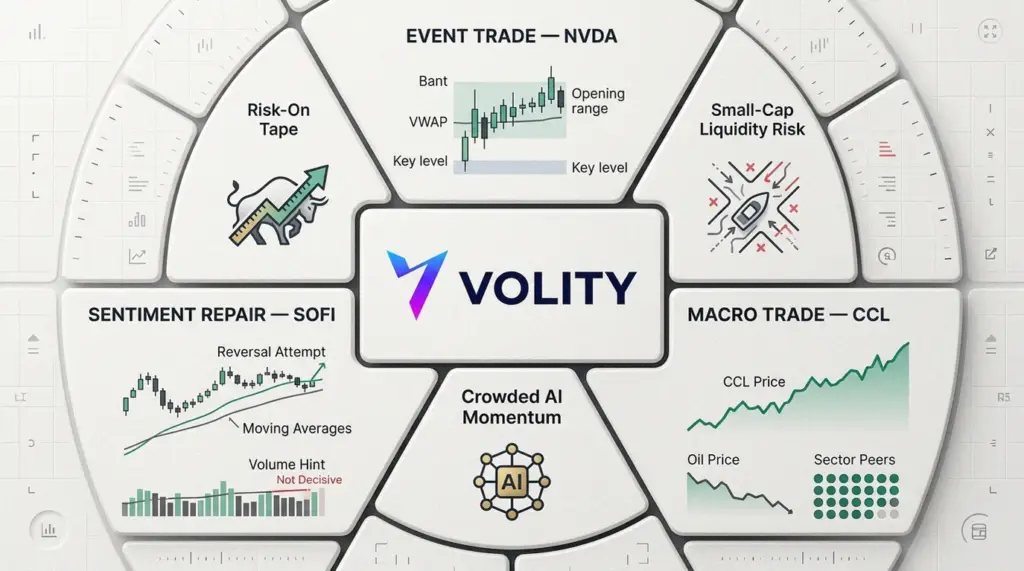
For traders, the cleaner approach is patience. The first 15 to 30 minutes after an earnings reaction often brings false confidence. Then the opening range, VWAP and prior day high or low start to matter.
If NVDA holds above its opening range with volume, buyers are showing commitment. If SNOW fades below VWAP after a strong open, the story has already weakened. Meanwhile, TJX can look defensive on paper but still trade violently around guidance.
The mistake is buying the press release. The trade starts when price confirms the market’s interpretation.
Macro Trades: Oil, Rates and Travel
Travel stocks have a cleaner macro hook. When crude weakens for more than a few hours, airlines and cruise lines benefit directly.
CCL, RCL and NCLH remain especially sensitive to fuel and discretionary spending. DAL, UAL, AAL and LUV carry the same oil link, although balance sheets and labour costs vary widely. Meanwhile, the JETS ETF offers a useful group check.
A single red day in crude is not enough. However, a multi-day decline gives these shares a tactical tailwind. If CCL rises with RCL and NCLH, the move has breadth. If DAL and UAL follow while JETS firms, the trade has better confirmation.
Still, these are not “set and forget” investments in this context. Oil can reverse on one geopolitical headline. Therefore, the trade lives only while the macro leg holds.
The AI bucket has more heat and less forgiveness.
ARM, MRVL, WOLF and INTC all touch the same broad theme. Yet they do not trade the same way. ARM and MRVL remain closer to high-momentum AI demand. WOLF is more speculative and cyclical. Intel is a turnaround story wearing an AI jacket.
In a risk-on tape, traders will chase breakouts in ARM and MRVL quickly. However, the better setups need more than a new high. They need volume, follow-through and a hold above the breakout level.
Large intraday reversals deserve respect. In hot names, a reversal from early strength often signals distribution. It is not always “healthy volatility”.
Intel sits apart. INTC may become a multi-year restructuring story, but traders need relative strength first. If INTC cannot outperform the SOX index on good news, money still prefers purer AI exposure.
Speculative Names: Story Meets Liquidity
The small-cap and biotech list is where green markets become dangerous.
WNW, PSNL, CRDF, GOVX and IMVT each has a hook. WNW brings the tiny-float, AI-adjacent skincare angle. PSNL has a more tangible catalyst through Medicare coverage expansion. CRDF carries legal noise against analyst support. GOVX trades around infectious-disease narratives. IMVT is drawing buyers despite earnings disappointment, likely because pipeline optimism still matters.
These names can move fast because liquidity appears suddenly. However, it can vanish just as quickly.
A small-cap stock can rally 40% in a morning and erase half the move by lunch. Therefore, position size matters more than conviction. The story does not protect a trader when spreads widen and bids disappear.
PSNL and IMVT offer cleaner catalyst frameworks than most. Meanwhile, WNW and GOVX need visible follow-through, not just fashionable wording. “AI” and “platform” can open the door. They do not keep buyers in the room.
- WNW: tiny-float squeeze candidate, but financing risk remains central.
- PSNL: coverage expansion gives revenue visibility a firmer base.
- CRDF: legal overhang makes the trade noisy and binary.
- GOVX: headline-sensitive, with liquidity risk above normal.
- IMVT: pipeline confidence matters more than the latest miss.
Sentiment Trades: Bruised Names Seek a Bid
SOFI, BB, HTZ and DRVN belong in a different pile. These are sentiment repairs, not clean macro bets.
SoFi is trying to rebuild after post-earnings damage. A risk-on tape helps. However, SOFI still needs to reclaim key moving averages and hold them with volume. Until then, it is a reversal watch, not a confirmed turn.
BlackBerry has fresh credibility from government security certification. Yet BB has a long history of sharp pops and fast fades. Contract wins would matter more than an enthusiastic one-day move.
Hertz is more technical. HTZ has drawn interest because of a Golden Cross and a notable institutional buyer. Still, car rental fundamentals remain uneven. If HTZ holds above short-term averages despite bad headlines, the sentiment trade has life.
Driven Brands is quieter but interesting. DRVN delivered a good quarter while analysts cut targets. That can mean expectations are resetting rather than collapsing. If the stock grinds higher anyway, a re-rating may be starting under the surface.
Quality Anchors: the Dull Names Still Matter
AutoZone and Cintas do not offer the same dopamine hit as a small-cap gapper.
That is partly the point. AZO and CTAS are long-term compounders with years of disciplined execution. They rarely need a hot tape to justify attention. Instead, they work best as portfolio anchors bought during market stress.
In a watchlist full of WNW, GOVX and crypto headlines, AZO and CTAS provide a useful contrast. Real wealth often comes from owning exceptional businesses through dull months. Meanwhile, trading profits depend on speed, discipline and exits.
Mixing those two jobs creates trouble. A compounder can be held through noise. A speculative squeeze cannot.
Crypto Policy: Clarity is the Catalyst
Bitcoin, XRP and the broader crypto market face a different kind of event risk.
The CLARITY Act matters less as a single political object and more as a signal. Investors want to know whether Washington will draw usable lines around tokens, exchanges and market structure.
Concrete progress could lower the risk premium and invite more institutional capital, especially toward BTC. However, restrictive or confused proposals would likely hit altcoins harder. In that case, Bitcoin dominance could rise as traders retreat toward the largest asset.
For XRP, the reaction matters more than legal chatter. If actual text lands and XRP cannot rally, the market is saying expectations were already too high.
Related coverage on Volity
- Crypto Market Today: Bridge Hacks, MiCA, Solana ETF Bid
- Bitcoin Below $80k as ETF Flows, Tokenised Treasuries Grow
- Master Crypto Investments: Navigating Risk and Opportunities
- UK Small Cap Stocks Outpace Big Tech: IWM Takes the Lead
- How to Navigate Crypto and Investment Hype for Smart Returns
Key Takeaways
- NVDA, SNOW, TJX: trade the post-event reaction, not the headline.
- CCL, RCL, DAL, UAL: need a sustained oil decline, not one soft print.
- ARM, MRVL, WOLF: momentum works until reversals show distribution.
- WNW, GOVX, CRDF: keep size small because liquidity can disappear quickly.
- AZO, CTAS: treat as long-term anchors, not green-day chases.
The best use of this market is not to trade everything moving. It is to decide what kind of trade each name actually offers.
Event names need levels. Macro names need the backdrop to keep cooperating. Speculative names need strict exits. Meanwhile, compounders need time, not adrenaline.
Green screens flatter weak plans. The harder work starts when the opening bell turns stories into prices.