Gold sounds simple until you try to buy it, and then you hit a wall of coins, bars, funds and contracts that all promise “gold”. There are five routes, and the right one depends on a single question: what do you want gold to do for you? This guide explains all five in plain English, helps you pick yours in a minute, and walks you through your first move today on a free demo, so it stays calm instead of a panic-click.
TL;DR / Quick insight: There are five ways to get gold exposure: physical metal you own and store, a gold ETF (a fund that tracks the price), a gold CFD (a leveraged contract to trade up or down moves), gold-miner stocks, and gold futures. Beginners usually pick a gold ETF for cheap price tracking, or a gold CFD to trade short-term moves. Decide your one reason first, pick the route, start small, and practise on a free demo. Gold can rise or fall – it is one option with real risk, not a guarantee.
Most gold articles throw a price headline and a bank forecast at you. We won’t do that here. Prices move daily and you can check a live screen yourself. What you actually need is a map: the routes, what each one costs in plain terms, and which one fits you.
Why beginners add gold to a portfolio
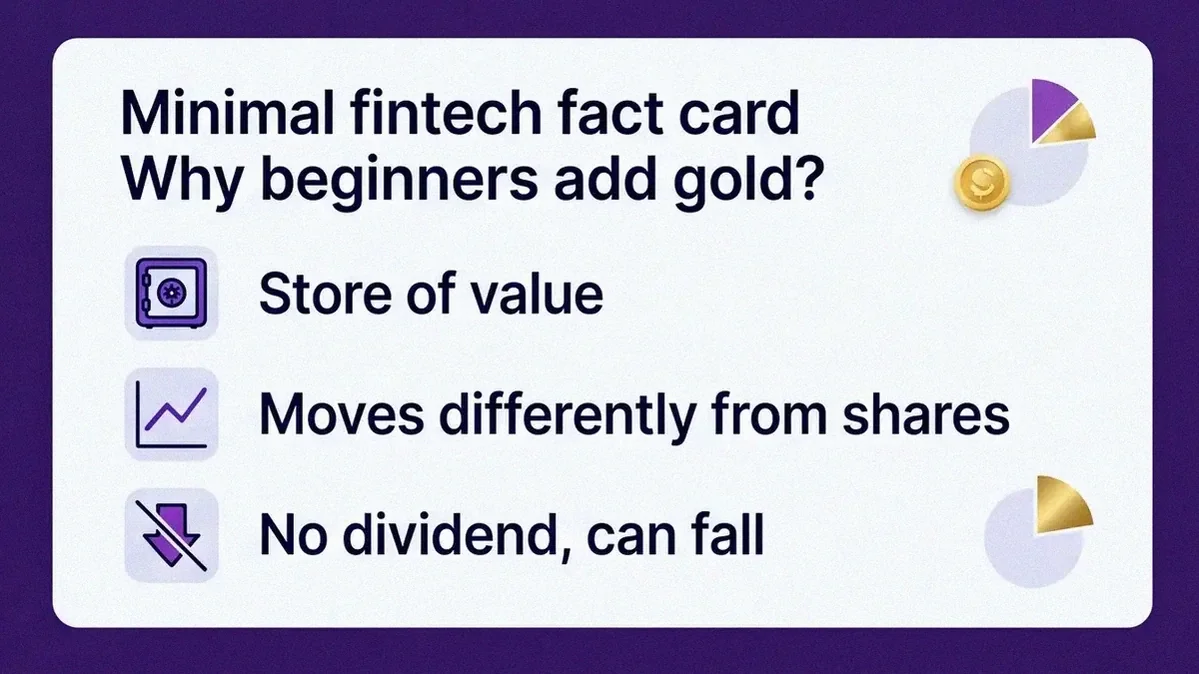
People hold gold for two everyday reasons. It has long been treated as a store of value, so some savers like a slice of their money sitting in something that isn’t a currency or a single company. Gold also tends to move differently from shares, so it can act as a diversifier – a way of not putting every egg in one basket.
Here is the part sales pages skip. Gold is not guaranteed. It can fall in value, sometimes for years, and it pays no dividend while you hold it. So write your one reason in a single line – “long-term hold”, “diversify”, or “trade short-term moves”. That choice drives every decision below.
The five ways to get gold exposure, explained simply
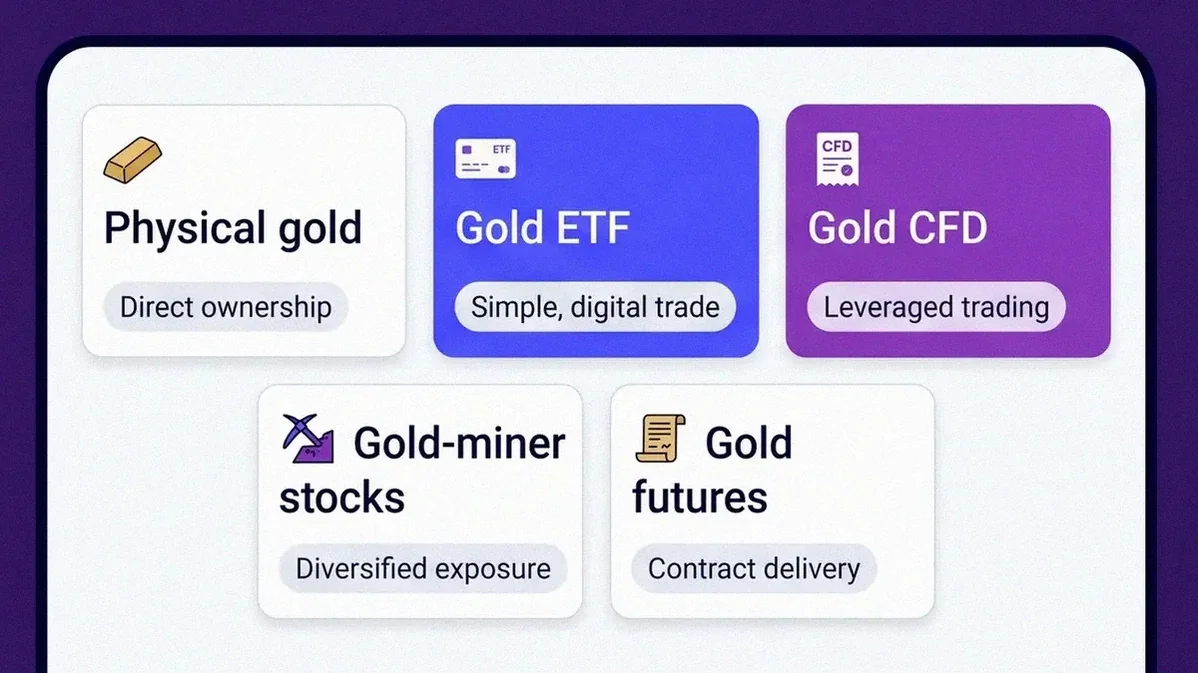
Every term is explained the first time it appears. Read all five, then pick.
1. Physical gold (coins and bars)
You buy real metal and own it. The catch is everything around it. You pay a premium (a markup over the raw metal price) when buying, you need somewhere safe to store it, and selling means finding a dealer. Great if you want metal in hand; clunky if you only want price exposure.
2. Gold ETF
An ETF (exchange-traded fund) is a fund you buy and sell like a normal share. A gold ETF tracks the gold price for you, so you get the movement without storing metal, for a small annual fee. This is the classic beginner route: cheap and simple.
3. Gold CFD
A CFD (contract for difference) mirrors the gold price, so you can profit if it goes up – or down – without owning metal. CFDs usually use leverage, which lets you control a larger position with a smaller deposit, magnifying gains and losses equally. Good for short-term traders, and a poor fit for parking money and forgetting it.
Instead of the metal, you buy shares in the companies that dig it out. When gold does well these can do very well, but they carry company risk – bad management hits the share even when gold itself is fine. You can buy them whole or as fractional shares (a small slice of one share), so you start modest.
5. Gold futures
A future is an exchange contract to buy or sell gold at a set price on a set date. It is powerful, but it involves leverage, margin and expiry dates that catch beginners out. Don’t start here – cross futures off your list.
Now tick the routes that match your reason and cross off futures if you’re a beginner. Most people choose between a gold ETF and a gold CFD.
Compare the five at a glance
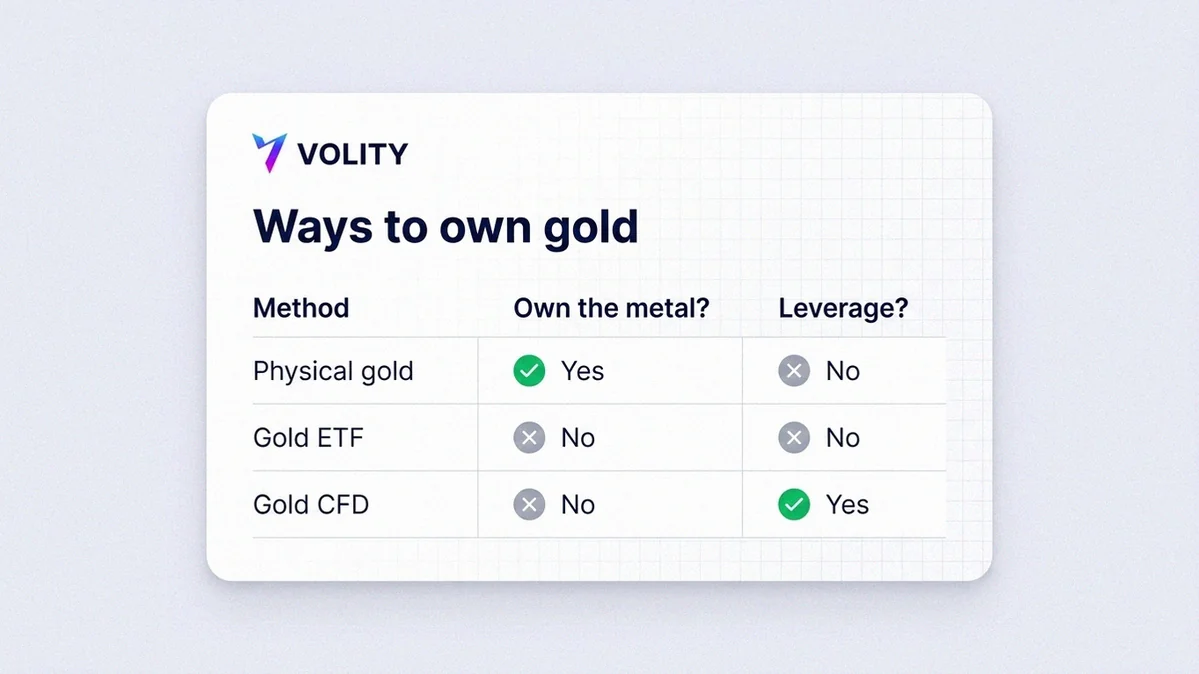
This table is your shortcut. Cost columns are described by type, not figure, since real costs depend on your provider.
| Route | Own metal? | Main cost type | Leverage? | Beginner-friendly? |
|---|---|---|---|---|
| Physical gold | Yes | Premium + storage | No | Medium |
| Gold ETF | No | Small annual fund fee | No | High |
| Gold CFD | No | Spread + overnight fee | Yes | Medium |
| Gold-miner stocks | No | Share price + spread | Usually no | Medium |
| Gold futures | No | Margin + contract costs | Yes | Low |
Two quick terms before you read it. A spread is the small gap between the buy and sell price, which is how trading the price usually costs you. An overnight fee (or rollover) is a small charge or credit for holding a leveraged position overnight. Circle the row that fits your goal and budget. That is your starting route.
Choose the route that fits you with one simple rule
Forget the noise and use this rule.
Decision rule: Hold metal → physical. Track the price cheaply → ETF. Trade short-term moves → gold CFD. Want company upside → gold stocks. Advanced, dated contract → futures.
A practical bonus: the ETF, gold-stock and gold-CFD routes can all sit inside one Volity account, so you can hold gold and fractional gold-miner shares without juggling brokers. Commit to one primary route now, and add a second later from the same login.
Make your first gold move, step by step
You don’t need a perfect plan to begin – just a small, deliberate first move. Follow these in order:
- Set your reason and budget. Reuse your one-line reason and decide a small, fixed amount you can leave alone.
- Choose your route. Use the decision rule. For most beginners that means a gold ETF or a gold CFD.
- Open or fund an account. Pick a provider that offers your route. With Volity, the Markets account is commission-free and the minimum deposit is just EUR 10.
- Practise on a free demo first. Volity offers a free demo on every tier – virtual money, real prices. Place one practice gold trade so your first real move isn’t your first ever.
- Place one small position. Keep it tiny. The first trade is for learning the buttons and the feeling, not for getting rich.
- Set a review date. Note a date to check it in a few weeks. Gold rewards patience.
So open a free Volity demo and place one practice gold trade today. On Standard pricing, spreads start from 0.6 pip. A pip is the smallest standard price step traders use to gauge how tight a price is.
Know the costs and risks before you buy
Every route has a cost, and pretending otherwise is how beginners get surprised. Physical gold carries a premium and storage. A gold ETF charges a small annual fund fee. Gold CFDs cost the spread plus an overnight fee if held with leverage past the cut-off – on Volity that rollover applies past 22:00 GMT. Gold-miner shares carry share-price risk, and futures involve margin.
On risk, be honest with yourself. Gold can fall and stay down for a long stretch, and leverage magnifies losses just as fast as gains. Never invest money you can’t afford to lose. Before you buy, check the exact costs for your route – for a Volity account the full fee schedule is published in plain numbers – and decide a small, fixed share you’re comfortable putting in.
Run your first-gold-position checklist
This is the final gate before real money. If you can’t tick every box, you’re not ready yet.
- Reason chosen and written in one line.
- Route chosen using the decision rule.
- Costs for that route understood, not guessed.
- Amount set – small, fixed, comfortable to lose.
- One practice trade placed on a free demo.
- Risk accepted: gold can fall, leverage cuts both ways.
- Review date set in your calendar.
Run the checklist top to bottom. When every box is ticked, place your first real position; if a box is empty, keep practising on the demo.
Reviewed by: A. Bennett, Volity editorial desk.
Data integrity: all Volity product details (commission-free Markets account, spreads from 0.6 pip on Standard, free demo on every tier, EUR 10 minimum deposit, gold, gold CFDs and fractional gold-miner shares in one account) are verified against the published Volity fee schedule as of June 2026. Gold-investing mechanics are general education; no price, return or forecast figure is stated as fact – always check a live source.
Related Volity guides
- ETF vs index fund: which to pick
- Dollar-cost averaging explained
- How much money do you need to start trading?
Frequently asked questions
Is gold a good investment for beginners?
It can be a sensible part of a balanced portfolio because it often moves differently from shares, which spreads your risk. But it is not guaranteed and pays no income while you hold it. Treat it as one diversifier among several, and never put in money you can’t afford to lose.
How much gold should I own?
There is no single right number, and anyone handing you a fixed percentage is guessing for you. Decide a small, fixed share of your savings you’re genuinely comfortable with. Start modest; you can add more later.
What is the cheapest way to invest in gold?
Compare cost types, not headlines. Physical gold adds a premium and storage, which the price-tracking routes avoid. A gold ETF charges a small annual fund fee, while a gold CFD costs the spread plus an overnight fee if held with leverage. The cheapest route depends mostly on how long you hold.
Can you start with a small amount?
Yes. Fractional shares let you buy a slice of a gold-miner stock instead of a whole one, and a free demo lets you practise with zero risk. On a Volity account the minimum deposit is EUR 10, so a small start is possible from day one.
What is leverage and is it safe for a first gold trade?
Leverage lets you control a larger position with a smaller deposit, common on gold CFDs and futures. It magnifies both gains and losses, so it is never “safe” by default – it demands a small position size and a clear plan. Practise on a free demo first and keep real positions tiny.
Ready to practise? Explore gold, gold CFDs and fractional gold-miner shares in one login – see the gold hub, and the stocks hub for gold-miner shares. Torn between metal and a fund? Our physical gold vs gold ETF guide weighs up that choice.
Sources
This guide draws on the following public sources.
- LBMA – LBMA Gold Price, the global benchmark and how it is set
- LBMA – LBMA Good Delivery standard for gold bars
- World Gold Council – Historical gold price data and performance
- U.S. Energy Information Administration – EIA petroleum supply, demand and price data
- U.S. Energy Information Administration – EIA natural gas storage, production and price series
- Silver Institute – Silver supply and demand fundamentals
- SPDR Gold Shares – SPDR Gold Shares (GLD) official fund information
- LBMA – LBMA precious metal benchmark prices
- U.S. Energy Information Administration – EIA spot prices for WTI and Brent crude