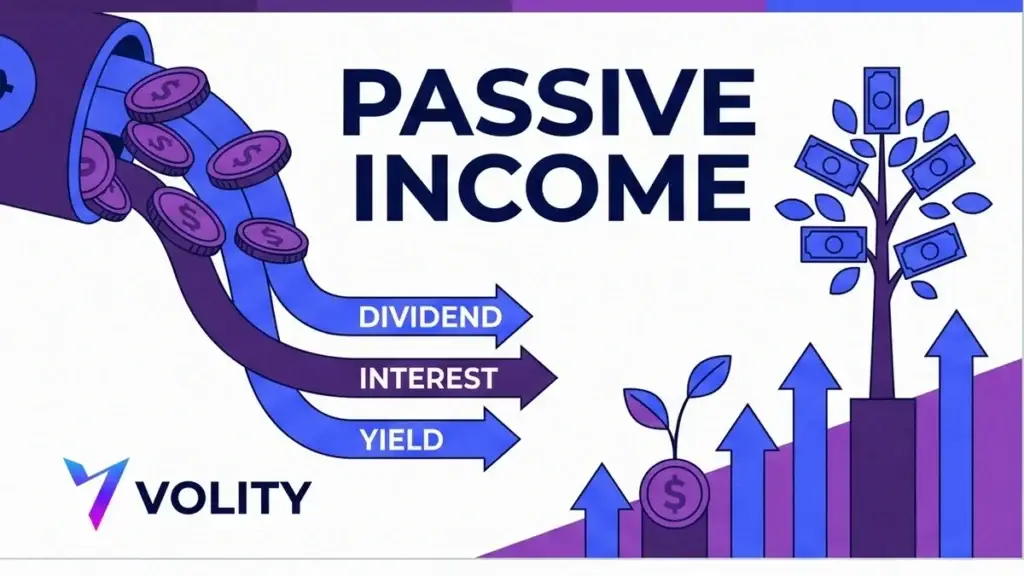
Everyone wants money that arrives while they sleep, and that is the honest promise of how to earn passive income from investing: capital put to work pays you back in dividends, interest or yield without daily effort. The income is real, but rarely large at the start, because it scales with the money behind it. This guide shows what passive income from investing looks like, the maths behind it, and a calm plan a beginner can follow.
TL;DR / Quick insight: Passive income from investing is the regular cash your money produces – dividends, interest from cash and bonds, or yield from staking – without you working for each payment. It is realistic, but it scales with your capital, so early on you reinvest and compound rather than draw. Spread your sources, keep costs low, and treat any high yield as a risk flag. With Volity you hold shares, fractional shares and crypto in one commission-free account, plus a $0 multi-currency wallet that puts your cash to work.
Nothing here is personal advice – investing carries risk, and the value of investments can fall as well as rise.
What passive income from investing really means
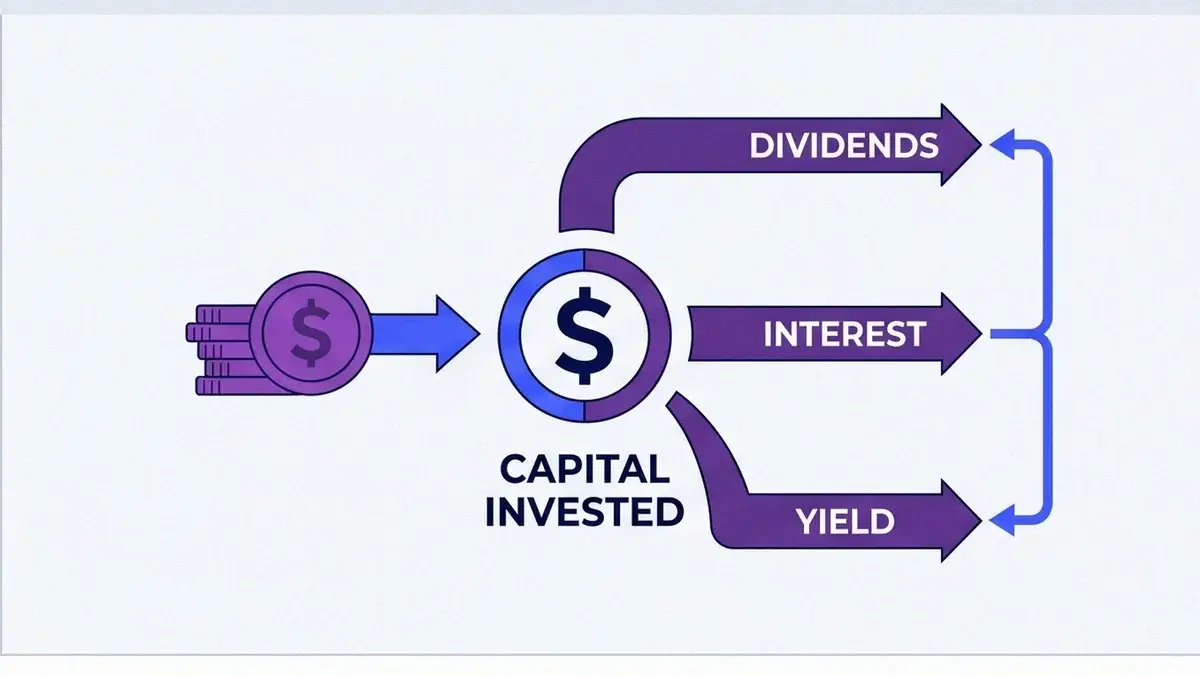
Passive income from investing is the cash your holdings pay you simply for owning them. You do the work once when you buy, then the asset keeps producing. It differs from a capital gain, which you realise only by selling; income lands while you still hold the asset.
Three sources do most of the work. Dividends are a slice of a company’s profit. Interest is what cash and bonds pay for lending money. Yield from crypto staking rewards you for helping run a blockchain network. Each behaves differently and carries its own risk, so spreading across them beats chasing whichever pays most.
The honest maths, income needs capital
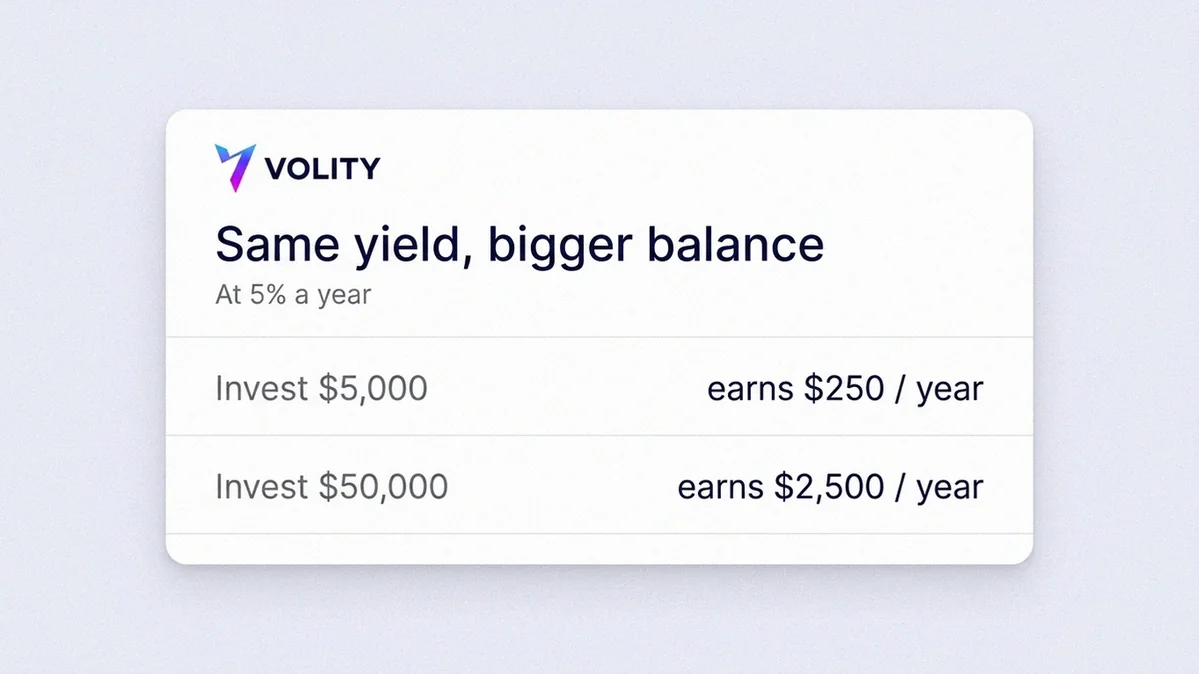
Here is the part the get-rich headlines skip. Income from investing is a percentage of your capital, so a modest balance pays modest income. As an example only: if an asset paid a 4 per cent yield, then 1,000 invested would produce about 40 a year and 10,000 about 400. Same rate, ten times the income, because ten times the capital was behind it.
This is why “live off passive income” is a destination, not a starting line. Two levers move you toward it: adding capital steadily, and time, because reinvested payments buy more of the asset, which then pays more again. That loop is compounding. Volity fits this slow build: the Markets account opens from a $1 entry minimum and trades commission-free, so small, regular contributions are not eaten by charges, and a free demo lets you rehearse.
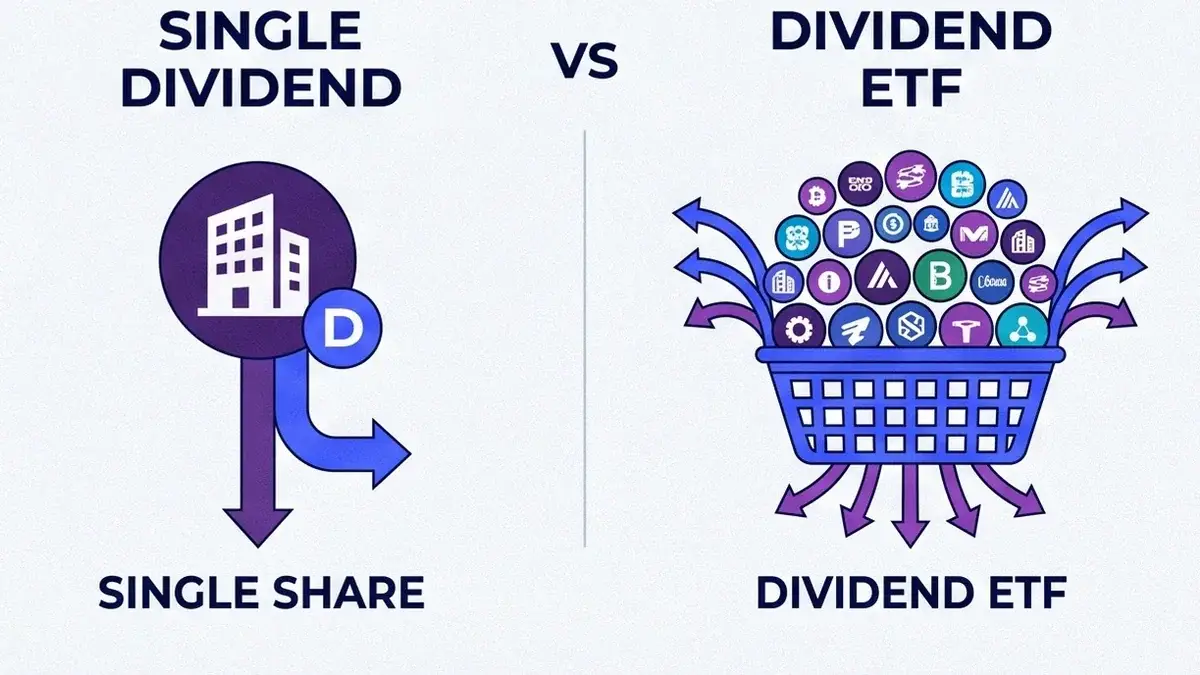
Dividends are the most familiar income source. A company that makes a profit can hand some back to shareholders a few times a year; hold the share on the right date and the payment lands. Two routes exist. Individual dividend-paying shares give you control but concentrate risk in single companies. A dividend ETF is a basket fund holding many payers at once, so one purchase spreads income across dozens of firms, usually the calmer start.
| Route | What you get | Main trade-off |
|---|---|---|
| Single dividend share | Direct ownership of one company, full control of the pick. | One firm cutting its dividend hits your income directly. |
| Dividend ETF | Income spread across many companies in one holding. | You take the basket’s average, the high and the low together. |
| Fractional share | A slice of an expensive payer for a small amount. | Tiny early payments until you build the position. |
One caution worth keeping. A very high dividend yield can be a warning rather than a gift, because the yield rises when the price falls, and the price may be falling for a reason. Treat a fat payout as a prompt to read why, not to pile in. On Volity you can hold real shares, fractional shares and a dividend ETF in one login. The stocks hub goes deeper.
Interest from cash and bonds
Not every income stream rides the stock market. Cash and bonds pay interest, which tends to be steadier than dividends and acts as the ballast in a mix. Cash in the right place earns a return for sitting there. Bonds are loans to a government or company; they pay interest over a set term and return your capital at the end, assuming the borrower holds up. The trade-off is plain: steadier income usually means a lower rate, and the borrower can still run into trouble.
Interest income earns its keep by being boring. When dividends wobble or crypto swings, it keeps paying, which smooths the ride. Volity’s $0 multi-currency wallet is built for this cash layer: it carries yield, FX and IBAN features, so money waiting between investments is not idle, and card or crypto transfers are free and instant.
Crypto staking and its trade-offs
Crypto staking is the newest income source and the one that demands the most care. When you stake, you lock up a crypto holding to help secure its network, and it pays a reward. On paper it reads like interest on cash; in practice it is a different animal. The reward is paid in the token you staked, and that price can swing hard, so a generous-looking rate can be wiped out by a falling price. Your capital is not protected the way a bank balance might be, and some networks lock your coins for a period.
None of that makes staking a bad idea; it makes it a small-slice idea. Treat it as the garnish, not the main course, and only with money you can afford to see fall. On Volity, crypto sits in the same account as your shares and cash, so a measured slice stays beside steadier income.
Reinvest now and draw income later, the two-phase plan
The mistake many beginners make is trying to spend the income before there is enough of it to matter. A two-phase plan fixes that. In the build phase, you reinvest every payment, so each dividend, interest payment and staking reward buys more of the asset and your income base grows on its own while you add fresh contributions. This is where compounding does the heavy lifting. Later, in the draw phase, you switch the tap: instead of reinvesting, you let payments arrive as spendable cash, by then from a base worth drawing on.
The discipline is simple to state and hard to keep: do not raid the build phase early. Holding shares, fractional shares, crypto and cash in one Volity account keeps every source in one view.
Build your first income stream
Run this when you set up, then again whenever you add money.
- Decide an amount you can commit and contribute regularly, accepting that early income will be small.
- Pick a steady core: a dividend ETF or interest-bearing cash for broad, calmer income.
- Add a second source for spread, such as fractional dividend shares or a small bond exposure.
- Size any crypto staking as a small slice only, with money you can afford to see fall.
- In the build phase, set payments to reinvest rather than spend.
- Keep costs low with commission-free buys and a $0 wallet.
- Treat any unusually high yield as a flag to investigate, never an automatic buy.
- Book a review date and resist trading between reviews.
If any line gets a “no”, fix it first. The checklist catches the two classic traps: overpaying in fees and overreaching for yield.
What to do next
Set a contribution you can sustain, rehearse on the free demo, then fund from your wallet and place your first income holdings in one account – dividend shares, fractional shares and crypto, with a $0 wallet for cash. OPEN A VOLITY ACCOUNT to build your first income stream commission-free. Want the numbers? SEE FEES AND ACCOUNT TYPES.
Reviewed by: A. Bennett, Volity editorial desk.
Data integrity: every product figure here (Markets minimum deposit, commission-free trading, $0 multi-currency wallet with yield, free demo, one account for shares, fractional shares and crypto) is verified against Volity’s published account and fee docs. No yield or return figure in this article is a promise; the example rates illustrate arithmetic only.
Related Volity guides
- Dividend investing for beginners
- Dividend reinvestment (DRIP), explained
- Dollar-cost averaging explained
Related coverage on Volity
- Dividend Investing for Beginners: How to Start
- Dividend Reinvestment Plan (DRIP): How It Works and Who It Suits
- ETF vs Index Fund: The Difference and Which to Pick
- Dollar-Cost Averaging Explained: A Beginner Guide
- Fractional Shares Explained: How to Start Investing With
Frequently asked questions
How much do you need to earn passive income from investing?
When learning how to earn passive income, there is no fixed minimum, but income scales with capital, so a small balance pays small income at first. Begin from a $1 minimum on Volity’s commission-free Markets account, reinvest every payment, and let the base grow before you draw.
Is passive income from investing realistic?
Yes, as long as your expectations match your capital. Dividends, interest and staking rewards are genuine payments for owning assets. What is not realistic is large income from a tiny balance overnight. Treat it as a slow build that compounds over years.
What is the safest passive income from investing?
Interest from cash and high-quality bonds is generally the steadiest, because the payments are more predictable than dividends or staking rewards. Nothing is fully risk-free – bonds carry the risk the borrower fails, and cash loses value to inflation. Spreading across several sources is safer than relying on the punchiest one.
How do beginners start building passive income?
Begin with a steady core, such as a dividend ETF or interest-bearing cash, then add a second source for spread. Reinvest every payment in the early years instead of spending it. Practise on Volity’s free demo first, and keep costs low.
Should I use crypto staking for passive income?
Only as a small slice, and only with money you can afford to see fall. Staking rewards can look high, but they are paid in a token whose price swings hard, and some networks lock your coins. Hold it beside steadier dividend and interest income, not as the main one.
Sources
The guidance above draws on the following public sources.
- Dividend – what a dividend actually is
- Exchange-traded fund – how an ETF spreads holdings
- Compound interest – compounding reinvested payments over time
- Proof of stake – what staking rewards are paid for
- Bank of England – interest as the reward for saving
- Bank of England – why cash left idle loses buying power
- European Securities and Markets Authority – investor guidance on assessing an investment
- GOV.UK – how dividend income is taxed
- GOV.UK – how a gain on disposal is taxed
- GOV.UK – the UK tax-free savings and investment wrapper