There are two ways to buy McDonald’s stock. You can own MCD shares through a share-dealing account and hold them for years, collecting the dividend, or you can trade the McDonald’s share price with a contract for difference (CFD) to go long or short with leverage. On Volity you trade McDonald’s as a CFD, from the same account as forex, crypto and indices, on the Volity MT platform. You do not own the underlying shares when you trade the CFD.
CFDs are leveraged, so they can magnify both gains and losses, and you can lose more than the money you put in. This guide walks through both routes, the exact steps to place a trade, what buyers in the UK need to know, why McDonald’s is treated as a Dividend Aristocrat, and how to keep the risk under control.
What are you buying when you buy McDonald’s stock?
The McDonald’s Corporation trades on the New York Stock Exchange under the ticker MCD, which is the same share people mean when they search for how to buy McDonald’s shares. Owning the share gives you a stake in the business, the dividend it pays and voting rights, and a holding you can keep for as long as you like. There is more to the company than the restaurants themselves. The great majority of McDonald’s outlets are run by franchisees, so much of the group’s income comes from rent and royalties rather than from selling food directly, which tends to make the cash flow steadier than a pure restaurant operator.
McDonald’s has raised its dividend every year since it first paid one in 1976, a record that has earned it Dividend Aristocrat status, the label for an S&P 500 company that has lifted its payout for at least 25 years in a row. That makes it a classic holding for a long-term investor who wants a rising income alongside the share price. You can follow the payout history and the numbers behind it on the company’s investor relations pages and cross-check the live price on an independent tracker such as stock data sites.
A CFD works differently. It tracks the McDonald’s share price, so your result is the difference between your entry and your exit, and you never hold the share itself. Traders use CFDs because going short is as simple as going long, and you post margin rather than paying the full price of the share. Be clear on one point before you start: as a CFD holder you receive a dividend adjustment on your position rather than a real dividend, and you get none of the ownership or voting rights that come with the actual stock. Whichever route you choose, check the live MCD quote on the exchange before you plan a trade.
How to buy McDonald’s stock step by step
The process looks much the same whether you own the share or trade the CFD. On Volity the CFD route runs through the Volity MT platform, and the six steps below take you from a new account to a live position.
- Open a Volity account and complete the quick KYC checks, or start on a free demo first if you are new to trading.
- Fund your account by card, bank transfer or crypto in your chosen currency. Opening an account is free, you can fund from as little as $1, and you can start trading from $1.
- Search for MCD and open the McDonald’s chart from the instrument list.
- Choose your order type, a market order to fill at the current price or a limit order to fill only at a price you set.
- Set your position size from your stop distance and a fixed percentage of your account you are willing to risk on the trade.
- Place the order, then manage the position and protect it with a stop-loss.

It comes down to why you are buying. If you want to hold McDonald’s for years and collect its dividend, owning the share suits you best. If you want to trade shorter moves in either direction, or hedge a holding you already have, a CFD gives you that flexibility. The table sums up the trade-off.
| Feature | Owning MCD shares | Trading a McDonald’s CFD (Volity) |
| Ownership and voting | Yes | No |
| Go short | Hard for retail | One click |
| Leverage | Usually none | Up to 1:500, product-dependent |
| Dividends | Paid to you | Adjusted on the contract |
| Best for | Long-term investors | Active traders and hedgers |
McDonald’s is US-listed, so buyers in the UK take one of two paths. For ownership, a UK share-dealing account with access to US-listed shares lets you hold MCD, potentially inside a Stocks and Shares ISA. For trading, a CFD account lets you go long or short on the McDonald’s share price. Because MCD is priced in US dollars, anyone working out how to buy McDonald’s shares in the UK should factor in the GBP/USD exchange rate as well as the share price itself, since a stronger pound can quietly eat into a dollar gain. If your aim is active trading, the CFD route on Volity keeps McDonald’s next to your other markets in one account. If you would rather own the shares outright, UK stockbrokers deal in international shares too.
McDonald’s is a consumer business that sells to millions of people every day, so its price tracks how comfortable those customers feel about spending. What matters most is comparable sales growth at existing restaurants, the split between higher prices and real customer numbers, input costs such as beef, potatoes and wages, and currency, since the company earns a large share of its money outside the United States and reports it back in dollars. The dividend and share buybacks weigh on the stock as much as headline sales do, which is why many people thinking about how to invest in McDonald’s treat it as a slow-and-steady income holding rather than a fast trade. For the figures themselves, lean on the company’s own results and filings rather than the price predictions you see online, which are opinions rather than facts. If income is your reason for buying, our guide to dividend investing explains how payouts and reinvestment compound over time.
How to manage the risk on a McDonald’s position
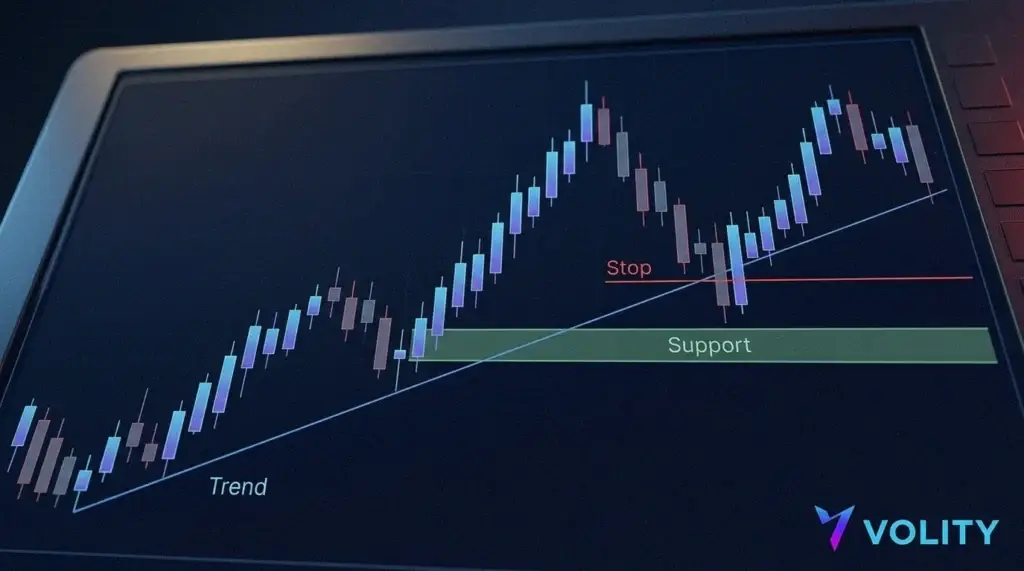
McDonald’s is less jumpy than most high-growth technology shares, but no stock is risk-free, and a CFD stacks leverage on top of the share’s own moves. Start on a demo, keep the risk on any single trade to a small fixed percentage of your account, and use a stop-loss every time. Hold McDonald’s as one position in a diversified mix rather than a concentrated bet, and keep leverage modest while you are still learning. On Volity the maximum is up to 1:500 depending on the instrument, and single shares such as McDonald’s sit well below that headline figure, so the size you actually choose matters far more than the size you could reach.
Leverage is also why regulators watch CFDs so closely. Both ESMA and the FCA restrict the leverage retail clients can use on share CFDs and require a clear risk warning, because a leveraged position can lose money as quickly as it can make it. Trade with a stop, size from your own risk, and use only money you can afford to lose.
Why trade McDonald’s on Volity?
Volity lets you trade McDonald’s (MCD) as a CFD, long or short, on the Volity MT platform with TradingView charts. Execution is quick, with 99.6% of orders filled in under a second and no re-quotes, and McDonald’s sits among 10,000+ instruments across stocks, forex, crypto and indices in one account. Volity operates under CySEC licence 186/12 through UBK Markets. You can review spreads and overnight costs on the charges and fees page, read the wider stocks trading guide for the fundamentals, and open a free demo to place your first McDonald’s trade without risking real money.
Frequently asked questions
Can I buy McDonald’s stock with a small amount?
Yes. A CFD lets you open a McDonald’s position on margin, and fractional shares let you own part of a single MCD share. Both lower the entry cost, though leverage on a CFD raises the risk, so it is wise to start on a demo and keep your first positions small.
Use a UK share-dealing account with US access to own MCD, or a CFD account to trade the price. McDonald’s trades in US dollars, so the GBP/USD rate affects your return alongside the share price itself.
Do I get the McDonald’s dividend if I trade a CFD?
Not as a real dividend. A CFD tracks the McDonald’s share price without giving you ownership, so any payout is handled as a dividend adjustment on your position rather than cash paid to a shareholder. Choose a share-dealing account if you want to own the shares and collect the dividend itself.
How much does it cost to trade McDonald’s on Volity?
Your costs are the spread and any overnight financing on leveraged positions held past 22:00 GMT, with no separate wallet fee. Current figures are on the charges and fees page.