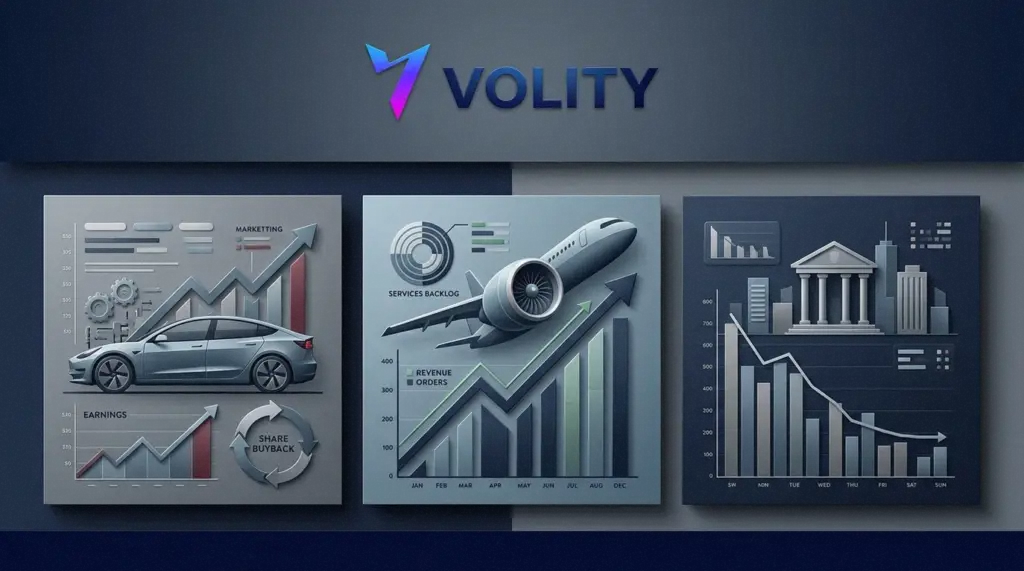
Earnings beats meet the guidance test
Wall Street began October 20 with a familiar earnings-season question: can a strong quarter lift a stock?
General Motors and GE Aerospace both beat expectations. However, their shares now face different tests.
For GM, investors must weigh a vast buyback against a narrower profit range. For GE Aerospace, the debate centres on valuation after another forceful upgrade.
Meanwhile, bank shares continue to flash caution across the broader market. The KBW Bank Index has now fallen for six straight weeks.
The results matter, but guidance, cash generation and price action will decide the next trade.
General Motors reported third-quarter revenue of $50.02 billion. Analysts had expected roughly $48.7 billion.
Adjusted earnings reached $3.70 a share, beating the $3.63 consensus estimate. The operational beat was modest, yet clean.
GM also unveiled a multiyear $20 billion share-repurchase authorisation. It had only recently completed a separate $6 billion programme announced in January.
That headline will attract attention, particularly from value-focused investors. Still, an authorisation is not the same as immediate buying.
Management narrowed its full-year adjusted EBIT forecast to $14.5 billion through $15.5 billion. Its previous range ran from $14 billion to $16 billion.
The revised range removes both downside and upside. Traders will now ask why management chose greater precision.
GM did raise its automotive free-cash-flow forecast. It now expects $11.5 billion to $12.5 billion, up from $9.5 billion to $11.5 billion.
Cash flow gives the buyback more substance. Yet the market will scrutinise pricing, incentive spending and North American vehicle demand.
Truck and SUV sales remain GM’s financial engine. Any signs of weakening mix would quickly overshadow the repurchase pledge.
China also deserves attention, even if it no longer determines the entire GM thesis. Losses or fresh price pressure could unsettle investors.
The stock’s opening reaction may prove misleading. A rally that fades below the prior close would signal scepticism towards the outlook.
Conversely, a sustained advance on heavy turnover would suggest investors trust GM’s cash-flow trajectory. That would turn the buyback into more than a headline.
- GM revenue: $50.02 billion, versus $48.7 billion expected.
- GM adjusted EPS: $3.70, versus $3.63 expected.
- New buyback authority: $20 billion over multiple years.
- Automotive free cash flow: $11.5 billion to $12.5 billion forecast.
GE Aerospace delivers a cleaner message
GE Aerospace presented investors with fewer obvious caveats. Its third-quarter numbers showed growth across revenue, profit, orders and cash generation.
Adjusted earnings came in at $2.25 a share. Wall Street had expected approximately $2.00 to $2.01.
Adjusted revenue rose to $13.29 billion. The consensus estimate sat near $12.85 billion to $12.87 billion.
Total orders jumped 49% to $19 billion. Adjusted revenue increased 18%, while adjusted operating profit climbed 30%.
Those figures matter because aircraft engines generate long service relationships. The original engine sale begins the economics, rather than finishing them.
GE Aerospace lifted its full-year forecasts for adjusted earnings, operating profit and free cash flow. That combination usually carries more weight than a quarterly beat.
The company now sees 2026 adjusted earnings of $8.00 to $8.10 a share. It expects operating profit of $10.9 billion to $11.0 billion.
Free cash flow should reach $9.1 billion to $9.4 billion next year. Management also expects low-double-digit commercial-services growth.
Its commercial-services backlog exceeds $170 billion. That provides a visible runway, although supply-chain constraints can still disrupt delivery schedules.
The market’s challenge is straightforward: GE has become expensive because it has executed well. A good company can still be a difficult stock to buy.
Early buyers should watch whether the shares hold their post-results range. A move higher with broad volume would indicate fresh institutional demand.
A sharp gap followed by a reversal would send another message. It would suggest that much of the optimism had already reached the share price.
Elsewhere, bank stocks offer a less cheerful reading of risk appetite. The KBW Bank Index has declined for six consecutive weeks.
That matches a run last seen during the 2008 financial crisis. The comparison is striking, though it does not predict another crisis.
The index has fallen about 11% during the streak. It stands roughly 13% below its August high.
Investors appear to be applying a sector-wide discount. That differs from a sell-off focused on one weak lender or one bad loan book.
Rate expectations, credit concerns and funding costs can all pressure bank valuations. Lower long-term yields may also squeeze net interest income.
Still, six losing weeks raise the odds of a tradable rebound. Oversold markets often rally before their underlying concerns disappear.
Traders should separate a technical bounce from a genuine turn. Improving breadth and sustained closes above resistance would provide stronger evidence.
Relative strength could identify the better candidates. Banks holding above recent lows deserve more attention than names making fresh breakdowns.
What traders should watch
- GM: Watch guidance commentary on pricing, margins and North American demand.
- GM: Check whether free-cash-flow confidence translates into actual repurchase activity.
- GE Aerospace: Watch the post-earnings range and volume before chasing an opening surge.
- GE Aerospace: Track service growth and supply-chain comments against its $170 billion backlog.
- Banks: Look for broad participation before treating any rally as a durable sector recovery.
Earnings season is rarely a simple contest between beats and misses. Markets price the next several quarters, not the previous three months.
GM offers a guidance-versus-valuation trade. GE Aerospace offers proven momentum, but at a price that leaves little room for disappointment.
Bank weakness, meanwhile, remains a warning against indiscriminate risk-taking. The headline gets attention, but the outlook decides whether money stays.