Quick answer
To create your own cryptocurrency you can either make a token on an existing blockchain like Ethereum or Solana, the easier route using smart-contract standards, or build a new blockchain from scratch, which is far harder. A token needs a smart contract, a supply and tokenomics; a coin needs its own network and validators. Legal and security considerations matter before launching either.
The Crypto Trading Starter Kit
A plain-English PDF: what to check before you trade, how orders and risk really work, and the mistakes to skip. Get it free.
Launching a cryptocurrency involves significant legal, technical, and financial risks. In 2026, regulators (FCA/MiCA) strictly target tokens without clear utility or those classified as unregistered securities. Technical bugs in smart contracts can lead to total loss of liquidity. Proactive auditing and legal counsel are essential. Past performance is not indicative of future results. Capital at risk.
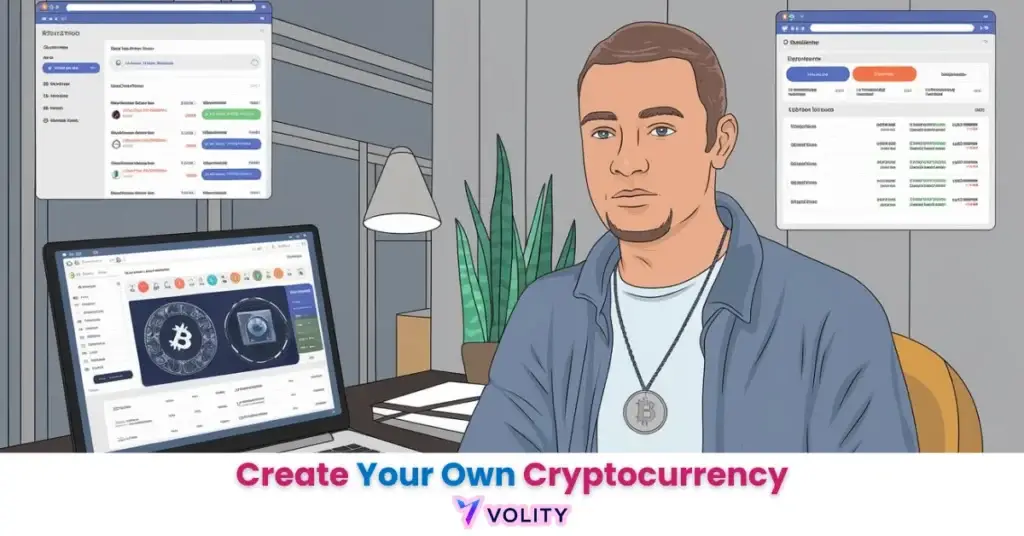
Creating your own cryptocurrency identifies the process of deploying a digital asset via no-code generators or custom smart contracts. This mechanism reveals a 2026 landscape where basic tokens cost as little as $100 to launch on chains like Base or Solana. Identifying a genuine use case and adhering to MiCA compliance reveals the path to long-term project viability.
Creating your own cryptocurrency identifies the foundational procedure for launching a digital economy, whether for a community reward program, a DeFi protocol, or a tokenized startup. This process reveals a significant 2026 market maturity where transaction costs on Layer 2 networks like Base have fallen below $0.01 per mint, democratizing access for non-technical founders. By leveraging pre-audited smart contract templates, innovators can bridge the gap between creative concept and on-chain reality.
The 2026 blockchain environment is defined by the decline of ‘hype-based’ launches and a renewed focus on ‘organic community’ development and clear regulatory compliance. As institutional interest shifts toward the Solana and Ethereum ecosystems, understanding the difference between native coins and smart-contract tokens is essential. This guide identifies the step-by-step paths for creating your digital asset and reveals the strategic benchmarks for a successful 2026 launch.
While understanding Creating a Cryptocurrency is important, applying that knowledge is where the real growth happens. Create Your Free Crypto Trading Account to practice with a free demo account and put your strategy to the test.
What is the difference between a coin and a token?
The primary difference between a coin and a token identifies the underlying infrastructure, where a coin operates on its own sovereign blockchain while a token is built on an existing network using smart contracts. Coins like Bitcoin (BTC) and Ethereum (ETH) serve as the foundations for their own ecosystems with their own consensus mechanisms. Tokens (layer 2 assets) leverage ERC-20 and BEP-20 standards, building on the security of their host chains without requiring separate validation networks.
Creation complexity reveals why building a coin identifies as a $30,000+ technical undertaking compared to the $100 cost of a token. The 2026 standards show how the Solana SPL standard is becoming the preferred alternative to Ethereum’s ERC-20 for high-frequency startups seeking speed and lower costs. The overwhelming majority of new digital assets are tokens deployed on an existing chain rather than new coins with their own validator set, because the token route inherits the host chain’s security and settlement. The interface itself is documented in the ERC-20 Token Standard and, on Solana, in the Solana token documentation. Ethereum 2.0: A Game-Changer for Traders explores how chain selection impacts project outcomes.
Ready to Elevate Your Trading?
You have the information. Now, get the platform. Join thousands of successful traders who use Volity for its powerful tools, fast execution, and dedicated support.
Create Your Account in Under 3 MinutesHow to create a cryptocurrency without coding in 2026?
Creating a cryptocurrency without coding identifies a streamlined path using no-code generators that deploy standardized smart contracts to the blockchain in under 60 seconds. Top 2026 platforms include 20Lab (startups), TokenGeneratorApp (advanced tokenomics), and Smithii (Solana), each offering parameter configuration without technical knowledge. Contract verification happens automatically as 2026 tools verify source code on Etherscan or Solscan to build user trust and transparency.
Defining the token parameters (Name, Symbol, Total Supply, Decimals) takes minutes, with the standard decimal setting being 18 for EVM chains. Flat fee models across primary no-code providers range from 0.01 ETH to 0.1 SOL deployment costs. Build Your Crypto Exchange: Tech & Regulations explores how infrastructure decisions scale as your project grows.
Use a Mainnet/Testnet toggle during deployment. In 2026, many no-code platforms offer free testnet practice, identifying the best way to verify your tokenomics before spending real capital on the live blockchain.
Custom Coding: Launching Your Token on Ethereum and Base
Custom coding your own cryptocurrency identifies the most flexible path, requiring Solidity programming skills and the use of the OpenZeppelin library for secure contract deployment. Development stack uses Remix IDE, Solidity, and MetaMask for EVM-compatible deployment, providing a complete environment for development and testing. OpenZeppelin v5 identifies the 2026 standard for audited, bug-free token logic, including transfer restrictions and governance mechanisms.
Deployment steps follow the proven cycle: Compile → Testnet (Sepolia) → Mainnet → Verify. Advanced logic in 2026 tokens implements features like ‘Anti-Whale’ caps that limit individual transaction sizes and ‘Auto-Liquidity’ triggers that automatically add liquidity to DEX pairs. Smart Contracts: The Self-Executing Code Replacing Banks explores the security foundations of contract-based systems.
2026 Deployment Costs and Platform Comparison
Cryptocurrency deployment benchmarks reveal the significant cost reduction enabled by Layer 2 technology and Solana’s low-rent fee model in 2026.
| Platform | Cost Tier | Typical cost |
| No-Code (Basic) | Entry | $100 – $200 |
| Solana CLI | Developer | 0.01 SOL account rent |
| Base (Layer 2) | Scalable | <$0.01 per mint |
| Startup Pack | Professional | $2,000 – $5,000 |
| Enterprise Coin | Custom | $100,000+ |
Indicative ranges, not quotes. Network-level costs are set by the chain, not by any vendor: see the ERC-20 Token Standard, the Solana token documentation and the OpenZeppelin ERC-20 contract reference. Vendor pricing changes without notice; check the provider before you budget.
Turn Knowledge into Profit
You have done the reading, now it is time to act. The best way to learn is by doing. Open a free, no-risk demo account and practice your strategy with virtual funds today.
Open a Free Demo AccountThe Legal Landscape: MiCA, SEC, and 2026 Compliance
Cryptocurrency legal compliance identifies a rigorous 2026 environment where projects must distinguish between utility tokens and security tokens to avoid regulatory enforcement. MiCA (Markets in Crypto-Assets) regulation requires a detailed whitepaper for all EU-facing tokens, establishing clear utility and governance structures. Securities regulators apply established investment-contract tests to decide whether a token is an unregistered security, and the answer turns on how the token is marketed and who is relied on to create its value, not on the technology used to mint it.
Anti-Money Laundering (AML) requirements mandate that issuers implement KYC for primary fundraising rounds. Utility mandate shows that tokens without a verifiably active use case identify as high-risk assets for retail buyers. KYC & AML in Crypto: Why Compliance Matters reveals how proper identification procedures protect legitimate projects.
WARNING: Utility is the 2026 regulatory benchmark. Tokens launched without a verifiably active use case (like governance or service access) identify as ‘high-risk’ for delisting or regulatory enforcement actions.
Regulation (EU) 2023/1114 (MiCA) is the regulation itself, and ESMA maintains a plain-language overview at Markets in Crypto-Assets Regulation (MiCA).
Solana vs. Ethereum vs. Base: Choosing Your Launch Chain
Choosing a launch chain identifies the tradeoff between Ethereum’s massive liquidity, Solana’s high-speed SPL standard, and the low-cost scalability of Base. Ethereum remains the deepest venue for institutional liquidity but carries the highest gas fees of the three, and those fees move with mainnet congestion rather than sitting at a fixed rate. Solana identifies as the preferred choice for 2026 high-frequency apps with 1-second finality and transaction costs under $0.01. Base, Coinbase’s Layer 2, identifies the best on-ramp for US-based retail users seeking zero-gas execution.
Polygon serves ESG-focused projects requiring zero-carbon footprints and institutional compliance. A worked illustration, not a record of a real launch: a DePIN (decentralised physical infrastructure) project that expects thousands of small on-chain interactions per user will find per-transaction cost, not deployment cost, decides whether the design is viable at all. Choose the chain against the transaction profile you expect, not against the one-off cost of minting. Past performance is not indicative of future results.
💡 KEY INSIGHT: Solana’s Token-2022 standard is a 2026 game-changer. It identifies built-in features like ‘transfer fees’ and ‘interest-bearing’ logic that previously required complex custom coding on EVM chains.
Solana Crypto: High-Speed Blockchain Explained explores ecosystem dynamics and developer adoption.
OpenZeppelin Contracts 5.x: ERC-20 documents the audited token implementation most production launches build on.
Etherscan, the Ethereum blockchain explorer, is where a deployed contract’s source is published and checked.
Key Takeaways
- Creating your own cryptocurrency identifies the choice between native coin development ($30k+) and smart-contract token deployment ($100).
- No-code token generators identify the fastest path for non-technical founders, enabling Mainnet deployment in under 60 seconds.
- Solana and Base reveal 2026’s lowest transaction fees, with minting costs verifiably falling below $0.01 per token on Layer 2.
- MiCA and FCA regulations identify utility as the primary benchmark, requiring tokens to have a genuine use case to remain compliant.
- Audited templates from OpenZeppelin identify the 2026 security standard, protecting custom projects from common smart contract bugs.
- Organic community growth is more durable than paid hype; building an audience before the token exists is what gives it order flow on day one.
Frequently Asked Questions
This article contains references to cryptocurrency creation tools, blockchain platforms, and tokenization processes, and mentions Volity, a regulated CFD trading platform. This content is produced for educational purposes only and does not constitute financial advice or legal advice. Creating and launching a cryptocurrency involves significant regulatory, technical, and financial risks. Always consult qualified legal and technical advisors before deploying any token. Some links in this article may be affiliate links.
What our analysts watch: Real launches in 2026 split three ways. Most are ERC-20 deployments on Ethereum or Base, settling for under fifty dollars in gas. A smaller cohort builds Solana SPL tokens for sub-cent transfer fees. The serious projects layer in audited contracts, locked liquidity, and a written token-distribution memo before any listing conversation. Skipping audit is the single fastest way to get delisted.
Volity operates a trading platform and also publishes educational and analytical content about trading. The content on this page is for educational purposes only and should not be considered financial advice. Volity may benefit commercially when readers open trading accounts through links on this site.
Our content is produced and reviewed under documented editorial standards; see our comparison and review methodology.