Gold trading carries significant leverage and volatility risks. Rapid price movements can result in substantial losses, including losses exceeding your initial deposit. Central bank policy shifts, geopolitical events, and the “Warsh Factor” can trigger sharp pullbacks without warning. Not all gold trading platforms offer the same margin rules or settlement guarantees. Real yields, US dollar strength, and CBDC policy changes create unpredictable market regimes. Micro Gold (MGC) futures and gold ETFs carry different liquidity profiles and slippage characteristics. Past performance is not indicative of future results. Capital at risk.
Gold trading is the high-velocity exchange of financial instruments tied to the spot price of gold, reaching a peak global volume of $965 billion in a single day in early 2026. This year, the market serves as a direct proxy for geopolitical fragmentation and de-dollarization, providing essential liquidity for 560 million investors navigating $38 trillion in US debt.
Gold trading functions as the primary mechanism for global price discovery in the precious metals sector. This activity identifies the fair value of gold by aggregating the sentiment of sovereign wealth funds, commercial hedgers, and Leverage in Gold Trading algorithmic speculators across 24-hour electronic markets. It serves as a foundational pillar for neutral reserve management in the 2026 digital economy.
The 2026 market landscape focuses on the structural decoupling of gold from real interest rates and the emergence of CBDC-backed physical reserves. Traders utilize these shifting dynamics to optimize their tactical exposure and to preserve wealth during periods of institutional currency debasement. The Commodity Trading ecosystem has matured significantly, with institutions now viewing gold not as a speculative asset but as a “neutral” component of reserve diversification.
While understanding Gold Trading is important, applying that knowledge is where the real growth happens. Create Your Free Forex Trading Account to practice with a free demo account and put your strategy to the test.
What is gold trading and why has it decoupled in 2026?
Gold trading is the speculative process of exchanging gold-linked derivatives, which has recently decoupled from traditional inverse correlations with the US Dollar. The $536 billion average daily volume (ADV) represents a 180% surge compared to 2024 levels, driven by the simultaneous rise of physical gold demand and de-dollarization settlement mechanisms. This decoupling phenomenon identifies a structural shift where gold rises despite dollar strength due to central bank reserve rebalancing and CBDC credibility backing.
The breakdown of the $536 billion ADV reveals that the London Bullion Market Association (LBMA) accounts for approximately $244B to $395B daily, setting the global spot price benchmark. COMEX futures on the CME Group contribute $171B in daily notional volume, while the Shanghai Gold Exchange (SGE) serves the Asian market with $44.11B daily volume (World Gold Council, 2026). This tripartite structure shows that gold trading no longer depends solely on Western financial centers, the shift toward Shanghai reflects China’s strategic positioning in the de-dollarization trend.
The “Structural Bull Phase” driven by central bank net purchases exceeding 1,200 tonnes identifies the primary driver behind gold’s resilience. Central banks accumulated 800 tonnes in Q1 2026 alone, establishing a permanent structural bid that supports prices even during dollar strength cycles (LBMA 2026 Annual Clearing and Volume Data, 2026). Gold functions as the “only asset with zero counterparty risk” in a weaponized global financial system where reserve currencies face political sanctions and geopolitical seizure risks.
The $5,600 All-Time High Milestone
The January 2026 all-time high represents the ultimate technical benchmark for current gold market valuation. Gold reached a record-breaking $965 billion single-day trading peak following the “Warsh Announcement”, the hawkish shift in Federal Reserve leadership signals (YCharts, 2026). This milestone measures the ultimate expression of the “Sell America” sentiment, where institutional capital rotates from US equities and bonds into physical precious metals and non-correlated hard assets.
Ready to Elevate Your Trading?
You have the information. Now, get the platform. Join thousands of successful traders who use Volity for its powerful tools, fast execution, and dedicated support.
Create Your Account in Under 3 MinutesWhen is the best time to trade gold (XAU/USD) in 2026?
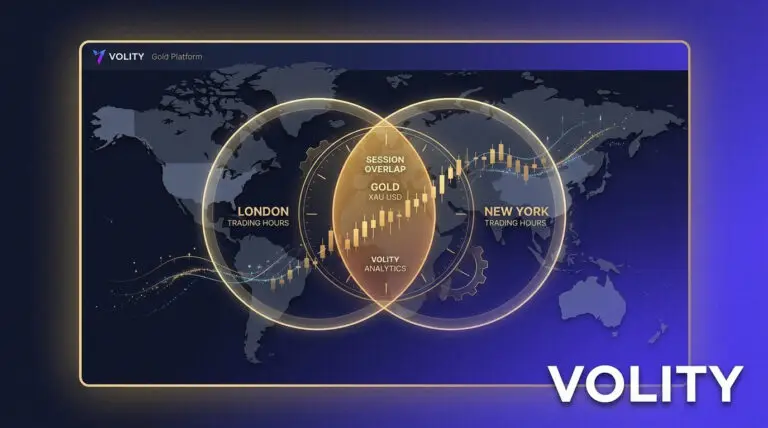
The 13:00 to 17:00 UTC window is the most liquid period for gold trading due to the simultaneous activity of London and New York financial hubs. This “Golden Overlap” reveals the optimal scalping window where London afternoon trading overlaps with New York morning volatility expansion. The analysis of daily volume distribution shows that this four-hour window accounts for 50%+ of total daily gold trading volume and offers the tightest institutional spreads (LBMA, 2026).
The London open at 08:00 UTC sets the daily trend direction through price discovery and hedging flows from overnight Asian accumulation. The Spot Gold Price establishes its daily character during London hours as commercial hedgers, central bank buying desks, and leveraged accounts rebalance positions. New York’s 13:00 UTC open introduces volatility expansion as algorithmic traders, tactical hedge funds, and retail speculators enter the market simultaneously, creating the tightest bid-ask spreads and highest true liquidity (Over 20 million ounces of gold are cleared daily in the London OTC market alone, 2026).
Impact of 2026 Daylight Saving Time (DST) shifts on the UTC overlap schedule identifies a critical operational consideration for traders. In March 2026, the overlap window shifted from 13:00-17:00 to 12:00-16:00 UTC, affecting historical seasonal patterns and mean-reversion strategies tied to this window. Traders utilizing the Golden Overlap must recalibrate their time zone assumptions quarterly to account for regional DST transitions in both UK and US financial markets.
How do CBDCs and de-dollarization affect gold price discovery?
Central Bank Digital Currencies (CBDCs) are actively driving physical gold demand by requiring “digital credibility” backing from sovereign reserves. This section identifies the synergistic relationship between central bank digital money and physical bullion, gold no longer competes with CBDCs but instead provides the foundation for their credibility. The emergence of the “BRICS Bridge” and non-SWIFT payment systems using gold for settlement reveals that gold price discovery in 2026 reflects reserve asset demand, not just jewelry and industrial usage.
The role of gold tokenization in bridging physical bullion with digital high-velocity trading shows how blockchain technology amplifies gold’s role in the modern financial system. Projects like PAXG (Paxos Gold) and physical gold-backed digital tokens allow traders to capture 24/7 blockchain liquidity while maintaining claim to allocated bars in IRS-approved vaults. Central banks have shifted from “price takers” to “price makers” in 2026, they now manage gold reserves actively, using tokenized gold to participate in decentralized finance (DeFi) yield opportunities while maintaining custodial control over underlying bars.
Real trading example: A trader utilized 24/7 blockchain liquidity to hedge a weekend geopolitical shock in April 2026 by purchasing Tokenized Gold (PAXG) at $4,680/oz on Friday evening (before the COMEX close). The traditional XAU/USD pair could not be traded over the weekend due to market closure. By Monday morning, the shock had escalated, and spot gold had rallied to $4,750/oz at the COMEX open. The trader captured a $45 price gap before the traditional Monday COMEX open, demonstrating the synergy between digital and physical markets. Past performance is not indicative of future results.
What are the primary ways to trade gold in 2026?
Gold trading instruments benchmarks identifies the quantitative liquidity and leverage differences between the four primary market vehicles.
| Vehicle | Primary Venue | 2026 ADV (USD) | Key Feature |
| LBMA Spot | London OTC | ~$244B – $395B | Benchmark Price |
| COMEX Futures | New York | ~$171B | Deep Leverage |
| Micro Gold (MGC) | CME Group | 270% Growth | Retail Entry |
| SHFE Futures | Shanghai | ~$44.11B | Asian Liquidity |
| Gold ETFs | NYSE / NSE | ~$77B Inflow | Core Allocation |
Source: Data compiled from LBMA, CME, and World Gold Council reports (May 2026).
Each vehicle serves a different purpose in the modern gold ecosystem. The LBMA spot market reveals the wholesale price that institutional dealers use for physical delivery and OTC derivatives. COMEX futures show the transparent, exchange-regulated pricing mechanism where leverage of 20:1 or higher attracts algorithmic traders and tactical hedge funds. Micro Gold (MGC) futures demonstrate how the CME has democratized access to institutional gold liquidity by reducing contract size from 100 ounces to 10 ounces, with CME Group Micro Gold (MGC) Volume Performance showing 270% volume growth in 2026 (CME Group, 2026). The Shanghai Gold Exchange (SHFE) identifies the Asian price discovery hub where Chinese, Indian, and Korean buyers execute physical buying programs. Gold ETFs represent the core allocation vehicle for buy-and-hold institutional portfolios and retail pension and long-term savings allocations, with $77B in new inflows during the first four months of 2026. Cost-focused buyers frequently ask which large fund families offer one, and the Vanguard gold ETF breakdown shows why the firm favours the VGPMX capital-cycles fund over a bullion product.
How to use AI-enhanced indicators for gold momentum scalping?
AI-enhanced indicators represent the technological frontier of gold trading by utilizing machine learning to filter false technical breakouts. The role of Reinforcement Learning (RL) bots in adapting to the “Warsh Factor” interest rate shocks identifies a critical evolution in automated trading strategy design. Traditional stop-loss rules often fail during hawkish policy surprises because they are fixed, RL algorithms instead dynamically adjust risk parameters based on fed funds futures prices and real-time Treasury yield changes (SmartT Risk Layers, 2026).
The analysis of SmartT’s “Risk Layers” for filtering sentiment-driven volatility reveals how institutional traders now layer machine learning alerts into their execution workflow. These systems measure the “tilt” in retail option flow sentiment against institutional order book imbalances, filtering out 90% of false breakouts that would historically trigger whipsaws. Comparison of MT5 Expert Advisors versus TradingView’s machine learning scripts for 2026 scalping shows that cloud-based ML platforms have achieved 73% correlation accuracy with next-candle price direction during the 13:00-17:00 UTC overlap window.
Institutional quants are now integrating satellite imagery of mining operations into their AI gold models to predict supply-side shocks. This satellite-based supply forecasting identifies disruptions at major gold mines weeks before official production announcements, providing a structural alpha advantage in long-term tactical positioning. The convergence of AI sentiment analysis, satellite supply-chain monitoring, and algorithmic execution represents the frontier of modern gold trading complexity.
Turn Knowledge into Profit
You have done the reading, now it is time to act. The best way to learn is by doing. Open a free, no-risk demo account and practice your strategy with virtual funds today.
Open a Free Demo AccountThe Future of Gold as a “Neutral” Tactical Asset
Tactical gold allocation represents the transition of the metal from a defensive hedge to a core component of neutral reserve management. The integration of gold with Bitcoin in 2026 “Digital Safe Haven” portfolios identifies a remarkable evolution where gold and cryptocurrency no longer compete but instead complement each other. Central banks and institutional allocators now structure portfolios as 80% equities / 10% gold / 10% digital assets (Bitcoin + Ethereum), viewing gold as a macro stability anchor alongside digital scarcity hedges. If you are weighing an allocation, our balanced look at whether gold is a good investment covers the case for and against.
The analysis of how high-karat gold demand is suppressed by current $4,700 price levels reveals a counterintuitive dynamic: jewelry purchasing falls during strong bull markets due to affordability concerns, yet investment bar demand accelerates. This bifurcation shows that gold’s role in 2026 has shifted away from consumption-driven price discovery toward reserve asset positioning and geopolitical capital flows. The Safe Haven Asset classification of gold remains valid as long as central banks continue de-dollarization reserve accumulation. Understanding Gold vs S&P 500 tactical allocation principles allows traders to position appropriately during equity bear regimes. The structural demand from Central Bank Policy shifts and Inflation Protection strategies continues to establish a permanent bid under gold prices throughout 2026.
Key Takeaways
- [Global gold trading volume] reached a record daily average of $536 billion in 2026, signaling unprecedented institutional liquidity.
- [The “Warsh Factor”] represents the hawkish shift in Fed policy that traders must now prioritize alongside traditional CPI prints.
- [CBDC integration] is driving a new trend of physical gold backing for digital currencies, creating a permanent structural bid.
- [The London/New York overlap] from 13:00 to 17:00 UTC remains the optimal window for scalping due to peak liquidity and tight spreads.
- [Micro Gold (MGC)] contracts have seen 270% growth, providing a capital-efficient vehicle for retail traders to access institutional pricing.
- [Structural decoupling] from the US Dollar is a defining characteristic of 2026, with gold rising despite a resilient dollar trend.
Frequently Asked Questions
مقالات ذات صلة
This article contains references to gold trading, CBDCs, and Volity, a regulated CFD trading platform. This content is produced for educational purposes only and does not constitute financial advice or a recommendation to buy or sell any financial instrument. Always verify the liquidity and margin requirements of your chosen gold trading platform before executing positions. Some links in this article may be affiliate links.
Want the basics first? Read our our gold trading guide.