Crypto market shrugs off hacks and geopolitics
Crypto has spent the week doing what it does best: absorbing bad headlines, then carrying on. Michael Saylor’s MicroStrategy, now branded “Strategy”, said it bought another 34,164 Bitcoin. That pushes its stated stash to 815,061 BTC, an eye-watering number as Bitcoin circles $75,000. Meanwhile, ETF flows have stayed supportive, yet Friday’s chunky options expiry hangs over the tape.
Even so, the most striking signal is not the price. It is the market’s refusal to panic. Hacks, Middle East jitters and a busy regulatory rumour mill have all hit at once. However, dips have looked more like inventory reshuffles than true risk-off.
Bitcoin meets $75,000 with a wall of options
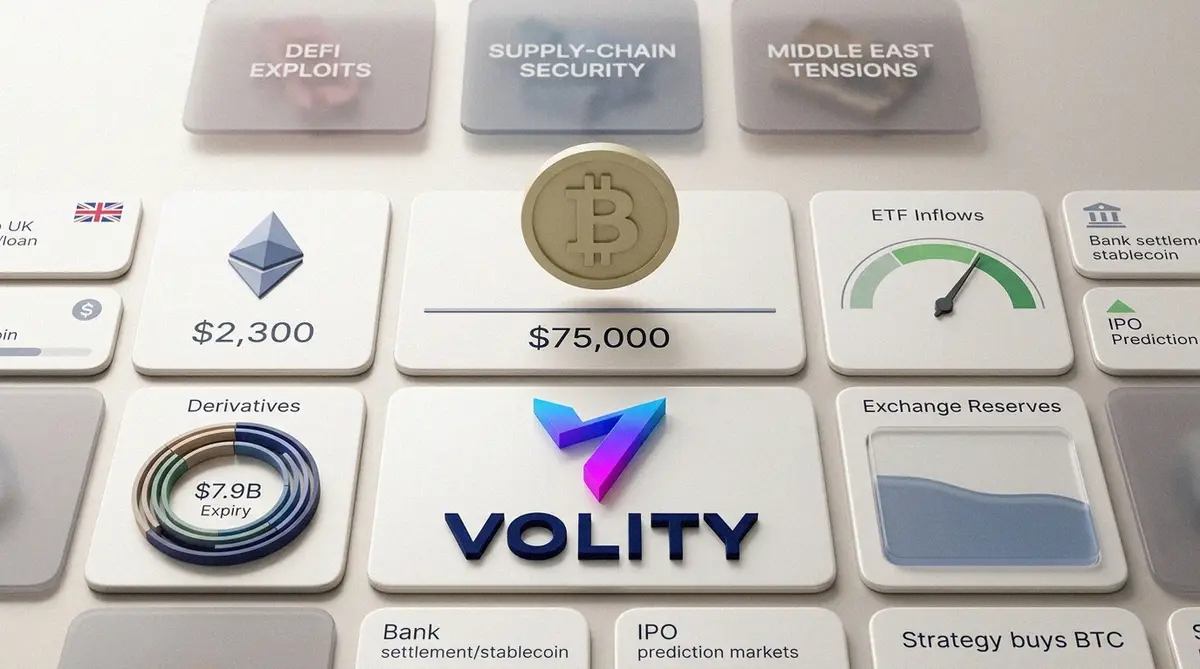
Bitcoin has struggled to turn $75,000 from a bragging point into a floor. Traders have $7.9 billion in options expiring on Friday, which can magnetise price and punish late leverage. On-chain data has shown profit-taking into strength. Yet exchange balances also matter, and Binance reserves have slid to levels not seen since October 2025.
That mix sets up the classic squeeze question. If supply stays tight while dealers hedge option risk, then price can jump awkwardly. However, geopolitics still sits in the corner like a wet coat. Reports of rising Iran tensions, including a US ship seizure, have revived doubts about any near-term diplomatic thaw.
- BTC: Slid roughly $3,000 from recent peaks, while $75,000 stays the key pivot.
- ETH: Held around $2,300, even as broader screens turned patchy.
- SOL: Near $84.85 after clearing a watched resistance zone.
- XRP: Tightened into a symmetrical triangle as ETF demand picked up.
Ethereum and the ETF bid keep peeking through
Ethereum has looked quietly constructive. It has held a $2,300-ish range, while chart-watchers point to a bullish triangle set-up. Importantly, spot ETH ETFs have logged seven straight days of inflows, which gives the pattern more than just vibes.
Elsewhere, XRP-linked products pulled in $55 million last week, their strongest weekly haul so far. Solana, meanwhile, has traded like a market with fewer sellers, helped by renewed chatter around messaging-based trading integrations.
Institutions keep feeding the pipes
Weekly inflows into crypto funds hit $1.4 billion, the largest since January. That cash has not stayed abstract. It has flowed through Bitcoin and Ethereum ETFs, and it has given alt exposure a reason to exist beyond memes.
Coinbase rolled out crypto-backed loans in the UK, offering up to $5 million via Morpho on Base. That is a reminder that “DeFi” increasingly looks like plumbing behind familiar brands. Circle also launched a payments network pitched at banks, promising stablecoin settlement without forcing institutions to hold awkward assets on their balance sheets.
In the frothier lanes, Polymarket is reportedly chasing a $15 billion valuation with a $400 million raise. Kraken IPO talk has bubbled up again. Meanwhile, established names like Charles Schwab and Citadel have been linked to a growing interest in prediction markets, which now sit somewhere between derivatives and social media.
Saylor doubles down, critics jeer, the market watches the debt
Saylor’s buying spree remains the loudest single-company bet in modern markets. Strategy’s latest purchase keeps the firm within striking distance of 800,000 Bitcoin, with the stated total now above that. He has hinted at more buying and floated the idea of semi-monthly dividends tied to STRC stock.
Peter Schiff, a long-time Bitcoin critic, has again questioned the debt-fuelled approach. That argument matters because the trade is no longer “Bitcoin up”. It is “Bitcoin up faster than the cost of capital”, with equity dilution and credit spreads acting as the real governors.
On a different anxiety, Blockstream’s Adam Back brushed off 2029 quantum-computing fears. Traders, for now, seem to agree. They price today’s flows, not tomorrow’s physics.
Hacks hit confidence, yet the tape stays orderly
DeFi suffered another rough week. Kelp DAO took a heavy hit, with LayerZero pointing to Lazarus Group. The broader tally cited was $293 million in DeFi losses, which matters less for the absolute figure than the cumulative fatigue.
Aave slipped to about $90 at one point, though derivatives positioning has suggested bargain hunting. Separately, a Vercel supply-chain breach prompted the usual credential-rotation scramble. Binance also said its platform and funds remain safe, which helped prevent a familiar spiral of uninformed rumours.
EasyDNS admitted a security failure after an eth.limo hijack. RAVE token collapsed 95% amid scrutiny, while RaveDAO issued responses after an earlier 80% drop. None of this is new. However, it keeps reinforcing a simple rule: smart-contract risk is not theoretical, and “audited” is not a shield.
Tradfi, AI and stablecoins jostle for the next narrative
Big tech’s chip race keeps bleeding into market sentiment. Google’s work with Marvell to scale AI chips adds another angle on Nvidia’s dominance. Meanwhile, Coinbase has tested AI agents inside Slack, a small detail that still lands loudly for anyone watching headcount and operating leverage.
Bank and policy voices have also sharpened. A Moody’s executive argued stablecoins could nibble at bank market share. The BIS chief warned that US dollar stablecoins could create global instability. Those statements are not trading signals by themselves. However, they show where the next set of regulatory fights may gather.
Key takeaways
- BTC’s $75,000 level matters more into the $7.9 billion Friday options expiry than any single headline.
- ETF inflows keep acting as the market’s shock absorber, especially for BTC and ETH.
- Strategy’s leverage story remains a proxy bet on Bitcoin’s path versus funding costs.
- DeFi exploits keep capping enthusiasm, so rallies favour larger, more liquid names.
- Stablecoin policy risk is rising, therefore payment and banking narratives may turn headline-driven.