Crypto markets brace for scarcity as Bitcoin hits 20 million milestone
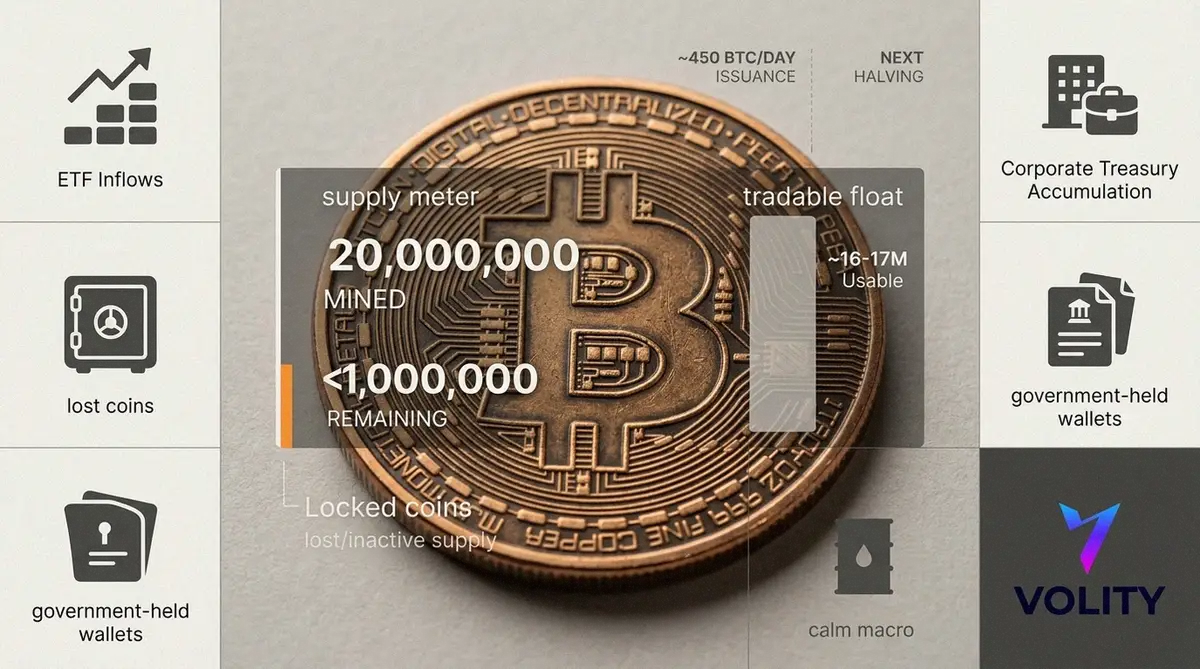
Bitcoin just slipped past a headline number that tends to concentrate minds. More than 20 million coins have now been mined, which means roughly 95% of the hard capped 21 million supply is already out in the world. Meanwhile, the remaining million will dribble out over more than a century, because the issuance schedule keeps tightening like a ratchet.
Therefore, traders are being forced to separate two questions that often get mashed together. First, how scarce is Bitcoin on paper. Second, how scarce is it in practice, once you strip out lost coins, long term hoards and institutional lock ups.
Supply maths gets unforgiving
The network took about 17 years to reach 20 million mined. However, the last million will take until roughly 2140, because each halving cuts new supply again. Daily issuance sits around 450 BTC at present, and it will step down further at the next halving cycle. As a result, price tends to matter more at the margin than narrative does, because fewer new coins arrive to meet fresh demand.
Effective supply looks tighter still. Several chain analytics estimates put permanently lost Bitcoin at 2.3 to 3.7 million coins, through forgotten keys, unspendable addresses and estates that never move. Consequently, the truly usable float may be closer to 16 to 17 million, even before you account for coins parked in cold storage for years.
Big holders keep tightening the float
It is not only early adopters who sit tight. MicroStrategy, now rebranded as Strategy in some market chatter, recently spent $1.28 billion to buy 17,994 BTC. Meanwhile, spot Bitcoin ETFs still pulled in fresh cash in early March, even as Bitcoin wobbled around the high $60,000s.
Strategic stockpiles add another layer. The US government holds roughly 328,000 BTC in seized or controlled wallets. Separately, Satoshi era coins remain untouched in size, with about 1 million BTC associated with the creator’s early wallets. Therefore, more of the supply sits in hands that rarely trade, which can sharpen both rallies and drawdowns.
By the numbers
- 20,000,000+ Bitcoins mined, about 95% of total supply.
- 1,000,000 coins left, expected to be mined through 2140.
- Estimated 2.3 to 3.7 million BTC likely lost, shrinking the real float.
- Current issuance near 450 BTC per day, before the next step down.
- US controlled wallets near 328,000 BTC, largely inactive supply.
Oil whipsaws, Bitcoin shrugs
Macro traders had little time for purity tests this week, because energy markets did their own impression of a meme coin. Crude leapt on Middle East shipping fears, then retraced sharply after talk of a large release hit the tape. As a result, risk markets flashed stress in pockets, with equities wobbling and volatility waking up.
Bitcoin’s reaction was notably restrained. It churned around the mid to high $60,000s, slipping below $66,000 at points, yet avoiding the kind of air pocket that used to follow a macro scare. However, “steady” in crypto often masks a lot of internal rotation, with altcoins and leverage telling a more nervous story than the headline BTC chart.
Altcoin flows hint at a market still trading, not investing
While Bitcoin supply becomes structurally tighter, many traders still look for beta elsewhere. XRP saw whale activity as larger holders accumulated during drawdowns. Meanwhile, Solana continued to post eye catching on chain activity and stablecoin turnover, which keeps it on the tactical watchlist.
However, the backdrop remains fragile for everything outside Bitcoin. Liquidity is thinner, positioning is more crowded and catalysts are less dependable. Therefore, the scarcity story may buoy sentiment, yet it does not eliminate the usual crypto reality that correlations can spike when the tape turns ugly.
What would actually drive the next leg?
Scarcity is not a catalyst on its own. Instead, it is the stage on which catalysts play out. If ETF inflows resume with conviction, fewer freely traded coins could amplify the move. Similarly, if rate cut expectations rise again after soft economic data, risk appetite could return and pull crypto higher.
On the other hand, if energy volatility feeds back into inflation expectations, central banks could stay restrictive for longer. In that case, Bitcoin may hold up better than frothier tokens, yet it would still have to fight for new marginal buyers at higher prices.
Key takeaways
- Watch issuance, not mythology: fewer fresh coins means flow data matters more.
- Track ETF and corporate buying: they remove float and can steepen rallies.
- Mind macro shocks: oil driven inflation scares can cap risk across the board.
- Separate BTC from alts: scarcity supports Bitcoin, yet alts still trade like leveraged risk.
- Volatility can rise on “good” news: a tight float can also mean sharper liquidation cascades.