...

Day Trading for Beginners: A Real-World Guide to Profit & Risk

Table of Contents
Quick Summary
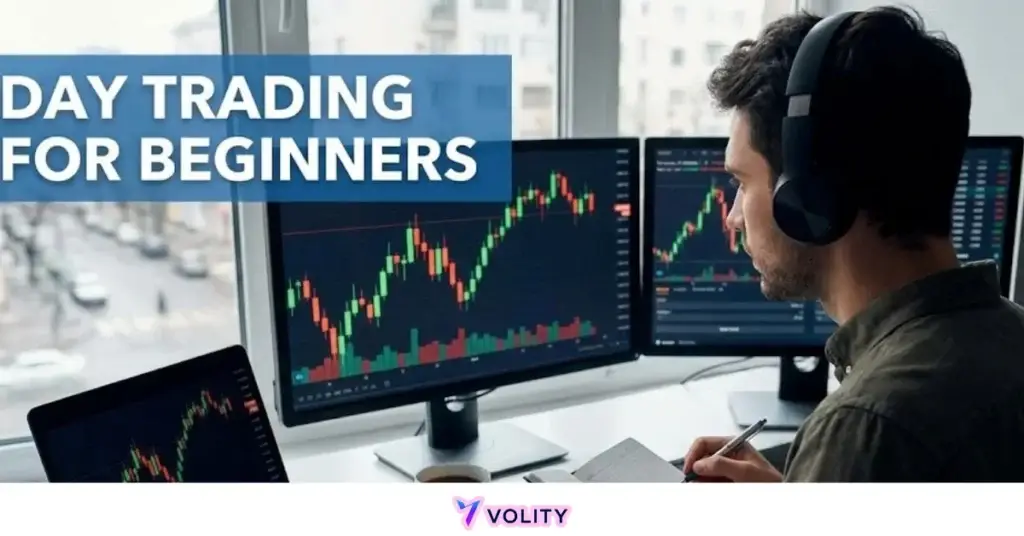
Day trading involves buying and selling financial assets within the same trading day to capture short-term price movements. Traders close all positions before the market closes to avoid overnight risk. Day trading requires fast execution, strict risk management, and sufficient capital to handle rapid price changes.

Day trading involves buying and selling financial instruments within the same day. It capitalizes on short-term price fluctuations. Day traders execute multiple trades to generate small profits. This strategy requires advanced technical analysis and strict risk protocols for success.

Many aspiring traders wonder if day trading is a scam or if they will lose all their money. This guide reveals the street-smart reality behind institutional definitions. It helps navigate complex markets and avoid common pitfalls.

While understanding Day Trading is important, applying that knowledge is where the real growth happens. Create Your Free Forex Trading Account to practice with a free demo account and put your strategy to the test.

What is Day Trading?

Day trading describes the practice of executing trades within a single trading day. These trades open and close before the market’s daily close. This approach focuses on capturing small, rapid price movements across various securities.

Typical instruments include stocks, options, and exchange-traded funds (ETFs). Day trading contrasts sharply with long-term investing. It demands constant attention to market volatility and liquidity. To truly grasp the landscape, it’s essential for new participants to understand the broader context of beginner trading and how various strategies compare.

Day Trading vs. Investing vs. Swing Trading

For any aspiring trader, understanding the fundamental differences in investing vs trading (including day trading and swing trading) is crucial, as they differ primarily in their holding periods and capital exposure. Day trading involves holding positions for seconds to hours, never overnight. This minimizes overnight market risk.

Long-term investing means holding assets for months or years. Investors seek capital appreciation and dividends. This strategy focuses on fundamental analysis.

Swing trading occupies a middle ground. Positions typically last from several days to a few weeks. Swing traders capture larger price swings than day traders. They accept moderate overnight risk.

The “90% Statistic” (Why Most Fail)

Numerous studies confirm a high failure rate among retail day traders. The “90/90/90 Rule” states that 90% of traders lose 90% of their money within 90 days. This statistic highlights critical challenges faced by new entrants.

90 90 90  rule for day traders

Success requires more than market knowledge. It demands stringent discipline and psychological resilience. Lack of these attributes contributes significantly to widespread losses.

Understanding the “90/90/90 Rule”

The “90/90/90 Rule” is an informal market observation. It suggests the vast majority of new day traders experience substantial capital loss quickly. This rule underscores the difficulty of consistently profiting from short-term market movements.

It also serves as a stark warning about the learning curve. Many traders enter without proper preparation. They underestimate the required skill set.

The Role of Trading Psychology and Discipline

Trading psychology dictates how traders react to market events. Fear, greed, impatience, and overconfidence commonly lead to irrational decisions. These emotional responses disrupt objective analysis.

Strict discipline involves adhering to a predefined trading plan. It controls impulse decisions. Discipline provides the foundation for managing risk effectively.

💡 KEY INSIGHT: Day trading is a skill sport, not a lottery. It demands extreme psychological discipline.

The Barrier to Entry: Capital and Legal Rules

Entering day trading requires understanding specific capital requirements and legal regulations. Many aspiring traders inquire, “Can I trade with $100?” The answer involves more than just account balance. It includes regulatory hurdles and the math of fees.

Commissions and margin trading rules significantly impact small accounts. These elements define the real barrier to entry. They often surprise new traders.

Understanding the Pattern Day Trader (PDT) Rule

The Pattern Day Trader (PDT) rule is a regulation enforced by FINRA in the United States. It identifies traders who execute four or more day trades within a five-business-day period. This applies to margin accounts.

Designated PDTs face specific requirements. It restricts their trading activity. The rule protects against excessive risk-taking with margin.

The $25,000 Requirement (FINRA Regulations)

FINRA’s PDT rule mandates a minimum equity balance of $25,000. This balance must be maintained in the margin account. Falling below this threshold triggers a “margin call” or trading restrictions.

Traders cannot open new positions until the balance is restored. This rule significantly impacts traders with limited capital. It restricts active trading.

Workarounds: Cash Accounts vs. Offshore Brokers

Traders can navigate the PDT rule through specific strategies. Using a cash account bypasses the $25,000 requirement. Cash accounts only permit trading with settled funds. This means funds from a sale take 2 business days (T+2) to settle before reuse.

Offshore brokers also offer alternatives. These brokers operate outside FINRA’s jurisdiction. They often have lower capital requirements. However, using offshore brokers carries higher regulatory risk.

Ready to Elevate Your Trading?

You have the information. Now, get the platform. Join thousands of successful traders who use Volity for its powerful tools, fast execution, and dedicated support.

Create Your Account in Under 3 Minutes

Realistic Starting Capital

Starting with insufficient capital magnifies risk and limits profit potential. Realistic starting capital depends on individual goals and risk tolerance. It directly impacts strategy choices.

Many experts recommend starting with at least $500 to $1,000. This provides a buffer against initial losses. It also allows for diversified position sizing.

Can you start with $100? (The math of fees vs. profit)

Technically, one can start day trading with $100. However, this poses significant challenges. Brokerage commissions, even “commission-free” ones, often involve hidden fees. These fees erode small account balances quickly.

A $10 trade fee represents 10% of a $100 account. This requires substantial percentage gains on every successful trade. Sustainable growth becomes extremely difficult.

Leverage and Margin: The double-edged sword

Leverage enables traders to control larger positions with smaller capital. Margin accounts provide this amplified buying power. Brokers lend funds against the trader’s existing capital.

While leverage increases potential profits, it equally magnifies potential losses. A small market movement against a highly leveraged position can wipe out an account rapidly. It is a tool for experienced traders.

WARNING: Leverage amplifies both gains and losses. For beginners, it frequently leads to rapid account depletion.

Essential Tools and Setup

Successful day trading relies on a robust set of tools and a well-configured setup. These tools include reliable trading platforms and sophisticated charting software. Latency and data speed are critical factors.

Slow data feeds or platform delays can result in missed opportunities. They also cause inaccurate entry and exit points. A proper tech stack provides a competitive edge.

Choosing an Online Broker

Selecting the right online broker is a foundational step. Brokers provide access to financial markets and trading platforms. Their services, fees, and regulatory compliance vary widely.

Consider factors like commission structure, available instruments, and platform stability. Customer support responsiveness also plays a vital role. This choice impacts overall trading efficiency.

Commission-free vs. Direct Access Brokers

Commission-free brokers do not charge a fee per trade. They typically generate revenue through payment for order flow. This might involve slightly less favorable execution prices. They suit beginners.

Direct access brokers offer superior order routing and execution speed. They often charge commissions per trade or share. Professional day traders prefer these for their speed and advanced features.

Charting Software and Indicators

Charting software visualizes price action and market data. It forms the backbone of technical analysis. Traders use it to identify patterns and predict future movements.

Integrated indicators provide mathematical analyses of price and volume data. These tools help interpret market conditions. They guide trading decisions effectively.

Setting up Volume, VWAP, and Moving Averages

Specific indicators are indispensable for day traders. Volume indicates the number of shares traded. High volume confirms price moves.

VWAP (Volume Weighted Average Price) represents the average price of a security. It incorporates both price and volume. Traders use VWAP to identify fair value and strong trends.

Moving Averages smooth price data over a specified period. Simple Moving Averages (SMA) and Exponential Moving Averages (EMA) show trend direction. EMAs react faster to recent price changes.

Tip: 🔑 Master 2-3 key indicators before adding more. Overloading charts creates confusion.

Core Trading Strategies for Beginners

Beginner day traders benefit from mastering one or two proven strategies. Attempting too many approaches simultaneously leads to confusion and inconsistent results. Focus provides clarity and improves execution.

Common strategies include scalping, momentum trading, and trend following. Each strategy targets specific market conditions. Understanding their mechanics is crucial.

Scalping (The Quick Sniper)

Scalping is a high-frequency trading strategy. Traders aim to profit from small price changes. Positions open and close within seconds or minutes.

Scalpers execute numerous trades throughout the day. They rely on high volume and tight spreads. This strategy demands extreme focus and rapid decision-making.

Capitalizing on small price changes (Seconds to Minutes)

Scalping capitalizes on price fluctuations as small as a few cents per share. Traders target highly liquid stocks or instruments. They enter and exit quickly, avoiding larger market swings.

The cumulative effect of many small wins generates profit. This requires precise entry and exit points. It also necessitates high accuracy.

Momentum and Trend Following

Momentum trading involves identifying and riding strong price trends. Traders enter positions when a stock shows significant price movement. This movement is often fueled by news or high trading volume.

Trend following extends this concept. Traders hold positions as long as a clear trend persists. They exit when the trend shows signs of reversal or exhaustion.

Riding the wave of high volume news catalysts

News catalysts often trigger significant price movements and high volume. Earnings reports, product announcements, or economic data generate momentum. Traders identify these events and position themselves accordingly.

High volume confirms the strength of a trend. It indicates strong institutional participation. Beginners must understand the impact of news.

The 3-5-7 Rule in Trading

The “3-5-7 Rule” describes a specific reversal trading setup. It helps identify potential turning points in price action. This rule focuses on candlestick patterns.

The 3-5-7 Rule in Trading

It suggests that after a strong directional move, a series of specific candles indicates exhaustion. This often signals a potential reversal. Traders look for confirmation.

Explaining the specific reversal setup

The 3-5-7 rule typically looks for three consecutive down candles after an uptrend, or three up candles after a downtrend. A subsequent 5-bar (or 5-period) consolidation forms next. Finally, a 7-bar (or 7-period) confirmation candle in the opposite direction validates the reversal. This pattern suggests a shift in market sentiment.

📌 REMEMBER: No single strategy guarantees success. Continuous learning and adaptation are essential.

Risk Management: The Only Way to Survive

Risk management forms the bedrock of sustainable day trading. It involves identifying, assessing, and mitigating potential losses. Ignoring risk management leads to inevitable account depletion.

This section is paramount for beginners. Competitors often gloss over its importance. Proper risk controls preserve capital and enable long-term participation.

The Golden Rules of Risk

Two fundamental rules govern effective risk management for day traders. These rules relate to position sizing and loss limits. Adherence prevents catastrophic losses.

They also instill discipline. Traders protect their capital. This allows them to stay in the game longer.

The 1% Rule (Never risk more than 1% of account)

The 1% Rule dictates that a trader never risks more than 1% of their total trading capital on a single trade. For example, a $1,000 account risks a maximum of $10 per trade. This limits exposure significantly.

Even a string of losing trades will not severely deplete the account. This rule is crucial for beginners. It fosters capital preservation.

Setting static vs. mental Stop Losses

A stop-loss order is an instruction to automatically close a trade when a security reaches a predetermined price. Static stop losses are physically placed with the broker. They provide definitive exit points.

Mental stop losses are self-imposed limits without an actual order in the market. They require greater discipline to execute. Emotional biases often prevent mental stops from being honored. Static stops are safer for beginners.

Developing a Trading Plan

A comprehensive trading plan outlines specific rules for every aspect of trading. It details entry and exit criteria, position sizing, and risk parameters. The plan acts as a blueprint for action.

It removes emotional decision-making. It ensures consistency. Beginners must develop and follow a strict trading plan.

Journaling trades to identify behavioral leaks

Trading journaling involves meticulously recording every trade. This includes entry/exit points, rationale, emotions, and outcomes. A detailed journal provides invaluable data.

Analysis of the journal reveals recurring mistakes or “behavioral leaks.” It highlights areas for psychological and strategic improvement. Journaling accelerates the learning process for new traders.

Real World Troubleshooting (Reddit/Forum Pain Points)

New day traders frequently encounter specific psychological and operational challenges. These issues range from emotional reactions to market losses to identifying fraudulent schemes. Addressing these “pain points” is crucial for realistic guidance. This section tackles common struggles discussed on forums.

Dealing with “Revenge Trading” after a loss

Revenge trading occurs when a trader attempts to immediately recover losses. This often involves taking larger positions or deviating from their trading plan. It is a highly emotional response to a losing trade.

This usually results in further, greater losses. Recognizing and avoiding this impulse is vital. Stepping away from the screen after a loss is a primary defense mechanism.

Why “Paper Trading” (Simulators) feels different than real money

Paper trading, or simulated trading, allows beginners to practice without risking real capital. It provides a safe environment for strategy development. However, the psychological experience differs significantly.

The absence of real financial risk removes emotional pressure. Fear and greed do not influence decisions. Transitioning to real money trading introduces these intense emotions.

Identifying “Pump and Dump” scams in penny stocks

“Pump and Dump” schemes are fraudulent market manipulations. Promoters artificially inflate the price of a low-volume “penny stock.” They spread false or misleading information.

Once the price rises, the promoters sell their holdings. This causes the price to crash. Unsuspecting investors are left with worthless shares. Beginners must research companies thoroughly.

Turn Knowledge into Profit

You've done the reading, now it's time to act. The best way to learn is by doing. Open a free, no-risk demo account and practice your strategy with virtual funds today.

Open a Free Demo Account

Comparison: Cash Account vs. Margin Account

FeatureCash AccountMargin Account
PDT Rule (FINRA)Not Applicable (No $25,000 requirement)Applicable ($25,000 minimum equity required)
Settlement TimeT+2 (Funds from sales settle in 2 business days)Instant (Funds immediately available for new trades)
Leverage/MarginNot AvailableAvailable (Typically 2x or 4x buying power for day trades)
Short SellingNot AvailableAvailable
Risk ProfileLower (Limited to owned capital)Higher (Magnified gains/losses, margin calls possible)
FlexibilityLimited (Requires settled funds for new trades)High (Allows rapid re-entry into trades)
FeesStandard commissions (if any)Standard commissions + margin interest on borrowed funds

Key Takeaways

  • Understand day trading involves rapid, short-term trades within a single day.
  • Recognize the “90/90/90 Rule” highlights high failure rates due to psychology and lack of discipline.
  • Adhere to the Pattern Day Trader (PDT) rule and its $25,000 capital requirement for margin accounts.
  • Implement strict risk management, including the 1% Rule and static stop losses.
  • Develop a comprehensive trading plan and consistently journal all trades for improvement.

Bottom Line

Navigating day trading from zero to a live trade demands a structured, disciplined approach. The critical path involves selecting a regulated broker, rigorously adhering to KYC protocols, and mastering platform setup. Prioritizing robust risk management, even over quick profits, is non-negotiable for capital preservation. Beginners must recognize market realities, particularly the impact of the PDT rule and the psychological warfare involved. Open a demo account today to test these settings and strategies risk-free before committing real capital.

FAQ

Is $100 enough for day trading?

Technically, yes, but functionally very difficult. High fees relative to capital and the PDT rule significantly hinder growth and increase the risk of rapid account depletion.

Why do 90% of day traders lose money?

Most traders fail due to a lack of disciplined risk management, uncontrolled emotional trading, and entering the market without a well-defined, tested strategy. Many also underestimate the learning curve.

How can I turn $100 into $1,000?

Realistically, this requires consistent, small percentage gains over an extended period—potentially months or even years. It is a compounding process that depends heavily on strict risk control and high trading accuracy.

What is a realistic daily profit for a beginner?

A realistic daily profit for a beginner is often in the range of 0.5% to 1% of their trading capital. Focusing on consistent small gains and strict risk management is more important than chasing large, unrealistic returns.

Can I day trade as a side hustle while working a 9-5?

It is challenging due to overlapping market open hours. Pre-market and after-hours trading offer some flexibility, but the most liquid and volatile periods often occur during regular market hours, typically requiring dedicated focus.

References

Start Your Days Smarter!

Get market insights, education, and platform updates from the Volity team.

Start Your Days Smarter!

High-Risk Investment Notice:  Website information does not contain and should not be construed as containing investment advice, investment recommendations, or an offer or solicitation of any transaction in financial instruments. It has not been prepared in accordance with legal requirements designed to promote the independence of investment research, and it is not subject to any prohibition on dealing ahead of the dissemination of investment research. Nothing on this site should be read or construed as constituting advice on the part of Volity Trade or any of its affiliates, directors, officers, or employees.

Please note that content is a marketing communication. Before making investment decisions, you should seek out independent financial advisors to help you understand the risks.

Services are provided by Volity Trade Ltd, registered in Saint Lucia, with the number 2024-00059. You must be at least 18 years old to use the services.

Trading forex (foreign exchange) or CFDs (contracts for difference) on margin carries a high level of risk and may not be suitable for all investors. There is a possibility that you may sustain a loss equal to or greater than your entire investment. Therefore, you should not invest or risk money that you cannot afford to lose. The products are intended for retail, professional, and eligible counterparty clients. For clients who maintain account(s) with Volity Trade Ltd., retail clients could sustain a total loss of deposited funds but are not subject to subsequent payment obligations beyond the deposited funds. Professional and eligible counterparty clients could sustain losses in excess of deposits.

Volity is a trademark of Volity Limited, registered in the Republic of Hong Kong, with the number 67964819.
Volity Invest Ltd, number HE 452984, registered at Archiepiskopou Makariou III, 41, Floor 1, 1065, Lefkosia, Cyprus is acting as a payment agent of Volity Trade Ltd.

Volity Trade Ltd. is an introductory broker for UBK Markets Ltd. It offers execution and custody services for clients introduced by Volity. UBK Markets Ltd is authorised and regulated by the Cyprus Securities and Exchange Commission (CySEC), license number 186/12 and registered at 67, Spyrou Kyprianou Avenue, Kyriakides Business Center, 2nd Floor, CY-4003 Limassol, Cyprus.

Volity Trade Ltd. does not offer services to citizens/residents of certain jurisdictions, such as the United States, and is not intended for distribution to or use by any person in any country or jurisdiction where such distribution or use would be contrary to local law or regulation.

Copyright: © 2025 Volity Trade Ltd. All Rights reserved.