Derivative trading involves complex financial instruments and significant risk of capital loss. Leverage can magnify both profits and losses. Ensure you fully understand the mechanics of futures and options before trading. Past performance is not indicative of future results. Capital at risk.
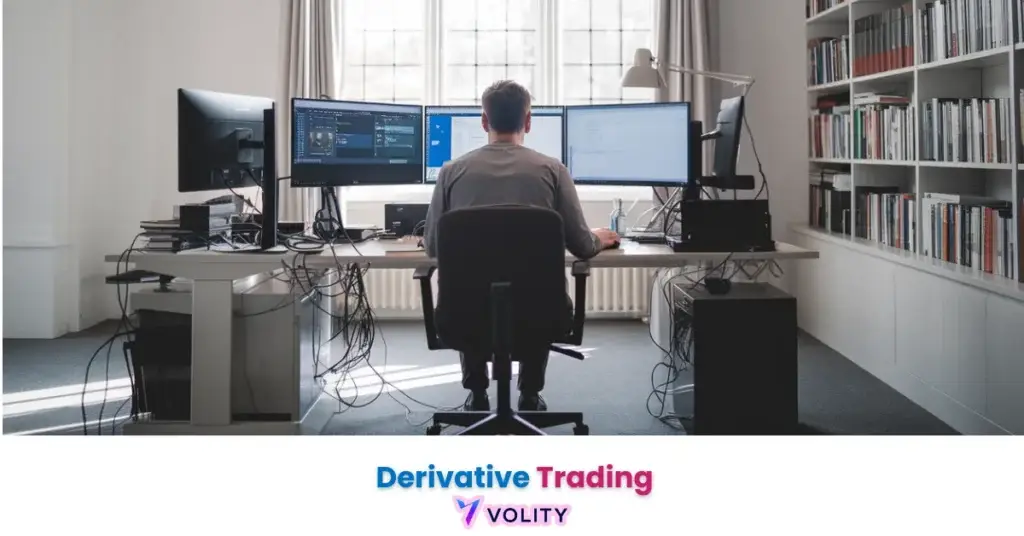
Derivative trading is the practice of buying and selling contracts whose value is derived from an underlying asset like stocks, currencies, or commodities. Statistics from mid-2025 show a record $845.7 trillion in global notional outstanding value, driven by institutional hedging and speculative activity in increasingly volatile global interest rate markets.
While understanding Derivative Trading is important, applying that knowledge is where the real growth happens. Create Your Free Forex Trading Account to practice with a free demo account and put your strategy to the test.
By Volity Editorial, Volity research desk.
What our analysts watch: Three structural numbers reveal where the derivative book is really running. Cleared versus uncleared notional split shows how much risk is sitting inside CCP default funds rather than bilateral credit support annexes. Initial-margin add-ons under the BCBS-IOSCO uncleared margin rules tell us when bank balance sheets are tightening on the margins. And open-interest concentration in the top three CME complexes signals whether positioning is broad based or skewed before a major macro print. Practitioners who track these three together rarely get blindsided by a structural unwind.
Ready to Elevate Your Trading?
You have the information. Now, get the platform. Join thousands of successful traders who use Volity for its powerful tools, fast execution, and dedicated support.
Create Your Account in Under 3 MinutesWhy do traders and corporations use derivatives in 2026?
Traders use derivatives to execute risk management strategies, speculate on directional price moves, and gain leveraged exposure to expensive assets. Hedging enables corporations to lock in prices against future volatility. A European aerospace firm earning revenue in US dollars uses currency derivatives to “fix” the USD/EUR exchange rate, ensuring that a 10% currency decline does not wipe 10% from annual profit. Speculation leverages small capital into disproportionate gains; a $5,000 margin deposit controls a $100,000 oil futures position, capturing 1,000% gains if oil rises 10%.
The gross market value of derivatives rose 29.5% in 2025 to $21.8 trillion, reflecting increased costs for replacing volatile contracts as market participants hedged unprecedented energy and interest rate swings (Source: BIS, 2025). margin and leverage mechanics explains how leverage multiplies both capital gains and drawdown risk.
ISDA Research on OTC Derivatives 2025 provides institutional hedging trends and volatility cost analysis.
What are the main types of derivatives in modern finance?
The main types of derivatives consist of futures, options, forwards, and swaps, each serving a distinct purpose in portfolio construction. Futures are standardized, exchange-traded contracts obligating both parties to settle at a future date. Oil futures obligate the buyer to accept delivery (or cash settlement) on the contract expiration date. Options grant the right, but not obligation, to buy (call) or sell (put) an asset at a predetermined strike price. A Tesla call option gives the holder the right to purchase shares at $150 by March 2027; if Tesla rises to $180, the call gains $30 in intrinsic value.
Swaps are private agreements between two institutions to exchange cash flows, typically used to convert floating-rate debt to fixed-rate or to manage currency mismatches. Forwards function as customized OTC versions of futures, where large corporations negotiate bespoke terms for delivery dates and quantities. Master options trading strategies covers how call and put contracts serve different portfolio objectives.
ESMA guidance on derivatives risk management under EMIR outlines regulatory frameworks for fund managers.
How do corporations use derivatives for real-world hedging?
Real-world hedging is the institutional application of derivatives to stabilize financial results against unfavorable fluctuations in exchange or interest rates. Currency hedging allows aerospace firms managing multi-billion dollar EUR/USD exposure to eliminate FX volatility from shareholder returns. Interest Rate Swaps enable regional banks to lock in fixed rates, protecting loan income against rising rates. Airlines use commodity derivatives to cap rising jet fuel costs, ensuring stable fuel expenses regardless of crude price movements.
Real hedging example:
Safran, a major aerospace supplier, managed a $58.6 billion currency hedging portfolio as of early 2026. The company targeted a 1.12 EUR/USD rate for 2026 to protect European manufacturing margins, while the market spot rate traded at 1.17. By locking in the 1.12 level through forward contracts, Safran ensured that unexpected euro weakness would not compress operating margins. The hedged rate protected the company’s financial plan, allowing management to commit to capex and hiring decisions despite volatile currency markets. Past performance is not indicative of future results.
interest rate trading strategies explains how interest rate derivatives function across central bank cycles.
What are the major risks of Derivative Trading?
Risks of derivative trading include excessive leverage impact, counterparty default in private contracts, and extreme liquidity gaps during market stress. Leverage risk compounds rapidly; a 1% move in the underlying asset can eliminate 20% of trading capital. A trader holding 20 ES (E-mini S&P 500) contracts with a 1% adverse move faces $20,000 loss against a $10,000 account, triggering forced liquidation. Counterparty risk threatens OTC derivative holders; if a bank fails, forward and swap contracts become unsecured claims in bankruptcy, often recovering cents on the dollar.
Market gaps emerge during crisis volatility when bid-ask spreads widen dramatically and stop-loss orders cannot execute. On March 16, 2020, gold futures gapped down $50 overnight during COVID panic selling, hitting stop-loss orders miles below intended exit levels. BIS OTC Derivatives Statistics at end-June 2025 documents current market notional value and growth trajectories. effective risk management in trading explains position sizing and stop-loss placement discipline.
2025-2026 Global Derivatives Benchmarks (EAV Table)
Global derivatives benchmarks reveal the current scale and growth trajectory of the different asset classes within the OTC market. Interest rate derivatives dominate, reflecting the structural importance of rates in determining corporate valuations and economic conditions. Foreign exchange derivatives rank second, driven by multinational corporate hedging and carry trade positioning.
| Entity | Notional Value (Mid-2025) | YoY Growth | Market Share |
| Interest Rate (IRD) | $665.8 Trillion | +15.0% | 78.7% (Source: BIS) |
| Foreign Exchange (FX) | $155.2 Trillion | +19.5% | 18.3% (Source: BIS) |
| Credit (CDS) | $11.3 Trillion | +22.9% | 1.3% (Source: BIS) |
| Equity-Linked | $10.4 Trillion | +19.7% | 1.2% (Source: BIS) |
| Commodities | $2.6 Trillion | +7.3% | 0.3% (Source: BIS) |
Sources: BIS, 2025-2026
Turn Knowledge into Profit
You have done the reading, now it is time to act. The best way to learn is by doing. Open a free, no-risk demo account and practice your strategy with virtual funds today.
Open a Free Demo AccountKey Takeaways
- Derivative trading reached a record $845.7 trillion in notional outstanding value as of mid-2025, led by interest rate products.
- Corporations like Safran use multi-billion dollar derivative portfolios to hedge against currency and interest rate volatility.
- Futures and options are the primary instruments for retail speculators seeking leveraged exposure to financial markets.
- Over-the-Counter (OTC) derivatives lack the clearinghouse protections of exchange-traded contracts, increasing counterparty risk.
- The 2026 trend toward 0DTE options allows for precise event-based hedging with low upfront premium costs.
- Leverage magnifies both potential gains and losses, making strict position sizing and stop-loss placement mandatory for survival.
Frequently Asked Questions
This article contains references to Derivative Trading and Volity, a regulated CFD trading platform. This content is produced for educational purposes only and does not constitute financial advice or a recommendation to buy or sell any financial instrument. Always verify current regulatory status and platform details before using any trading service. Some links in this article may be affiliate links.
Volity operates a trading platform and also publishes educational and analytical content about trading. The content on this page is for educational purposes only and should not be considered financial advice. Volity may benefit commercially when readers open trading accounts through links on this site.
Our content is produced and reviewed under documented editorial standards; see our comparison and review methodology.

![How to Invest in Precious Metals: [Gold, Silver]](https://volity.io/wp-content/uploads/2024/12/Invest-in-Precious-Metals-like-gold-768x402.webp)