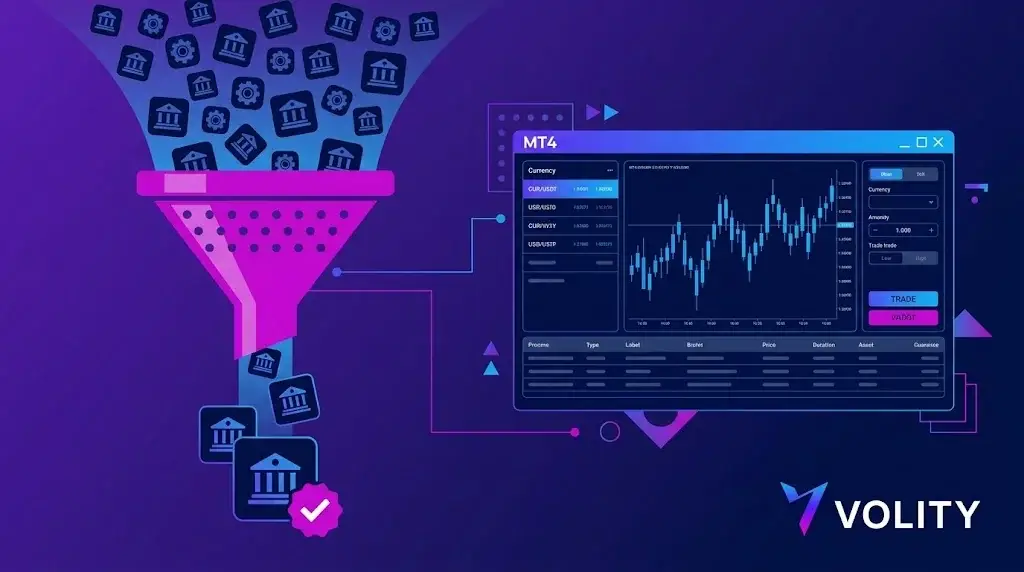
Quick answer
Choosing an MT4 broker comes down to a few checks that marketing rarely highlights: recognised regulation you can verify on a public register, real spreads measured during busy sessions, a declared execution model, transparent costs and clean withdrawals. Before you open an account, run every candidate through the same filter. If your priority is fast execution and tight spreads rather than the MetaTrader terminal itself, Volity is worth a look: it runs its own platform, Volity MT, under CySEC 186/12 via UBK Markets, with leverage up to 1:500 (product-dependent). You can open an account for $0, start investing from $1, and place your first trade from $1.
Investing in financial products involves risk. Losses may exceed the value of your original investment.
Trading carries risk. Prices move against you as well as in your favour, and leveraged products magnify both. Past performance does not predict future results. Never trade money you cannot afford to lose, and always verify a broker’s regulatory status before you fund an account.
An MT4 broker is a brokerage that offers the MetaTrader 4 terminal. The platform is popular, but the platform is not the broker: what protects your money and your fills is regulation, execution quality and transparent pricing behind whichever terminal you use. This guide gives you a filter for choosing any broker, and explains where Volity fits for traders who care more about execution and cost than about a specific piece of software. Volity runs its own platform, Volity MT, rather than MetaTrader.
MetaTrader 4 has been a default retail terminal for years, which is why so many traders search for the best MT4 broker. The trap is treating the software as the decision. The terminal is the same across most providers; what differs, and what actually determines your outcomes, is the broker behind it: how it is regulated, how it executes your orders, and what it really costs to trade. Get those right and the terminal becomes a detail.
This page lays out a practical filter for choosing a broker, whether you settle on an MT4 broker or a provider running its own platform. It also explains where Volity sits. Volity does not offer the MetaTrader terminal; it runs its own platform, Volity MT, focused on fast execution, tight spreads and multi-market access under CySEC 186/12 oversight via UBK Markets, with entities in Saint Lucia and Cyprus.
While understanding Choosing a Broker is important, applying that knowledge is where the real growth happens. Create Your Free Forex Trading Account to practice with a free demo account and put your strategy to the test.
What is an MT4 broker?
An MT4 broker is a brokerage that gives clients access to MetaTrader 4, a charting and order-execution terminal built by MetaQuotes. Traders choose it for familiar charts, custom indicators and the long-running MQL4 ecosystem of automated strategies. A forex broker with MT4 is common because the platform became a de facto standard, but that ubiquity is exactly why the platform alone tells you very little about the quality of the broker offering it.
The important distinction is between the terminal and the venue. Two brokers can both be an MT4 forex broker and yet differ enormously in regulation, spreads, execution and withdrawal reliability. That is the gap this filter is designed to expose.
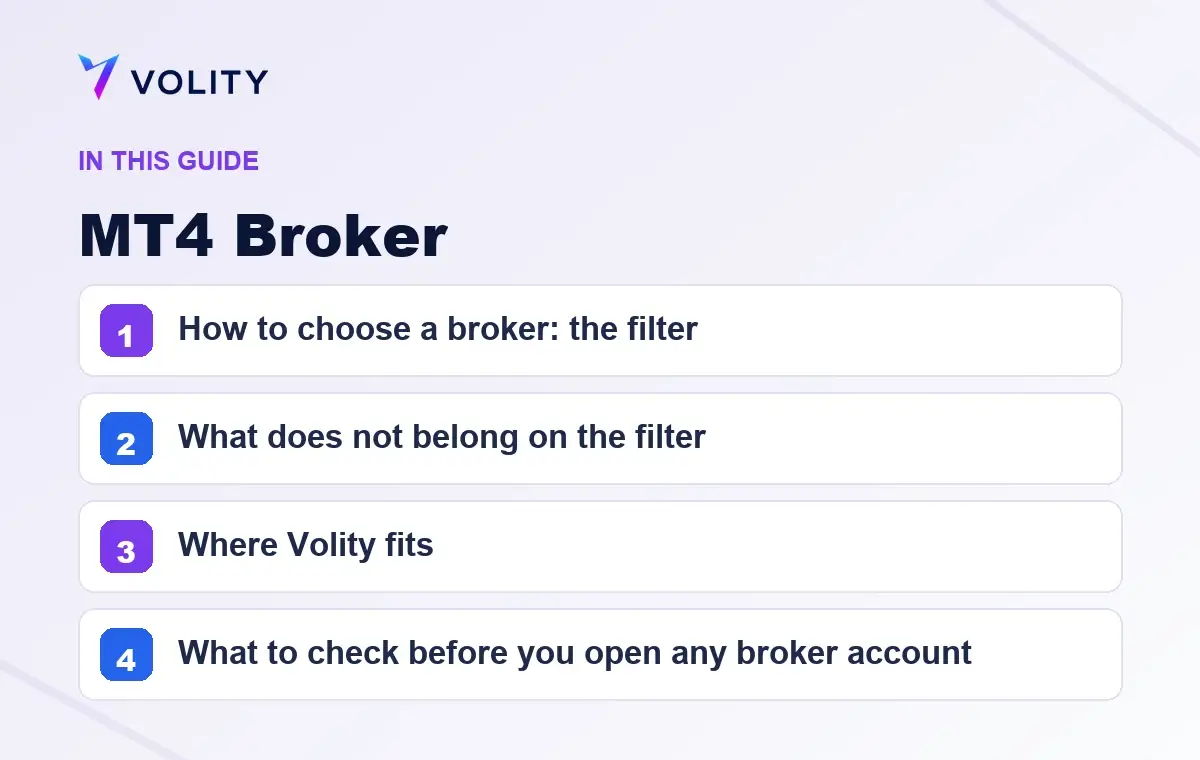
How to choose a broker: the filter
Score any broker, MT4 or otherwise, against these checks before you fund an account:
- Regulation you can verify. A recognised licence, with the number matching the regulator’s public register exactly. Check CySEC at cysec.gov.cy and the FCA at register.fca.org.uk.
- Declared execution model. The broker should disclose how orders are handled in its order-execution policy. A provider that hides the model benefits from your confusion about it.
- Real spreads, not marketing spreads. Headline spreads are quoted in quiet conditions. Watch the spread on your main markets around the London and New York sessions and major news.
- Transparent all-in cost. Spread plus any commission plus overnight financing. Compute it on your typical trade.
- Negative balance protection. The clause should be explicit, so you cannot lose more than the funds in your account.
- Clean, prompt withdrawals. A legitimate broker returns your money on a published timeframe without invented conditions.
Our full how to choose a broker guide expands each of these into a scored framework you can apply in an afternoon.
💡 KEY INSIGHT: The platform is not the broker. Whether you use MetaTrader 4 or a proprietary terminal, your fills, your costs and the safety of your funds are set by the venue behind it. Filter on regulation and execution first, and treat the software as a preference.
Ready to Elevate Your Trading?
You have the information. Now, get the platform. Join thousands of successful traders who use Volity for its powerful tools, fast execution, and dedicated support.
Create Your Account in Under 3 MinutesWhat does not belong on the filter
Three things attract attention and deserve none:
- Deposit bonuses. Bonuses with volume clawbacks are usually net-negative for a serious account.
- Award badges. Many trading awards are paid placements and rarely correlate with execution quality.
- Affiliate rankings. The top names in a sponsored best-broker list often reflect the largest commission paid, not the tightest desk.
Where Volity fits
Volity is not an MT4 broker. It runs its own platform, Volity MT, on web and mobile, rather than the MetaTrader terminal. That matters if what you are really searching for behind the words best MT4 broker is fast, dependable execution and tight spreads, because those are platform-independent qualities, and they are the point of Volity MT.
- Regulation. Volity trades under CySEC 186/12 via UBK Markets, verifiable on the CySEC register, with entities in Saint Lucia and Cyprus.
- Execution and spreads. The Volity MT engine is built for fast fills and readable pricing across forex, indices, commodities, shares and crypto from one account.
- Leverage. Volity offers leverage up to 1:500 (product-dependent), so the available ratio depends on the instrument and account. Leverage magnifies losses as much as gains, so size positions carefully.
- Low barrier to start. Open an account for $0, start investing from $1, and place your first trade from $1.
If you specifically need the MetaTrader 4 terminal and its MQL4 automation, a dedicated MT4 broker is the right tool, and this filter will help you pick a good one. If you care most about execution, cost and multi-market access, compare Volity MT against them on the criteria that actually move your results.
Whichever route you choose, demo first. Spend a week watching real spreads at session change and news, and test withdrawals with a small balance before committing serious capital. The cheapest due diligence in trading is the time it takes.
What to check before you open any broker account
- Verify the licence. Match the licence number to the regulator’s public register, not just the broker’s own claim.
- Read the execution policy. Know how your orders are handled before you fund.
- Measure real costs. Track spreads at the times you actually trade, then add commission and financing.
- Test a withdrawal. A small, clean withdrawal early tells you more than any review.
WARNING: Be wary of anonymous offshore brokers advertising extreme conditions or guaranteed returns, and of any provider whose licence number does not match the regulator’s register. Verify regulatory status before you transfer a penny.
Turn Knowledge into Profit
You have done the reading, now it is time to act. The best way to learn is by doing. Open a free, no-risk demo account and practice your strategy with virtual funds today.
Open a Free Demo AccountKey Takeaways
- An MT4 broker offers the MetaTrader 4 terminal, but the platform is not what protects your money or your fills.
- Filter every broker on verifiable regulation, declared execution, real spreads, transparent costs and clean withdrawals.
- Ignore bonuses, award badges and affiliate rankings; none correlate with execution quality.
- Volity is not an MT4 broker: it runs its own platform, Volity MT, focused on fast execution and tight spreads.
- Volity trades under CySEC 186/12 via UBK Markets, with leverage up to 1:500 (product-dependent).
- You can open a Volity account for $0, start investing from $1, and place a trade from $1.
Frequently Asked Questions
This article explains how to choose a broker when searching for an MT4 broker, and how Volity compares. It is produced for educational purposes only and does not constitute financial advice or a recommendation to trade any particular market or instrument. Volity runs its own platform, Volity MT, and does not offer the MetaTrader terminal. Trading carries a risk of loss, and leverage increases it. Always understand the risks and verify regulatory status before opening an account.
Volity operates a trading platform and also publishes educational and analytical content about trading. The content on this page is for educational purposes only and should not be considered financial advice. Volity may benefit commercially when readers open trading accounts through links on this site.
Our content is produced and reviewed under documented editorial standards; see our comparison and review methodology.