Investing in financial products involves risk. Losses may exceed the value of your original investment.
Quick answer
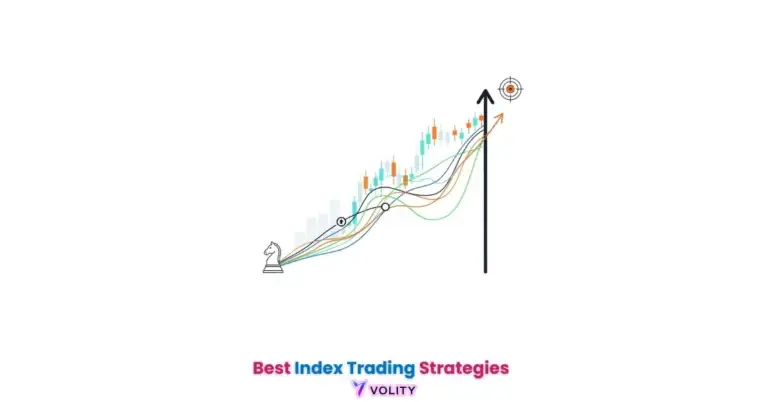
Indices trading is leveraged speculation on stock-market baskets like the S&P 500, NASDAQ 100, DAX 40, and FTSE 100, typically through CFDs or futures. Indices reduce single-stock risk through diversification, trade with tight spreads, and run 23 hours daily on CFD venues. Retail leverage is capped at 1:20 on majors under EU rules.
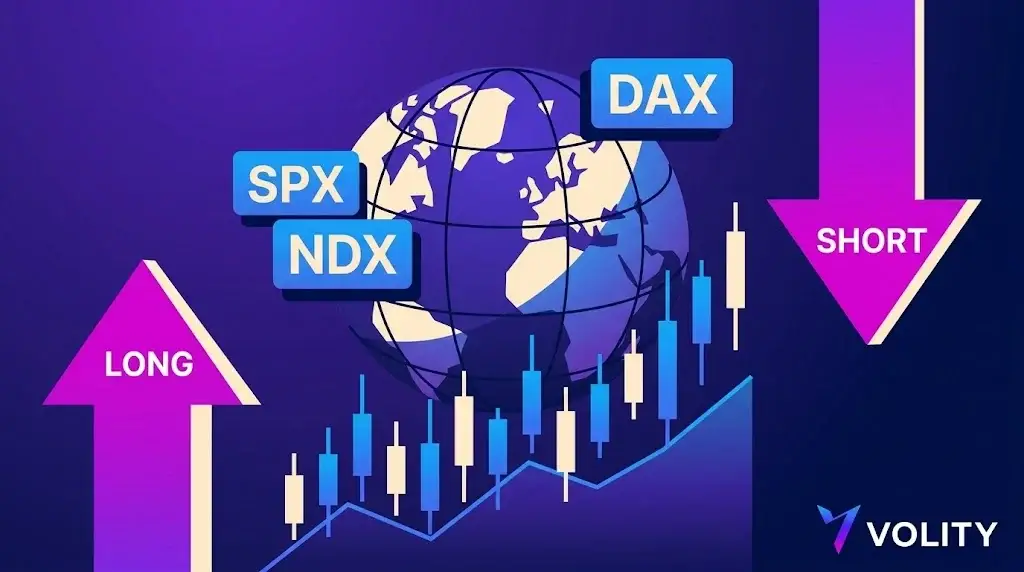
Indices trading is taking a long or short position on the value of a stock-market index (S&P 500, Nasdaq 100, FTSE 100, DAX, Nikkei 225) via a derivative such as a futures contract, an index ETF, or a CFD. You never own the underlying basket of stocks. You profit or lose on the price difference between your entry and exit, scaled by your contract size.
The four most common ways to trade an index
- Index futures. Standardised contracts on the CME, Eurex, ICE. High notional per contract (S&P E-mini = $50 x index level). Used by institutional flow.
- Index ETFs. Listed funds that track the index (SPY, QQQ, EWG). Cash equity. No expiry. Suit longer-term holders.
- Index CFDs. Cash-settled derivatives that mirror the index price. Smaller minimum size, no expiry rolling, available on broker platforms. Suit retail directional traders.
- Index options. The right but not obligation to buy or sell at a strike. Used for defined-risk strategies and volatility plays.
What moves an index
- Macro releases. CPI, NFP, GDP, FOMC. Tier-one releases can move major indices 1-3% in minutes.
- Earnings season. The largest index components (mega-cap tech for Nasdaq, banks for FTSE) drive disproportionate moves.
- Sector rotation. Risk-on flows into Nasdaq, risk-off flows into Dow or FTSE. The cross-spread is itself a tradeable view.
- Liquidity events. Quad-witch days, index rebalances, ETF flows. Predictable volume, less predictable direction.
The cost stack
- Spread. On major indices, 0.5-2 index points typical retail spread.
- Commission. Often built into the spread on CFDs; explicit on futures.
- Overnight financing. CFD positions held past the daily cut-off pay or earn financing on the notional. Long positions pay; short positions earn or pay depending on the rate.
- Slippage. Around macro releases the spread widens 5-10x for 30-90 seconds.
When does indices trading make sense?
- Macro view, not stock-picking. You think US large-cap will outperform but do not want to pick names. Buy SPX exposure.
- Hedge a single-name portfolio. Long a basket of US stocks, short S&P futures or CFDs to neutralise market direction.
- Trade event risk. Earnings season, central-bank meetings, election nights. Indices distil the macro noise.
- Diversification. One position gives exposure to 30-500 underlying companies.
What goes wrong
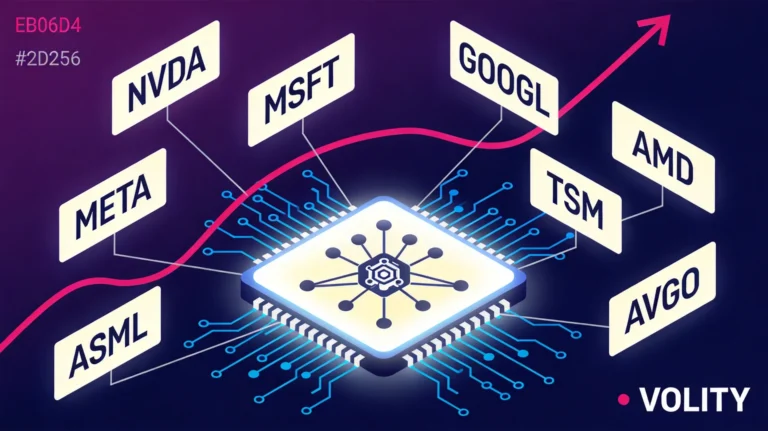
- Concentration inside the index. The S&P 500 is now 30%+ weighted to the top 10 stocks. A bet on the index is largely a bet on mega-cap tech.
- Overnight gaps. Cash indices trade only during exchange hours; CFD pricing continues but liquidity is thin overnight. A weekend headline can produce a 2-3% Monday gap that bypasses stops.
- Leverage abuse. The 1:20 retail cap on major indices is generous. A 1:20 position on a 5% adverse move wipes 100% of margin.
- Holding-cost drag. Long index CFDs held for months bleed financing every night. Equity-market drift up to 8-10% per year minus 4-6% financing leaves a thin net.
Indices at Volity
Volity offers CFD exposure to major equity indices: S&P 500, Nasdaq 100, Dow Jones, FTSE 100, DAX, CAC 40, IBEX 35, Euro Stoxx 50, Nikkei 225, Hang Seng, ASX 200. Trading is executed by UBK Markets Ltd, a Cyprus Investment Firm authorised by CySEC under licence 186/12. Retail leverage on major indices is capped at 1:20, on non-major indices at 1:10, under ESMA product-intervention measures. Negative balance protection applies. Eligible retail clients are covered by the Cyprus Investor Compensation Fund up to EUR 20,000 per client per firm.
Volity operates a trading platform and also publishes educational and analytical content about trading. The content on this page is for educational purposes only and should not be considered financial advice. Volity may benefit commercially when readers open trading accounts through links on this site.
Our content is produced and reviewed under documented editorial standards; see our comparison and review methodology.
Frequently asked questions
What am I actually trading when I trade an index?
Exposure to the aggregate movement of the constituent shares, weighted by the index methodology. You do not own the shares; you take a position on the level of the index through a derivative such as a CFD or a future.
Why do index prices move outside stock market hours?
Because index derivatives trade for longer than the underlying cash market. Between the cash close and the next open, the derivative reflects overnight news and other markets, which is what produces the opening gap.
What moves a stock index most?
The largest constituents, because most major indices are weighted by market capitalisation. A move in a handful of the biggest companies can drive the index level even when the majority of constituents are flat or falling.