Starting with tiny amounts can create a false sense of progress, a $100 monthly investment takes 7-10 years to grow to meaningful capital accumulation, risking the investor’s psychological abandonment of the strategy when patience wanes. Dollar-cost averaging can mask losses during extended bear markets, an investor who faithfully invested through 2022’s -18% correction will experience years of underwater positions, testing emotional discipline. Fractional shares introduce custody and tax-reporting complexity that many retail investors underestimate, particularly during inherited account transitions or emergency liquidations. Past performance is not indicative of future results. Capital at risk.
Stock investing identifies the strategic allocation of capital into publicly traded companies to capture long-term growth and dividend income. In 2026, the barrier to entry has been permanently lowered by fractional shares and no-fee brokerage models, allowing beginners to start with as little as $100. For the practical steps, see how to buy shares in the UK. To buy a single FTSE 100 name, see our guide on how to buy Shell shares. BP is another FTSE 100 energy major; see how to buy BP shares. By utilizing Dollar-Cost Averaging (DCA) and low-cost index ETFs, new investors can harness the power of compound interest while neutralizing the emotional risks of market timing and high-frequency volatility.
While understanding Beginner Investing Principles is important, applying that knowledge is where the real growth happens. Create Your Free Forex Trading Account to practice with a free demo account and put your strategy to the test.
Can you start investing with only $100 in 2026?
Fractional share investing is a brokerage feature that allows investors to purchase portions of a single stock, identifying the most accessible entry point for beginners with limited capital. You can own 0.01 share of a $4,000 stock (e.g., Berkshire Hathaway Class B equivalent), turning a $1 allocation into fractional ownership of a global giant. This mechanism has permanently transformed stock market accessibility, enabling retirement account accumulation from literally any starting capital amount.
Ownership democratization means that you can own 0.01 share of a $4,000 Booking Holdings equivalent rather than waiting years to save $4,000 for a whole share. The compounding arithmetic reveals why starting early matters infinitely more than starting large, a $100 monthly contribution compounding at 8% annually grows to $100,000 in approximately 11 years, while waiting 5 years to start and then investing $100 monthly requires 16 years to reach the same total.
In 2026, 92% of top-tier US brokerages offer fractional shares for as little as $1, making stock ownership accessible to anyone with a smartphone and a bank account (Fidelity Beginner Trends, 2026). The inflation-adjusted purchasing power of $100 in 2026 is equivalent to $60 in 2010 dollars, yet current fractional investing makes that $100 vastly more useful than $600 in 2010 was.
The Cost of Waiting vs. Starting Early
The opportunity cost of waiting identifies the permanent loss of compounding power that occurs when investors delay their first transaction. A 25-year-old who invests $5,000 immediately and then never adds another dollar will have more money at retirement than a 30-year-old who invests $1,000 per year for 35 years, purely due to the power of compound interest over decades.
The “Rule of 72” calculation reveals that at 8% annual returns, capital doubles every 9 years, meaning a 35-year-old with $50,000 and a 60-year-old with $50,000 follow completely different wealth trajectories. One experiences 3 more doublings (~8x growth), while the other experiences only 1.
Ready to Elevate Your Trading?
You have the information. Now, get the platform. Join thousands of successful traders who use Volity for its powerful tools, fast execution, and dedicated support.
Create Your Account in Under 3 MinutesTax-advantaged accounts identify the specific legal structures, such as the Stocks and Shares ISA, that allow investors to grow their wealth while minimizing future capital gains liabilities. A Stocks and Shares ISA lets you invest up to £20,000 per tax year (2026/27 allowance) and pay no UK tax on any gains or income it generates, creating a long-term tax-free compounding machine. A standard brokerage account provides immediate liquidity and no contribution limits, but forces you to pay annual capital gains taxes on winning positions.
Standard brokerage accounts offer maximum flexibility, you can withdraw funds at any time without penalty, making them ideal for investing that 6-month emergency fund or saving for a house deposit. Stocks and Shares ISA contributions offer tax efficiency for long-term capital that you want to shelter as it compounds. FSCS protection currently covers eligible investor assets up to £85,000 per person, per authorised firm, in the event of a broker failure, identifying a critical layer of systemic safety (FSCS Official Guide, 2026).
Diversification serves as the foundational strategy that protects your capital by spreading it across uncorrelated assets.
How to Build a Simple “Core-and-Satellite” Portfolio
Core-and-satellite construction identifies a portfolio strategy that balances a diversified index ETF foundation with small allocations to individual growth stocks. The ETF core represents 80% of your capital in a broad-market vehicle like the Vanguard Total Stock Market ETF (VTI), providing instant diversification across thousands of companies with a single trade. The stock satellite represents 20% in individual high-conviction names, allowing you to participate in specific company stories without taking concentrated risk.
Asset allocation mechanics require deciding between a 60/40 (Stocks/Bonds) mix for conservative capital preservation or 100% equity for younger investors with 30+ year horizons. A 25-year-old can comfortably hold 100% stocks, as any 2026 crash will be recovered by 2035-2040; a 60-year-old approaching retirement should hold 40% bonds to buffer volatility and provide predictable income.
Real trading example: A beginner investor started with $500 in March 2026, allocating 80% to VTI and 20% to fractional shares of a high-conviction tech leader. By utilizing Dollar-Cost Averaging through the March geopolitical shock, the investor lowered their average cost basis, resulting in a 12% portfolio gain by May as the broad market recovered. Past performance is not indicative of future results.
2026 Beginner Investing Benchmarks: Growth and Risk
Historical performance benchmarks identify the realistic range of returns and drawdowns that a beginner should expect over a full market cycle.
| Portfolio Type | 2026 Est. Return | 10-Year Avg | Max Drawdown (Hist) | Risk Profile |
| All-Equity ETF | +12.4% | +10.2% | -34% (COVID) | Aggressive |
| 60/40 Balanced | +8.5% | +7.4% | -18% (2022) | Moderate |
| Conservative MM | +4.5% | +2.1% | 0% | Low (Liquidity) |
| Growth Satellite | +18.2% | +15.5% | -50% (Tech) | Very High |
| Global Dividend | +9.2% | +8.1% | -22% | Moderate-Income |
Source note: Data compiled from Vanguard Investor Trends and BlackRock 2026 Capital Market Assumptions.
The benchmarks reveal that all-equity portfolios have historically returned 10%+ annually, while 60/40 balanced portfolios deliver 7-8% with dramatically lower volatility. A beginner starting at age 25 with an all-equity portfolio will experience multiple -20% corrections before retirement, but historical data shows complete recovery and further gains within 1-3 years for each crash.
**
The Power of Dollar-Cost Averaging (DCA)
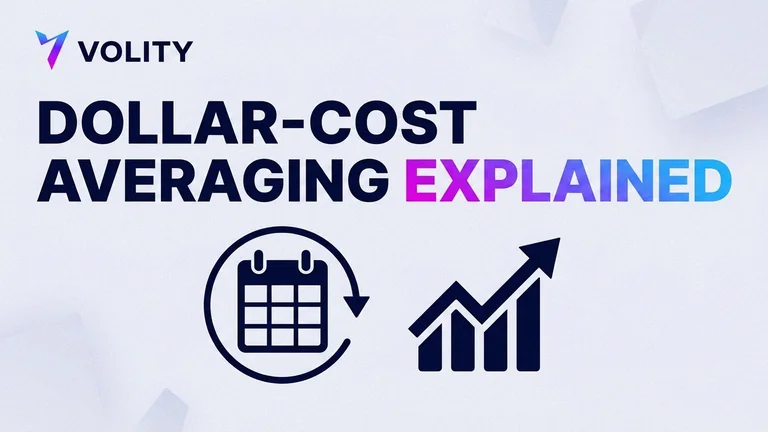
Dollar-cost averaging identifies the disciplined strategy of investing a fixed amount of money at regular intervals, regardless of market price fluctuations. Rather than trying to time your entry at the “market bottom,” you invest $200 every paycheck automatically, this forces you to buy more shares when prices are low and fewer when prices are high, mathematically guaranteeing a lower average cost basis over time.
Neutralizing volatility mechanics mean that when the market drops 20%, your DCA buys more shares at 20% discounts, and when it rallies 20%, your next purchase pays full price. Over 10-30 years, this mechanical approach eliminates the emotional burden of deciding “whether now is a good time to buy,” as you eliminate the decision itself through automation. Eliminating timing risk reveals why “Time in the Market” beats “Timing the Market” for 90% of investors, you cannot predict the 10 best days of 2026, but if you invested every single day, you’d capture them automatically.
**
Portfolio Rebalancing during bull markets ensures you automatically lock in gains and reduce concentration risk.
Turn Knowledge into Profit
You have done the reading, now it is time to act. The best way to learn is by doing. Open a free, no-risk demo account and practice your strategy with virtual funds today.
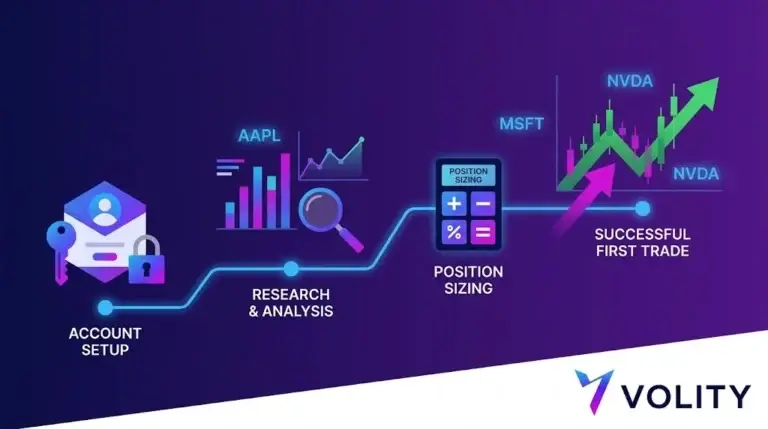
Open a Free Demo AccountStep-by-Step: How to Execute Your First Trade
Order execution represents the final mechanical step in the investing process, requiring a choice between market and limit orders for price control. A market order executes immediately at the current “Ask” price, if you’re buying VTI and the bid-ask spread is $180-$181, your market order fills at $181. A limit order sets a maximum price you’re willing to pay (e.g., “buy VTI at $179.50 or less”), protecting you from slippage during volatile opens, but carrying the risk of non-execution if price never drops to your limit.
The “Five-Minute Audit” means reviewing your trade confirmation to ensure no unintended fees were applied, verify the quantity of shares received, the price paid, and the total cost. Most brokers now offer zero commissions, but some maintain “operational fees” of $0.50-$2 per trade, so audit the confirmation before celebrating your first investment.
How to Analyze Shares teaches you to evaluate individual holdings you’ve added to your satellite allocation. What are Bonds explains how to integrate fixed income for investors moving toward a 60/40 allocation.
Key Takeaways
- [Stock investing] is the most effective way to build long-term wealth by harnessing the power of compound interest and corporate growth.
- [Fractional shares] have democratized the market in 2026, allowing beginners to own high-value stocks with an investment as low as $1.
- [Dollar-Cost Averaging] (DCA) reduces market risk by spreading purchases over time, ensuring a lower average cost basis across market cycles.
- [Index ETFs] provide instant diversification, serving as the “core” foundation for a resilient and low-maintenance beginner portfolio.
- [Tax-advantaged accounts] like the Stocks and Shares ISA identify the superior vehicle for long-term growth, offering tax-free gains and income.
- [Consistency] is more important than capital size; regular monthly contributions are the primary driver of achieving a six-figure net worth.
Frequently Asked Questions
This article contains references to Stocks Investing for Beginners and Volity, a regulated CFD trading platform. This content is produced for educational purposes only and does not constitute financial advice or a recommendation to buy or sell any financial instrument. Always verify current regulatory status and platform details before using any trading service. Some links in this article may be affiliate links.