Investing in financial products involves risk. Losses may exceed the value of your original investment.
Quick answer
Synthetic indices are simulated price feeds generated by a broker’s algorithm, not derived from real stock baskets or external markets. They trade 24/7 on certain offshore brokers and offer fixed volatility profiles (Volatility 75 Index, Boom and Crash Indices). Counterparty risk is concentrated entirely at the broker since no external market exists; regulated jurisdictions like the EU restrict or prohibit them.
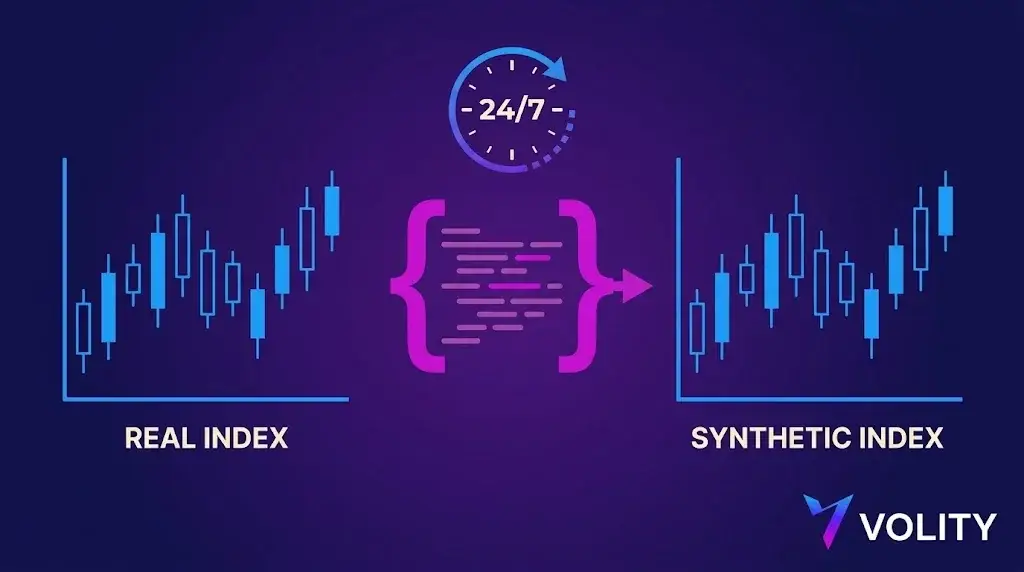
Synthetic indices are algorithmically generated price series designed to mimic the statistical behaviour of real markets (volatility, jumps, range-bound action) without referencing any actual underlying assets. The price feed is produced by a random number generator with cryptographic verification, runs 24/7 with no holiday gaps, and is unaffected by news, earnings, or central-bank decisions. They are a derivative product, not an index in the traditional sense.
How synthetic indices are constructed
- Volatility indices. Tick-by-tick prices generated to maintain a constant annualised volatility (commonly 10%, 25%, 50%, 75%, 100%).
- Crash and boom indices. Slow grind in one direction with rare large jumps in the opposite direction. Designed to test stop-loss discipline.
- Step indices. Equal-probability up or down steps of fixed size. The simplest random-walk model.
- Range break indices. Price oscillates inside a band; once per N intervals on average it breaks the band.
- Jump indices. A baseline volatility plus periodic discrete jumps of fixed magnitude.
Synthetic vs real indices: the differences
- No underlying. A real index (S&P 500, FTSE 100, DAX) is a basket of listed equities. A synthetic index is a number stream with no economic referent.
- 24/7 trading. No market open, no close, no weekend gap.
- No fundamental drivers. Earnings, GDP, interest-rate decisions move real indices. They do not move synthetic ones.
- Constant statistical properties. A synthetic volatility index is engineered to maintain its volatility regime. A real index drifts between regimes.
- Counterparty model. The price feed is provided by the broker or a third-party RNG. The trader takes feed-integrity risk.
What synthetic indices are useful for
- Strategy stress-testing. A scalping strategy can be back-tested against a continuous, regime-stable price stream.
- Out-of-hours trading. When real markets are closed, synthetic indices remain liquid.
- News-immune positions. A trader who wants pure technical exposure without fundamental shocks.
- Education. Beginners learn order types, position sizing, and stop placement without macro context to memorise.
When does trading synthetic indices make sense?
- You have a technical strategy that needs a clean test environment.
- You trade outside regular market hours and want a liquid, regulated alternative to thin overnight forex.
- You are training on order management without the noise of macro releases.
- You understand the product is a contract on a generated number stream, not a basket of stocks.
What goes wrong
- Confusion with real indices. Treating Synthetic Volatility 75 like the S&P 500. The instruments behave differently and the analysis frameworks do not transfer one-for-one.
- Pattern-projection. A trader sees a head-and-shoulders on a synthetic feed. The pattern has no fundamental meaning. Probabilistic edge has to be tested, not assumed.
- Crash-and-boom blow-ups. Selling crash indices on every grind-up looks profitable until the inevitable jump erases six months of gains in one tick.
- Regulatory availability. Synthetic indices are restricted in some jurisdictions including parts of the EU. Always check whether the product is available to retail clients in your country before opening a position.
Indices at Volity
Volity offers CFD exposure to major real-world equity indices including the S&P 500, Nasdaq 100, Dow Jones, FTSE 100, DAX, CAC 40, Nikkei 225, Hang Seng, and Australia’s ASX 200. Trading is executed by UBK Markets Ltd, a Cyprus Investment Firm authorised by CySEC under licence 186/12. Retail leverage on major indices is capped at 1:20 under ESMA product-intervention measures. Negative balance protection applies. Eligible retail clients are covered by the Cyprus Investor Compensation Fund up to EUR 20,000 per client per firm.
Volity operates a trading platform and also publishes educational and analytical content about trading. The content on this page is for educational purposes only and should not be considered financial advice. Volity may benefit commercially when readers open trading accounts through links on this site.
Our content is produced and reviewed under documented editorial standards; see our comparison and review methodology.
Frequently asked questions
Are synthetic indices linked to real markets?
No. A synthetic index is generated from a defined statistical process rather than from the prices of underlying securities, so it does not respond to earnings, economic releases or market sentiment.
Why do synthetic indices trade continuously?
Because there is no underlying exchange to close. The price series is produced continuously, which means there are no session gaps but also no fundamental reference point for judging value.
How is the price of a synthetic index produced?
By a defined random process running to published parameters, with the volatility characteristic set by the product. Because the generator is specified in advance, the statistical behaviour is stable even though each price path is unique.