Investing in financial products involves risk. Losses may exceed the value of your original investment.
Quick answer
The most effective index trading strategies for 2026 are trend following, swing trading, range trading, breakout trading, scalping, moving-average crossover, and AI-assisted trading. Indices like the S&P 500 and NASDAQ 100 offer broad diversification and lower volatility than individual stocks. Effective risk management caps position size at 1% to 2% of capital per trade.
Index trading stays popular for its stability, global access, and safe-haven appeal.
Study macro data and choose indices that match your expertise.
Use trend, swing, range, breakout, scalping, moving averages, or AI trading.
Apply stop-losses, diversify, and use tools like RSI, MACD, and Bollinger Bands.
Don’t overtrade, overleverage, or mix too many strategies, stay disciplined.
The Best Index Trading Strategies in 2026-2026
There are many trading strategies which can be used to create a well-rounded (and profitable) portfolio. However index trading has proven to represent one of the most popular approaches due to specific qualities such as reduced volatility, access to global markets, and relatively low costs. Trading indices is likewise a useful way to hedge against assets associated with higher levels of volatility (cryptocurrencies and Forex pairs are two potential examples). Discovering more about what index trading is and partnering with a qualified index trading broker also provides investors with a host of tools that can dramatically streamline the process. However, it is first wise to highlight why index trading has become such a popular methodology in 2026-2026 before moving on to discuss a wide range of effective strategies that can be immediately incorporated into your overall approach. If you are new to index trading, or simply wish to learn more, the information that has been collated below by Volity will certainly come in handy.
Why Trade Indices in 2026-2026?
So, why are indices beginning to take centre stage in terms of 2026 trading trends? Perhaps the most logical reason is actually one that has always been attributed to this marketplace. Indices represent relatively low-risk positions, making them ideal for a more conservative investment strategy. Furthermore, historical index movements can often be used to predict future trends with a fair amount of accuracy. 2026 could be a particularly beneficial year to become involved with index trading, as some experts are wary about increasing levels of open-market volatility. Others have cited the heightened probability of bearish reversals in sectors such as technology, and artificial intelligence. While these do not necessarily signal that any type of recession is looming, the fact of the matter is that times of market uncertainty will often cause investors to seek safe havens. Indices inevitably fall into this category.
Key Factors to Consider Before Choosing a Trading Strategy
Similar to any approach to investing, knowledge is power. This is when education naturally comes into play. It is always prudent to select an index that offers a degree of familiarity. For instance, those who are already involved with technology-based assets could opt for indices such as the S&P 500, or the NASDAQ 100. Another useful tip involves becoming comfortable with analysing macroeconomic data. Examples include (but are not limited to):
- Inflation
- Interest rates set by central banks
- Bond yields
- Labour market statistics
- Retail sales figures
It is a well-known fact that these variables can impact the momentum of an index, so maintaining a proactive approach is the best way to keep abreast of the latest news. Finally, we need to mention risk appetite. While index trading is normally associated with lower levels of perceived volatility, remember that this is relative. There can still be times when sudden swings may occur within a short period of time. Some indices are likewise more volatile than others. The S&P 500, and the NASDAQ 100 are two examples.
The Top Index Trading Strategies in 2026-2026
There is little doubt that the most effective (and reliable) index trading strategy is to work in tandem with a qualified index trading broker. Notwithstanding this somewhat obvious observation, there are specific approaches that have proven their merit over time. We will now delve into the finer points by examining seven powerful tools at your disposal.
Following Trends
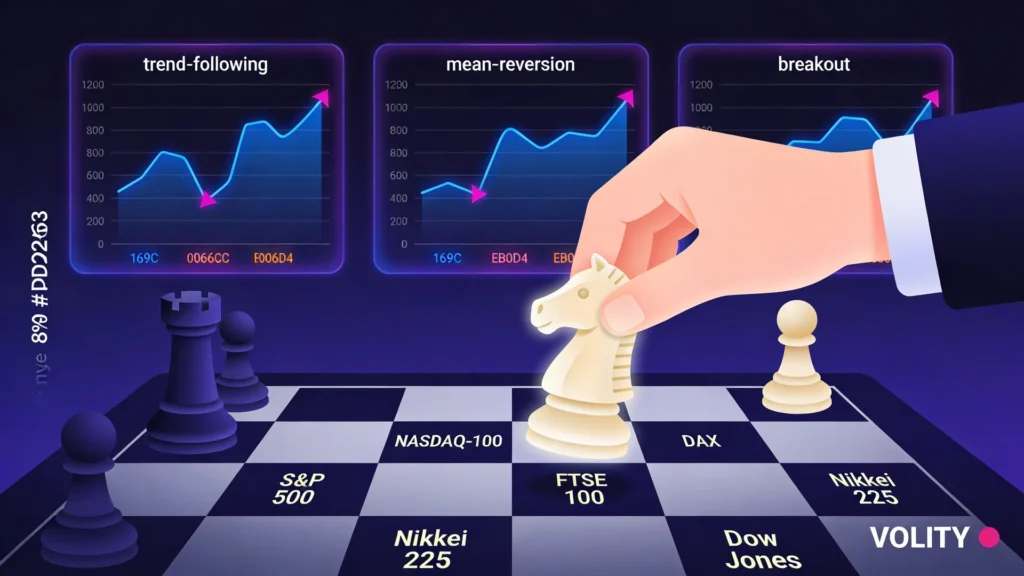
This is (arguably) the most straightforward approach, and it is often employed by those who are new to indices. Trend-based trading simply involves following the direction of broad market trends (bullish, bearish, or neutral). Investors can then decide the best time to become involved. Most will also enter into a trade once they have confirmed the direction with the help of additional indicators.
Swing Trading
Swing trading involves the use of technical tools; most often, the aptly named Swing Index Indicator. The intention here is to analyse the strength of underlying market conditions alongside price movements. Traders will then evaluate medium-term charts to spot when a reversal may occur. Some common metrics examined include market highs, lows, open, and close prices. It should be mentioned that swing trading generally works best for short- to medium-term index trades. However, longer term positions can still be opened with relative certainty through the use of other approaches (such as trend-based trading).
Range Trading
As the term suggests, range index trading works under the assumption that the price of a specific marketplace will “bounce” within a certain range. These are commonly referred to as the support (lower), and resistance (upper) levels. Range trading is also known as mean-reversion trading, although the principles remain the same. Range index trading is often used during times of volatility. Investors aim to capitalise on short-term price changes, once again assuming that the index’s general direction will remain within previously defined support and resistance levels. Some indicators associated with range-based trading include the relative strength index (RSI), Bollinger bands (and/or candlestick charts), and stochastic oscillators.
Breakout Trading
Breakout trading can essentially be thought of as the opposite of range trading. In this situation, investors are waiting for an index to move beyond predetermined levels of support and resistance. Whether employed in a bullish or a bearish move, a breakout tends to signal the time to enter into a trade. At least in theory, pronounced breakouts may signal that a reversal has occurred; indicating that an index has entered into new territory, and will continue in the same direction. Volume analysis, price action, moving-average convergence/divergence, and the relative strength index are some tools that can be used by breakout traders.
Scalping Index CFDs
Scalping index-based contracts for difference (CFDs) is a short-term strategy that seeks to take advantage of sudden price movements. Note that scalping can also used within countless other classes of underlying assets. Those who are not averse to open-market risks will often execute dozens of positions on a daily basis; sometimes within a matter of minutes. While scalping is attractive to those who hope to amass short-term profits, we need to remember that this is also an extremely volatile strategy, and plenty of risk is involved. Therefore, scalping should only be attempted by traders who possess a significant amount of experience.
Moving Average Crossover Strategy
- This rather technical strategy aims to constantly analyse two signals:
- The short-term moving average
- The long-term moving average
These are normally plotted on a price chart alongside other images (such as candlestick movements). If the lines between the short- and long-term moving averages cross, it could signal a potential change in the index’s direction. This trend can then be confirmed using other analytical tools (such as candlestick patterns and “Doji” patterns).
AI-Enhanced Trading
A final strategy that we wanted to mention involves the use of artificial intelligence (AI) to assist in index trading. Proponents cite several possible benefits, such as:
The ability to collate large amounts of data.
AI can be used to predict future trends based on the historical movements of an index.
A reduction in trading costs.
Emotion does not enter into the equation, resulting in complete objectivity.
A word of caution should still be mentioned. Even the latest iterations of artificial intelligence can make mistakes. They may interpret data incorrectly and even provide a false sense of security to traders with limited capital resources. AI trading models should therefore be used with caution.
Index-Specific Considerations
Let us now assume that the information outlined above is clear. There are still several other considerations to take into account. These will vary between markets, and should be carefully analysed. Generally, they can be segmented into two categories:
The composition of the index in question.
The weight of individual stocks.
For example, what stocks make up the index? What sectors are they involved with? Do certain stocks represent a higher proportion of the value of the total index? This is known as stock “weighting”. The size of the index is yet another metric, as larger indices may be more diverse (and consequentially more immune) to sudden fluctuations that may affect other sectors.
Tools and Indicators for Index Traders
Index traders are always encouraged to leverage the tools and utilities at their disposal. Perhaps the most common are collectively classified as technical trading charts (such as those utilising the candlestick patterns mentioned earlier). Additional tools that will provide investors with an edge include:
Automated charting software.
Fibonacci retracements.
MACD (moving average convergence/divergence) indicator.
The Relative Strength Index (RSI).
Bollinger bands.
The Average True Range (an indicator highlighting the volatility of an index over a predetermined time frame).
It should be stressed that one tool will not often be able to provide the “big picture”. For instance, analysing candlestick patterns is more effective when used in combination with other indicators such as the MACD.
Risk Management in Index Trading
Similar to any type of investment, an effective index trading strategy will also factor risk into account. For instance, many traders will not risk more than between one and two per cent of their total capital in any index position. other logical techniques include:
Determining clear stop-loss points.
Calculating the amount of money that will theoretically be returned if a trade is successful.
Diversifying underlying indices/assets
Appreciating which indices are the most prone to volatility.
Furthermore, becoming comfortable analysing macroeconomic data is just as important as identifying potential risks. This information represents a critical portion of any flexible index trading strategy.
Common Mistakes to Avoid
Index trading strategies are not without their flaws, and the vast majority of errors can be avoided by fully appreciating the risks well in advance. One common mistake made by novices involves the belief that an index will continue in the same direction. Historical data clearly shows that macroeconomic factors can lead to sudden changes; catching some investors off-guard. Risking too much per trade is another pitfall, along with over-leveraging a position, and refusing to cut one’s losses after a trade has already performed negatively (otherwise known as emotional trading). It is best to set clear stop-loss margins and stick to them. Some platforms now offer automated stop-loss tools, enabling you to quickly exit a trade if it does not go as planned. Speaking of emotions, overconfidence is an additional mindset to avoid at all costs. Although long-term index movements may appear to be rather straightforward, remember that underlying technical factors can quickly lead to surprise reversals. This is why appreciating index trading fundamentals is crucial. A final common stumbling block is associated with using too many strategies. Although this might appear to be a powerful way to “cover all bases”, the exact opposite is true. Combining numerous different strategies can lead to confusion, and it may result in additional errors. Become familiar with a handful of approaches, and stick with these.
Drawing a Solid Conclusion
We can now see that it is possible to choose from a kaleidoscope of index trading strategies. It is still important to remember that this article is only meant to provide a brief overview of each. Perform additional online research to learn about the associated mechanics, and be sure to contact a representative at Volity we will be more than happy to provide additional assistance, and our multi-asset online brokerage offers access to a wealth of major market indices within a single click. In terms of index trading success, it always pays to work with the best in the business.
Volity operates a trading platform and also publishes educational and analytical content about trading. The content on this page is for educational purposes only and should not be considered financial advice. Volity may benefit commercially when readers open trading accounts through links on this site.
Our content is produced and reviewed under documented editorial standards; see our comparison and review methodology.