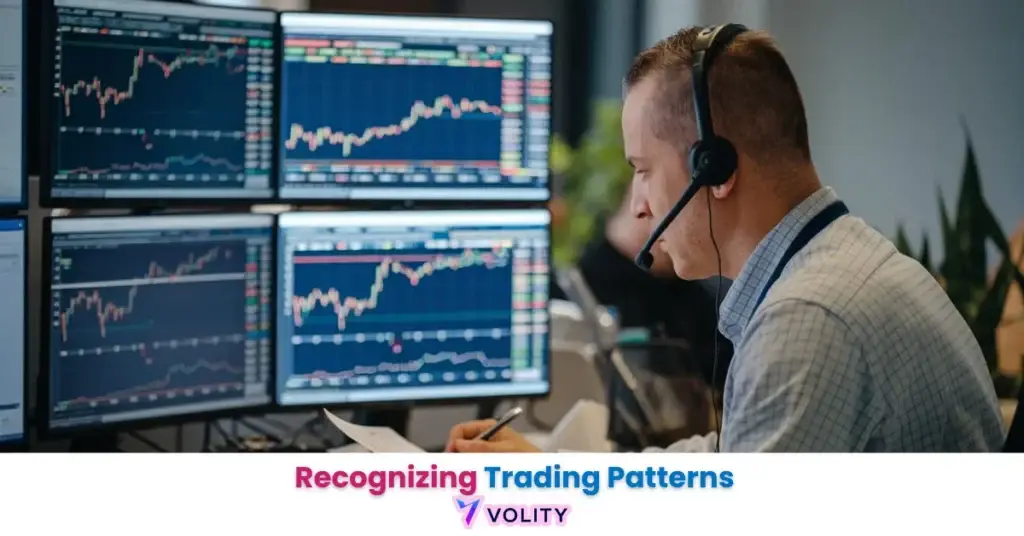
Chart patterns can collapse without warning when high-frequency algorithms exploit the same levels that retail traders use for stops, a “textbook” Head & Shoulders can trigger stop-hunts that gap prices 3-5% through support levels before reversing back into the pattern. False breakouts on low volume waste capital and trigger rapid 10-15% reversals that wipe out trading accounts of position-traders betting on pattern confirmation. AI pattern detection systems can fail catastrophically during volatility spikes when historical correlations break down, patterns that worked in 2025 may not work in 2026. Past performance is not indicative of future results. Capital at risk.
Recognizing trading chart patterns identifies the systematic mapping of historical price action to predict future market trends and reversals. By understanding the “Textbook Paradox”, where overly clean patterns are often front-run by algorithms, modern traders utilize volatility compression and subtle, messy formations to capture institutional-grade risk-to-reward ratios. Inverse Head and Shoulders patterns become far more dependable once the neckline breakout is confirmed.
While understanding Pattern Recognition Frameworks is important, applying that knowledge is where the real growth happens. Create Your Free Forex Trading Account to practice with a free demo account and put your strategy to the test.
Chart pattern recognition functions as the essential interface for translating raw price action into actionable trading intelligence. This methodology identifies recurring geometric structures, ranging from continuation flags to bearish reversals, that reflect the underlying collective psychology of market participants. It serves as a primary tool for eliminating emotional bias and maintaining objective execution in 2026.
The 2026 technical landscape is defined by the shift from manual observation to AI-integrated “Agentic Analysis.” Investors utilize high-speed scanning tools to recognize institutional accumulation patterns across thousands of charts simultaneously, filtering out the noise that often confuses human analysts evaluating Support and Resistance dynamics.
What are chart patterns and why do they repeat?
Trading chart patterns are visual representations of historical price action that identify recurring phases of market fear, greed, and equilibrium. The repetition mechanism emerges from consistent human psychology, fear and greed cycles repeat because the same neurological patterns govern decision-making across all market participants, from retail traders to institutions. When selling pressure overwhelms demand, a “Head & Shoulders” forms as sellers exhaust themselves; when accumulation pressure builds, a “Double Bottom” emerges as the market tests the same support level twice before breaking higher.
Human Psychology explains why mass behavior creates recognizable shapes through S&P 500 patterns and individual equity charts, fear causes panic selling that violates orderly price discovery, while greed triggers speculative buying divorced from fundamental value, creating the extreme price swings that technical analysis maps. The AI Shift has accelerated pattern repetition because algorithms now reinforce traditional patterns through automated execution, when an AI detects an Inverse Head & Shoulders forming on 500 different charts simultaneously, coordinated algorithmic buying drives all 500 breakouts in the same direction, amplifying the pattern’s reliability. AI-driven pattern detection lets a system scan far more charts than a trader could review by hand.
Institutional Liquidity dynamics reveal why large orders must be “disguised” inside consolidation patterns, a pension fund seeking to accumulate $500 million in a stock must hide its buying pressure over weeks or months to avoid telegraphing its intentions and triggering price inflation. This institutional camouflage creates the visual consolidation patterns that retail traders recognize, making pattern-following a self-reinforcing phenomenon where the very act of institutions hiding their intent creates the patterns that traders identify.
The Evolution of Pattern Verification (LLM Vision)
Agentic chart analysis identifies a 2026 breakthrough where GPT-5.4 Vision and Grok-4.20 analyze screenshots to provide real-time confidence scores for technical setups. Automated detection of “Messy” patterns, irregular structures that don’t match textbook geometry but still contain high-probability setups, represents a critical advantage over human analysis, which tends to focus on “perfect” formations. Multi-timeframe confluence checks ensure that a pattern visible on a 1-hour chart is also confirmed on the 4-hour and daily timeframes, increasing confidence substantially over single-timeframe analysis.
Ready to Elevate Your Trading?
You have the information. Now, get the platform. Join thousands of successful traders who use Volity for its powerful tools, fast execution, and dedicated support.
Create Your Account in Under 3 MinutesMost Reliable Bullish Reversal Patterns in 2026
Bullish reversal patterns identify the exact point where selling exhaustion meets institutional accumulation, signaling a potential long-term trend shift. The Inverse Head & Shoulders pattern forms when downward momentum fades after three waves of selling, with the middle (head) penetrating deeper than the left and right shoulders, followed by a neckline breakout to confirm the reversal. Double Bottom patterns are more dependable when the second “test” of support shows declining volume, signaling that selling pressure has genuinely exhausted rather than consolidating for another down-move.
Bullish Divergence using RSI Index provides confirmation that downward momentum is fading while price remains flat, when price makes a lower low but the RSI makes a higher low, the divergence signals that sellers are losing conviction and a reversal is imminent. The Double Bottom pattern is also more dependable when confirmed by rising volume profiles, a sign that institutional buyers are stepping in. How to Read Stock Charts provides the foundational knowledge for identifying these structures, while Moving Average crossovers offer additional confluence signals that boost confidence in the setup.
Detecting Bearish Reversals and Exit Signals
Bearish reversal patterns identify the transition from market optimism to profit-taking and distribution, marking the optimal levels for closing long positions. The Head & Shoulders pattern, considered the most reliable bearish reversal by professionals, forms when an initial peak (left shoulder) is followed by a higher peak (head), then a third lower peak (right shoulder), all connected by a “neckline.” When price breaks below the neckline with volume, the reversal is typically complete and a substantial decline follows.
Double Top patterns spot the “M-Formation” as a signal of buyer fatigue, when a stock rallies to a new high, then retreats, then returns to test the same high but fails to break above it, the pattern indicates exhaustion of buying power. Bearish Rising Wedges identify why tightening price in an uptrend often precedes a sharp correction, the wedge formation shows progressively higher highs and lows in a rally, but declining volume reveals that fewer and fewer buyers are participating, creating a trap for late-entry traders.
Real trading example: A trader observed a classic Head & Shoulders forming on the NVDA 4-hour chart in March 2026, with the right shoulder showing a 20% decline in trading volume. The price broke the “neckline” support level, leading to a 12% correction within three sessions, successfully identifying the reversal before the broader market realized the trend shift. Past performance is not indicative of future results.
The “Textbook Paradox”: Why Perfect Patterns Fail
The textbook paradox indicates that “perfectly clean” geometric patterns often fail in 2026 because they are easily front-run by high-frequency trading algorithms. When a Head & Shoulders pattern is “perfect”, identical shoulder heights, a head that’s exactly 50% higher, a neckline at 90 degrees, retail traders across the globe recognize it simultaneously and place identical stop orders just below support. Algorithms detect this crowding and execute “stop-hunts,” deliberately pushing price below support to trigger cascading sell stops, flushing out retail traders before the actual reversal occurs.
Messy Patterns provide more reliable signals than textbook examples because their irregular structure is harder for algorithms to recognize, a Head & Shoulders with slightly unequal shoulders or a neckline that’s not perfectly horizontal confuses retail traders and algorithms alike, reducing the crowding effect. Fake-Out Breakouts occur when a pattern breaks to new highs or lows on extremely low volume, representing a false move where sophisticated traders exit before the real move happens. Volume confirmation becomes the only way to verify if a pattern move is genuine, a breakout accompanied by volume at least 3x the 20-day average identifies true institutional participation, while low-volume breaks are typically stop-hunts.
Turn Knowledge into Profit
You have done the reading, now it is time to act. The best way to learn is by doing. Open a free, no-risk demo account and practice your strategy with virtual funds today.
Open a Free Demo AccountStep-by-Step: How to Scan for Patterns Automatically
Automated scanning represents the most effective strategy for identifying high-probability technical setups across thousands of global equities in real-time. Setting Up TrendSpider Filters allows traders to scan for “VCP” (Volatility Compression) and “Double Bottom” breakouts across the S&P 500 simultaneously, identifying which stocks are setting up to breakout before price even reaches the entry level. Using Tickeron Robots implements autonomous execution for AI-verified patterns, allowing traders to define if-then rules: “If Inverse H&S forms on the 4-hour with 95% AI confidence AND volume is 3x average, THEN buy at neckline breakout.”
Manual Verification remains essential despite automation, the “Five-Point Check” confirms AI signals before committing capital: (1) Is the pattern visible on multiple timeframes? (2) Does volume increase on the breakout? (3) Does the breakout hold above the neckline for at least 3 closes? (4) Is there a news/earnings catalyst that would explain the move? (5) What is my stop-loss level and is it tight enough to protect against a fake-out? Stock Screeners provide the infrastructure for automated pattern detection at scale, while How to Analyze Shares teaches the fundamental research process that distinguishes between genuine opportunities and algorithmic false signals.
Key Takeaways
- Chart pattern recognition identifies recurring price structures that reveal market sentiment and potential future trends.
- AI-enhanced tools can scan far more charts for patterns than a trader can review by hand.
- Inverse Head & Shoulders is a dependable bullish reversal pattern once the neckline breakout is confirmed.
- The Textbook Paradox warns that overly clean geometric patterns are often front-run by algorithms, leading to high retail failure rates.
- Volatility compression (VCP) is the preferred setup for AI models, as it identifies a buildup of energy before an explosive price breakout.
- Volume profile confirmation remains the most critical filter for distinguishing between genuine trend shifts and manipulative “stop-hunts.”
Frequently Asked Questions
This article contains references to Recognize Trading Chart Patterns and Volity, a regulated CFD trading platform. This content is produced for educational purposes only and does not constitute financial advice or a recommendation to buy or sell any financial instrument. Always verify current regulatory status and platform details before using any trading service. Some links in this article may be affiliate links.