The AUS200 is a contract for difference that tracks the S&P/ASX 200, the index of the 200 largest companies on the Australian Securities Exchange. Trading the AUS200 CFD lets you go long or short on Australia’s benchmark index from one position on Volity MT, with leverage of up to 1:500 depending on the instrument and no shares to own.

What is the AUS200?
AUS200 is the CFD ticker most platforms use for the S&P/ASX 200, Australia’s headline stock index. It is maintained by S&P Dow Jones Indices together with the Australian Securities Exchange, and it holds the 200 largest eligible companies by float-adjusted market value, the large majority of Australian share market capitalisation. Because it is capitalisation weighted, the biggest companies move the asx index the most. If the whole idea of an index is new to you, our explainer on what a stock index is covers the basics first.
Two sectors dominate the AUS200: financials, led by the big four banks, and materials, led by the large iron ore miners. That mix makes it a play on the health of Australian banking and on global demand for commodities at the same time, which is much of what gives the index its character.
Which companies drive the AUS200?
A small group of banks and miners carries most of the index’s movement. Ordered by weight, the heavyweights usually include the names below.
| Company | Sector | Role in the index |
| BHP Group | Mining | Largest weight; ties the index to iron ore |
| Commonwealth Bank (CBA) | Banking | Largest of the big four banks |
| CSL | Healthcare | Major biotech weight |
| National Australia Bank (NAB) | Banking | Big four bank |
| Westpac | Banking | Big four bank |
| ANZ Group | Banking | Big four bank |
| Macquarie Group | Financials | Investment bank exposure |
| Rio Tinto | Mining | Second major iron ore weight |
With banks and miners weighted so heavily, a move in iron ore prices or a shift in the outlook for Australian housing and credit can set the direction of the AUS200 on its own, even when the rest of the market sits still.
How does an AUS200 CFD work?
An AUS200 CFD is an agreement to exchange the difference in the index price between the moment you open a position and the moment you close it. You trade the movement, not the shares. You do not buy the 200 companies, you do not hold an exchange traded fund, and you do not hold index futures with a fixed size and expiry to roll. A contract for difference has three practical consequences.
- You can go long or short, so a falling index is as tradable as a rising one, and a short position needs no borrowing of stock.
- You post margin rather than the full contract value, so a smaller deposit controls a larger position. Volity offers leverage of up to 1:500 depending on the instrument, and because leverage magnifies losses as much as gains it rewards careful sizing.
- You own no shares, so no dividends are paid to you directly. Index CFDs instead carry a dividend adjustment when constituents pay out, covered in the costs section below.
Volity offers it as a CFD, so you can trade index CFDs on Volity alongside forex, commodities and crypto in one account, with CySEC-regulated execution under UBK Markets (licence 186/12). You trade the AUS200 from the same wallet you use for everything else.
When can you trade the AUS200?
The index constituents trade on the Australian Securities Exchange from 10:00 to 16:00 Australian Eastern time, after an opening auction earlier in the morning, and that cash session is when the AUS200 is most liquid. The AUS200 CFD tracks the index across the trading week and commonly quotes for extended hours around the cash session, so you can trade the Asia-Pacific reaction to the overnight moves on Wall Street.
This timing is one reason traders outside Asia follow the AUS200: it opens the global trading day and often sets the early tone for risk appetite. You can read the live AUS200 chart and current asx live prices inside Volity MT, and trade the instrument from the Volity app on mobile as well as desktop, rather than needing the exchange’s own asx app.
What does it cost, and what is ASX Limited?
Three cost lines matter on the AUS200 CFD. The spread, quoted in index points, is your main trading cost and is tightest during the Asia-Pacific cash session. Overnight financing applies to any position held past the daily rollover. A dividend adjustment applies when constituents go ex-dividend, crediting longs and debiting shorts so neither side takes a windfall from the payout itself. Funding in a currency other than the quote currency involves a 1% conversion. Full pricing is on the charges and fees page.
One point of confusion is worth clearing up. ASX Limited is the company that operates the Australian Securities Exchange, and it is itself a listed member of the index. So “ASX” can mean the exchange, the index family, or the operating company depending on context. The AUS200 tracks the S&P/ASX 200 index, not the ASX Limited share price.
What moves the AUS200?
Reading the drivers behind the day’s asx today news tells you more than reacting to a single headline. The index tends to respond to a familiar set of forces.
- Iron ore and commodity prices, since the big miners tie the index directly to raw material demand.
- China, Australia’s largest trading partner, whose growth and stimulus feed straight through to the miners and the index.
- Reserve Bank of Australia policy, whose rate decisions move the banks, the Australian dollar and housing-linked names.
- The big four banks, which make up the largest sector, so bank earnings and credit conditions carry real weight.
- Global risk sentiment, since overnight moves on Wall Street often set the AUS200’s opening tone.
The S&P/ASX 200 sits inside a wider S&P/ASX index series that runs from the ASX 20 up to the All Ordinaries, but the 200 is the benchmark most traders and funds actually follow, which is why it is the version quoted as the AUS200.
How to trade the AUS200 on Volity
The steps are the same as for any index CFD, and our wider guide to how to trade indices walks through the same discipline across the major benchmarks. In short:
- Open a Volity account and complete the quick KYC checks, or start on a free demo to practise first.
- Fund your wallet by card, SEPA or crypto. Opening an account is free, you can fund from as little as $1, and you can start trading from $1.
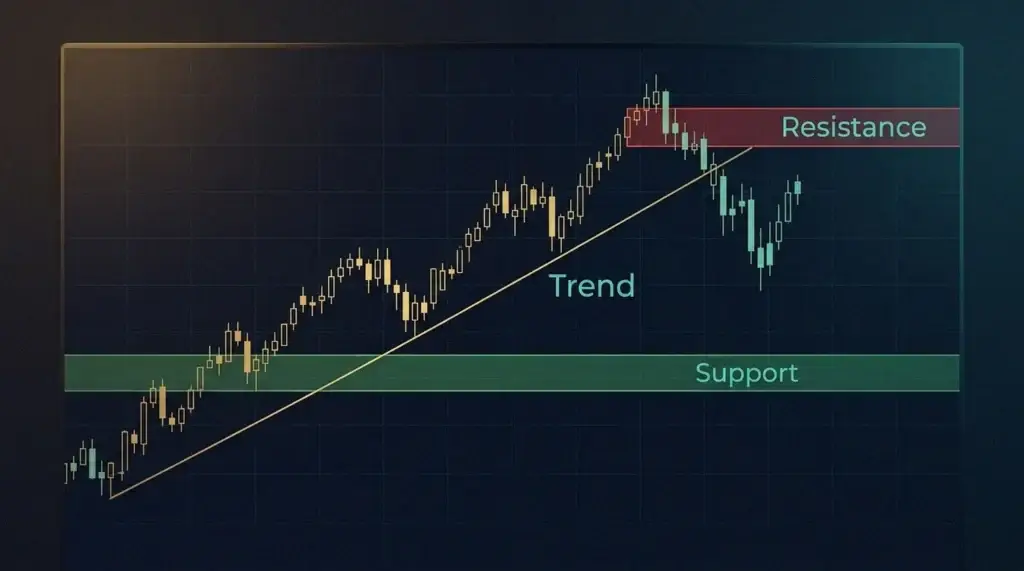
- Open the AUS200 instrument in Volity MT and study the live chart, using the built-in TradingView charting to mark levels.
- Decide your direction from your own analysis, set your size from the margin shown on the order ticket, and attach a stop-loss and a take-profit.
- Place the order and manage the position, watching iron ore, China and the banks for the drivers that move the index.
What are the risks specific to the AUS200?
Every leveraged index carries the general risks of CFD trading, but the AUS200 has a few concentrations worth understanding before you size a position.
- Commodity dependence: with the big miners so heavily weighted, a sharp fall in iron ore or other commodity prices can drag the whole index, sometimes regardless of how the rest of the market is doing.
- China concentration: the export economy is tied closely to Chinese demand, so Chinese growth data, property stress or stimulus can move the AUS200 more than domestic news.
- Bank and housing exposure: the big four banks dominate the financial sector, which links the index to Australian interest rates, credit growth and the housing market.
- Thin overnight liquidity: outside the Asia-Pacific cash session the spread can widen, so trades placed in quiet hours may cost more to enter and exit.
- Leverage: as with any CFD, it magnifies gains and losses alike, so a modest adverse move can have an outsized effect on your margin.
None of these is a reason to avoid the index. They are the factors to weigh when you choose your position size and timing. A trader who treats the AUS200 as, at heart, a bet on banks and commodities will read its moves far better than one watching the headline number alone, and practising on a free demo first is the simplest way to learn its rhythm before committing real capital.
Leverage is the reason position sizing matters more here than direction. A leveraged AUS200 position can lose money as fast as it can make it, and the size you choose decides how much of an adverse move you can sit through. Trade with a stop, size from your own risk, and use only money you can afford to lose.
Frequently asked questions
What is the AUS200?
The AUS200 is a CFD that tracks the S&P/ASX 200, the index of the 200 largest companies on the Australian Securities Exchange. Trading it gives you exposure to the whole Australian large-cap market, heavily weighted toward banks and miners, in a single instrument.
Is the AUS200 the same as the ASX 200?
Yes. AUS200 is the CFD ticker for the S&P/ASX 200 index. The price tracks the index closely, but as a CFD it lets you go long or short with leverage and carries financing and dividend adjustments rather than paying dividends directly.
When does the AUS200 trade?
The underlying constituents trade on the Australian Securities Exchange from 10:00 to 16:00 Australian Eastern time. The AUS200 CFD tracks the index through the trading week and commonly quotes for extended hours around that session, opening the global trading day in the Asia-Pacific region.
What is the difference between the ASX and ASX Limited?
The ASX is the Australian Securities Exchange, where shares trade. ASX Limited is the listed company that operates the exchange, and it is itself a member of the index. The AUS200 tracks the S&P/ASX 200 index, not the ASX Limited share price.