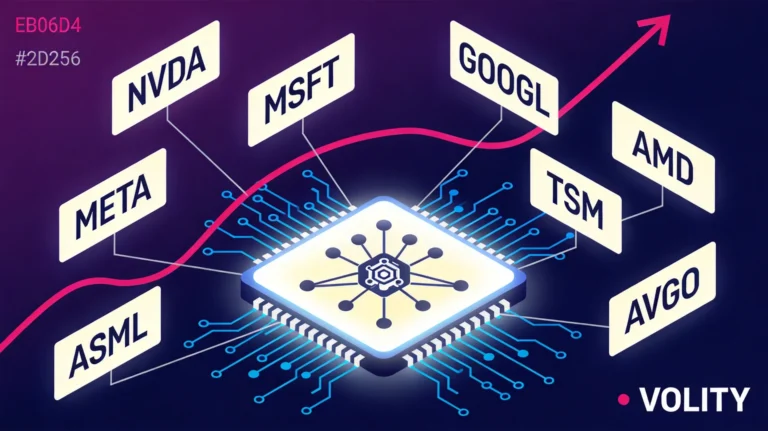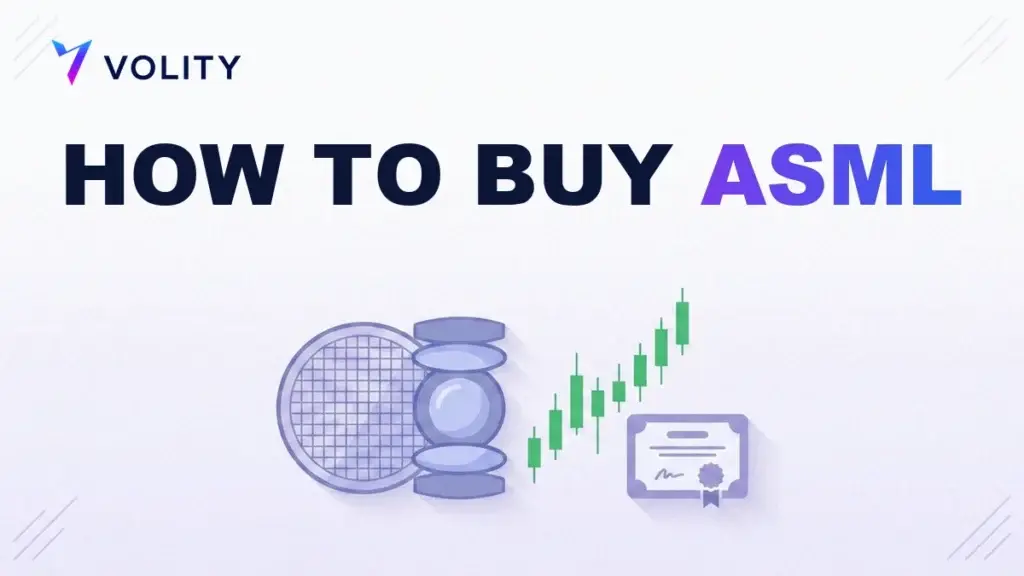
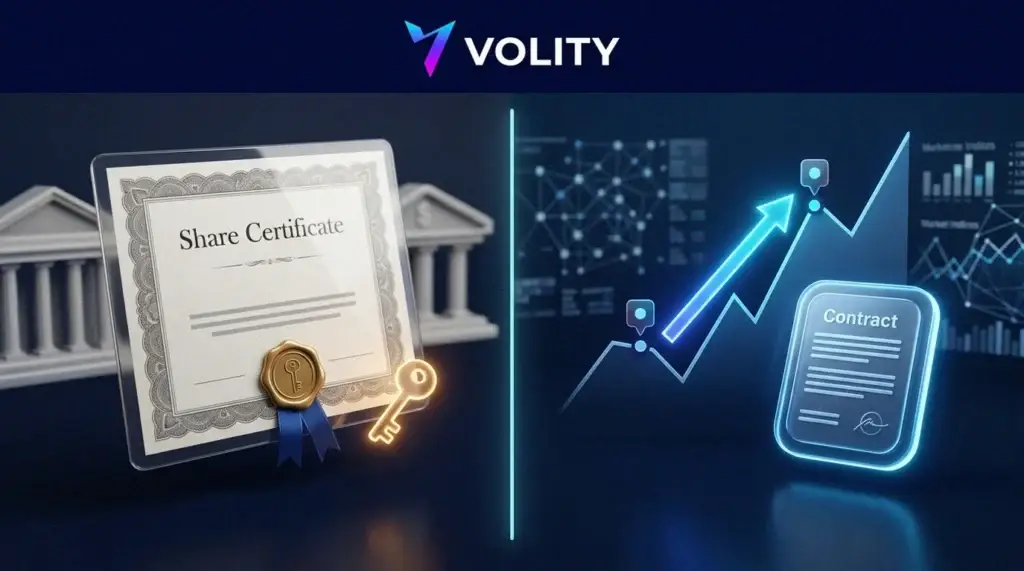
To buy ASML stock you have two very different routes. You can own the shares outright through a share-dealing account with a stockbroker, buying them on Euronext Amsterdam in euros or on Nasdaq in US dollars, or you can trade a contract for difference that tracks the ASML share price without owning the stock. On Volity you get the second kind: CFD price exposure to ASML, long or short, from one account, rather than shares registered in your name.
The short version
- ASML Holding N.V. is a Dutch company, primary-listed on Euronext Amsterdam, ticker ASML, priced in euros.
- It also trades on Nasdaq in US dollars, so the market you pick usually follows your account and home currency.
- Owning real ASML shares means a share-dealing account with a broker that offers the Amsterdam or Nasdaq listing.
- An ASML CFD on Volity gives you price exposure with leverage, long or short, but no ownership and no voting rights.
What is ASML, and why do investors watch it?
ASML Holding N.V. is a semiconductor equipment maker based in Veldhoven in the Netherlands. It builds the photolithography machines that print circuit patterns onto the silicon wafers behind every modern semiconductor. What sets it apart is its grip on the most advanced end of that market: ASML is effectively the only supplier of extreme ultraviolet lithography systems, the machines needed for the leading-edge chips that power artificial intelligence. As CNBC has reported, it is the only company making the equipment every advanced chipmaker relies on.
That has made ASML one of Europe’s most valuable listed companies, so its earnings and order book are read as a barometer for the whole chip cycle. It reported an order backlog of 38.8 billion euros at the end of 2025, but has since stopped publishing that figure every quarter, so treat any headline number as a snapshot and check the latest results release before acting on it.
Where does ASML stock trade, Amsterdam or New York?
Both, and the distinction matters when you buy in. The primary listing is on Euronext Amsterdam under the ticker ASML, quoted in euros. This is the home market, and it is where ASML sits as one of the largest weightings in the Dutch AEX index. Because the AEX is capitalisation weighted and caps any single member near 15%, ASML alone can move the whole benchmark on a strong or weak day. If indices are new to you, our explainer on what a stock index is covers the basics.
The same shares also trade on Nasdaq in US dollars, under the same ASML ticker. One detail is worth getting right: the Nasdaq line is made up of New York Registry Shares, which are registered ordinary shares, not the American depositary receipts many non-US companies use for a US listing, as ASML sets out on its own investor pages. Either way you buy the same interest in the same company, so the market you choose usually follows your broker and the currency you want to hold.
Buying the actual shares means opening a share-dealing account with a stockbroker or investment platform that gives you access to Euronext Amsterdam, Nasdaq, or both. The steps are the same as for any listed stock.
- Choose a regulated broker that lists ASML, and check whether it offers the Amsterdam or the Nasdaq line, since that decides your currency.
- Open the account, complete identity checks, and fund it in the currency you plan to trade in.
- Search the ASML ticker, decide your share count, and review the dealing commission and any conversion cost.
- Place a market or limit order, and once it fills the shares settle into your account in your name.
Owning the shares gives you a real stake: you can hold for years, collect dividends, and vote at the annual meeting. The trade-off is that you pay the full price up front, you only profit if the price rises, and short selling is hard for most retail investors. Our guide on how to choose a trading platform covers the checks that matter before you commit money.
How can you invest in ASML through a CFD on Volity?
Volity does not sell you ASML shares. It offers a contract for difference on the ASML price, an agreement to exchange the difference in the share price between the moment you open a position and the moment you close it. You trade the movement, not the company, and that structure has a few practical consequences.
- You can go long if you expect ASML to rise or short if you expect it to fall, so a down day is as tradable as an up day.
- You post margin rather than the full share price, so a smaller deposit controls a larger position. Volity offers leverage of up to 1:500 depending on the instrument, but single-share CFDs sit at the cautious end of that range, with retail leverage on individual shares commonly capped near 5:1 under European and UK rules.
- You own no shares, so you get no voting rights and no dividend paid to you directly. Instead a dividend adjustment applies to open positions when ASML goes ex-dividend.
- You trade on your own capital plus that leverage. There is no funded or prop-style account to pass; the position and the risk are yours.
On Volity you trade ASML from the same wallet you use for forex, commodities, indices and crypto, all inside the Volity MT platform, with execution under CySEC regulation through UBK Markets (licence 186/12). Opening an account is free, you can fund from as little as 1 dollar, and you can start trading from 50 dollars. Practise first on a free demo account, check the cost of holding a position on the charges and fees page, and see the wider Volity markets range that sits alongside single-stock CFDs.
You do not need to be in the Netherlands to invest in ASML. From the UK, Ireland, Australia or most other markets, a broker with international access will let you buy the Amsterdam listing in euros or the Nasdaq listing in US dollars, whichever your platform supports. Wherever you are based, check two things: the currency conversion cost, since buying a euro or dollar stock from a sterling account adds a fee each way, and how dividends are handled, since withholding tax on a Dutch or US listing can differ from your home market. On the CFD side, Volity serves clients across the non-US English-speaking world, so a UK-based trader gets the same ASML CFD, priced from the underlying market, as anyone else.
Does ASML pay a dividend?
Yes. ASML pays a dividend and has aimed to grow it, in interim instalments through the year with a final amount approved by shareholders at the annual meeting. The company frames this as a policy rather than a promise: its own capital return guidance ties any payout to available profits, reserves and cash, so it can be changed or paused if conditions demand it. One point often confuses newcomers: hold real shares and you receive the dividend in cash, but hold an ASML CFD and you do not, because you never owned the stock, so the position is adjusted around the ex-dividend date instead. Our primer on dividend investing for beginners covers how payouts work.
What are the risks of buying ASML stock?
ASML is a high-quality business, but a strong company is not a low-risk trade, and a few features deserve attention before you size a position.
- Cyclicality: chip demand runs in cycles, and orders for ASML’s machines can swing hard between boom and slowdown, which shows up in the share price.
- Policy risk: much of the growth story rests on advanced chipmaking, and export controls on selling equipment to certain countries can move the stock on political news alone.
- Valuation: a near-monopoly tends to trade at a rich multiple, so even good results can disappoint if hopes were higher, and pullbacks can be sharp.
- Currency: whether you hold the euro or the dollar line, exchange-rate moves change your return once converted back home.
- Leverage: on a CFD, gains and losses are both magnified, so a modest move against you can take a large bite out of your margin.
Leverage is why regulators watch products like this closely. Both ESMA and the FCA cap the leverage retail clients can use on share CFDs and require clear risk warnings, precisely because a leveraged position can lose money as fast as it can make it. Trade with a stop, size from your own risk tolerance, and use only money you can afford to lose. This article is general information, not personal advice.
Frequently asked questions
Can I buy ASML stock directly?
Yes, through a share-dealing account with a broker that lists ASML on Euronext Amsterdam in euros or on Nasdaq in US dollars. That gives you real shares in your name. On Volity you instead trade a CFD that tracks the ASML price, which gives you exposure and the ability to go long or short, but not ownership of the shares.
Is ASML listed in the US as an ADR?
Not exactly. ASML’s US listing on Nasdaq is made up of New York Registry Shares, which are registered ordinary shares rather than American depositary receipts. They trade under the ASML ticker in US dollars and represent the same company as the Amsterdam listing, so people often call them an ADR loosely, but the correct description is a registry share.
How much money do I need to invest in ASML?
To own a share outright you need at least the price of one share in euros or dollars, plus any dealing and conversion costs. To trade an ASML CFD on Volity the entry point is far lower, because you post margin rather than the full price. Opening a Volity account is free, you can fund from 1 dollar, and you can start trading from 50 dollars.
It depends on your goal. Buying shares suits a long-term investor who wants to hold, collect dividends and vote. A CFD suits a shorter-term trader who wants to go long or short with leverage and does not need ownership. The two are different tools, and many people use a broker for the first and a platform like Volity for the second.