Quick answer
Index trading strategies trade stock-market indices like the S&P 500 or DAX (or DE40) rather than single stocks, using approaches such as trend following, breakout trading, mean reversion and hedging. Indices are less prone to single-stock shocks, making them popular with swing and position traders. Most index trading uses CFDs or index futures with leverage, so risk management is key.
Index trading strategies involve leveraged CFD positions that can result in losses exceeding your initial deposit if prices move against your position. Systematic trading during volatile markets introduces liquidity risk where large positions cannot be closed at quoted prices during rapid market swings. Backtest results do not guarantee future performance; many strategies that work historically may fail during unprecedented market dislocations. Past performance is not indicative of future results. Capital at risk.
Index trading strategies identify the quantitative and technical rules used to manage broad-market exposure. These frameworks function as a shield against emotional decision-making during high-volatility regimes. Systematic macro strategies aim to capture trends in energy and defence exposure while holding drawdowns tight, which is why they suit traders who value capital preservation over maximum gain.
While understanding Index Strategy Optimization is important, applying that knowledge is where the real growth happens. Create Your Free Forex Trading Account to practice with a free demo account and put your strategy to the test.
Index trading strategies function as the essential roadmap for navigating the increasingly complex global equity markets of 2026. This methodology identifies recurring market regimes, ranging from bullish “momentum” phases to choppy “mean-reversion” cycles, allowing traders to adjust their risk parameters accordingly. It serves as a primary tool for institutional-grade portfolio management and capital preservation.
The 2026 market environment emphasizes the need for an “Absolute Return” mindset as traditional 60/40 correlations remain unstable. Investors utilize a combination of trend-following, breakout playbooks, and AI-enhanced volatility filters to maintain a competitive edge. During periods of rising Market Volatility, the most effective strategies systematically reduce exposure rather than attempting to predict market direction.
Primary Index Trading Frameworks: Trend vs. Mean Reversion
Strategy selection is a binary choice between trend-following and mean-reversion, identifying whether a trader expects the current price direction to continue or to revert to its average. Trend-following captures gains during sustained bull markets when the S&P 500 rises consistently above its 200-day moving average. Mean-reversion capitalizes on temporary price shocks by betting that oversold indices will recover toward their historical equilibrium.
Market regime identification reveals which strategy applies in current conditions. The 200-day SMA functions as the primary dividing line, when the S&P 500 trades above this level with positive slope, trend-following strategies dominate. When the index oscillates around or below the 200-day SMA, mean-reversion pullback tactics offer higher probability entries. Institutional desks continuously monitor this regime switch to adjust their strategic emphasis.
When realized volatility settles into a moderate band instead of spiking, volatility-sensitive mean-reversion becomes a primary tactic for institutional desks. In that regime both trend-following and mean-reversion can work; the regime itself decides which of the two works more efficiently.
Volatility-Regime Overlays
Volatility-regime overlays represent the most advanced 2026 strategy modification, adjusting position sizing based on the current level of market realized variance. When the VIX surges above 30, indicating elevated market stress, traders reduce their position sizes by 25-50% to minimize the impact of violent intraday swings. Conversely, when the VIX falls below 12, signaling complacency, traders increase position sizes knowing that stops will execute at reasonable prices without slippage.
Ready to Elevate Your Trading?
You have the information. Now, get the platform. Join thousands of successful traders who use Volity for its powerful tools, fast execution, and dedicated support.
Create Your Account in Under 3 MinutesTrend-Following Strategies: Capturing Global Momentum
Trend-following identifies the process of entering trades in the direction of the prevailing market bias, utilizing indicators like moving average crossovers and Donchian Channels. The 50/200-day SMA crossover signals the beginning and end of major trends, when the 50-day SMA crosses above the 200-day, the “Golden Cross” indicates an emerging uptrend. When the 50-day crosses below, the “Death Cross” signals that downside risk dominates.
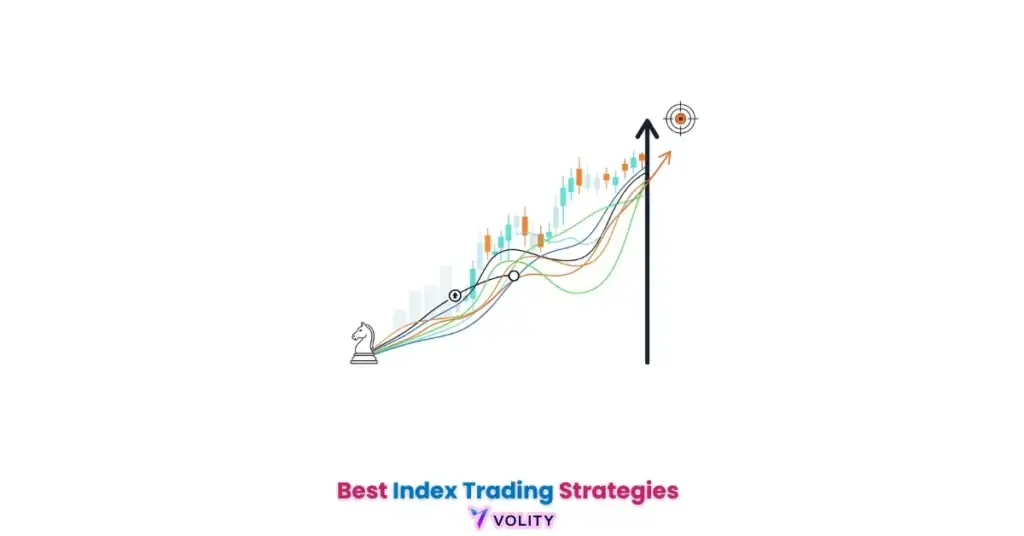
The Moving Average Ribbon strategy layers 5, 10, 15, and 20-day SMAs together to reveal the true strength of a trend through alignment. A perfectly stacked ribbon with all five lines in ascending order indicates maximum bullish momentum, creating optimal conditions for aggressive position increases. Conversely, a declining ribbon with lower lines below higher lines identifies deteriorating momentum suggesting that mean-reversion risks are increasing.
Momentum gapping occurs when major indices gap overnight based on earnings announcements or geopolitical events. Systematic traders use pre-market gap analysis to position before the market open, capturing the initial volatility surge as retail investors react to overnight news. Earnings season concentrates these gaps on the Nasdaq 100, which is where quick mean-reversion fades and momentum continuation trades most often set up.
Systematic macro trend-followers do best when a durable theme, such as energy security, persists long enough for a trend filter to stay on the right side of it. Traditional trend-following works well during inflationary periods, when real assets such as oil and defence equities provide returns that are uncorrelated with the broad index. How to Trade Indices provides foundational mechanics for executing these strategies across major benchmarks.
Mean-Reversion and Pullback Strategies: Buying the Washout
Mean-reversion identifies a statistical strategy that assumes price extremes will eventually return to the long-term average, providing entry points at “oversold” levels. The RSI(2) strategy generates signals by entering a long trade when the 2-period Relative Strength Index falls below 10, indicating an extreme short-term panic that will likely reverse. Bollinger Band reversion trades the “snapback” after a price spike touches the lower band on high-volume selling.
Gap-fade strategies short overnight “gap-ups” in indices showing high valuation tension. When the Nasdaq 100 gaps up 1.5% on modest earnings beats, mean-reversion traders recognize that this move is exaggerated relative to the fundamental improvement. By shorting into the gap open, these traders profit when profit-taking reverses the initial excitement by the end of the trading day.
Real trading example:
The rule works like this. The DAX 40 gaps down on a headline while the index is still structurally in an uptrend above its 200-day SMA. The mean-reversion trader enters long at the “Gap Fill” zone, the price level where the previous day’s close intersects the intraday chart, and exits when the gap closes. The trade is invalidated, not merely uncomfortable, if the index closes below the 200-day SMA, because the regime the setup depends on has changed. This is an illustration of the rule, not a record of a trade. Past performance is not indicative of future results.
Performance Benchmarks and Drawdown Limits in 2026
Risk-adjusted performance benchmarks identify the success rates of various systematic strategies relative to their maximum drawdown exposure in the current market. These metrics reveal that Systematic Macro strategies deliver consistent returns with minimal downside, while trend-following produces larger gains but requires tolerance for occasional significant drawdowns.
| Strategy Type | Return profile | Drawdown profile | Hit-rate profile | Risk Profile |
| Systematic Macro | Modest | Shallow | High | Low-Moderate |
| Trend Following | Large when trends persist | Deep | Low | Moderate |
| Mean Reversion | Modest | Moderate | High | Moderate |
| Scalping (HFT) | Small per trade | Shallow | Very high | High (Execution) |
| Long-Only Buy/Hold | Tracks the index | Full market drawdown | N/A | High |
The profiles above compare the shape of each strategy, not measured returns from a named index. Actual return and drawdown vary by manager, period and instrument. Index construction and weighting methodology: FTSE Russell, LSEG.
Systematic macro aims for the steadiest returns at the lowest drawdown, which suits traders who put capital preservation ahead of maximum gain. Trend-following targets larger absolute returns but demands the psychological tolerance to sit through the deep drawdown that arrives whenever a trend reverses sharply. Compare the two on your own backtests over at least one full bull and one full bear cycle before choosing between them.
Long-only buy-and-hold takes the index return and the full index drawdown with it: passive ownership captures the upside at the cost of every point of downside volatility. Traders who want to beat a passive index while holding a shallower drawdown should lean on systematic macro or mean-reversion rather than leveraged trend-following.
Drawdown Management and the “Asymmetry of Recovery”
Drawdown management identifies the process of limiting capital erosion to ensure that the mathematical gain required for recovery remains achievable. The 20/25 Rule reveals a critical mathematical reality: a 20% loss requires a 25% gain to break even, while a 50% loss requires a 100% gain. This exponential relationship means that controlling large losses is more important than generating large gains.
Institutional de-risking thresholds enforce hard stops at 15-20% portfolio drawdowns. When a professional trading desk realizes losses reaching this threshold, they immediately reduce position sizes or close losing trades entirely rather than continuing to hope for recoveries. This discipline protects capital during severe market dislocations and preserves the mathematical viability of the portfolio for future recovery attempts.
Fixed-fractional sizing maintains consistent 1-2% risk-per-trade regardless of account size or recent performance. A trader with a $100,000 account risks maximum $1,000-$2,000 per trade. This approach automatically reduces position size during losing streaks, after three consecutive losses, the trader reduces position size to $500-$1,000, limiting the damage. By contrast, revenge traders double their position size after losses, frequently resulting in catastrophic account destruction during inevitable losing streaks.
The arithmetic of why large losses are disproportionately damaging is checkable in one line: a 50% loss requires a 100% gain, meaning a trader with a $100,000 account that declines to $50,000 must earn $50,000 (a 100% return) just to return to breakeven. Reward-to-Risk Ratio provides the practical framework for sizing trades to maintain favorable return-to-drawdown mathematics.
Turn Knowledge into Profit
You have done the reading, now it is time to act. The best way to learn is by doing. Open a free, no-risk demo account and practice your strategy with virtual funds today.
Open a Free Demo AccountStep-by-Step: Selecting and Backtesting Your Index Strategy
Backtesting identifies the historical edge of a strategy by simulating its performance across diverse market cycles before committing live capital. The process reveals whether a strategy’s rules-based entries and exits genuinely produce consistent profits or whether past results were just luck during a favorable period.
Choosing your timeframe determines the instrument type and volatility tolerance. Scalping strategies operate on 1-minute charts, requiring specialized equipment and institutional-grade execution to compete against high-frequency traders. Position trading operates on daily or weekly timeframes, suitable for retail traders using standard brokers without requiring constant monitoring. Intermediate swing trading uses 4-hour to daily timeframes as a compromise between the pace of intraday strategies and the patience required for position trading.
Defining your invalidation level establishes the specific price where you accept that the original thesis was wrong. If a trader believes the S&P 500 will rise from 6,600 based on touching the 200-day moving average, the invalidation level might be 6,550, the point where evidence of trend reversal becomes apparent. Placing stop-losses at these objective technical levels avoids both premature exits during normal pullbacks and holding losing positions hoping for recoveries that never materialize.
The 2026 “Robustness Test” confirms that your strategy works on multiple indices. A strategy that works brilliantly on the S&P 500 but fails miserably on the DAX is likely overfit to US market characteristics. Professional traders verify that their rules work across the S&P 500, Nasdaq, DAX, and FTSE indices before deploying significant capital, ensuring their system captures genuine market mechanics rather than exploiting temporary quirks in a single benchmark.
What are Indices provides foundational understanding of index construction and weighting that directly impacts how different strategies perform. Indices with market-cap weighting (S&P 500) behave differently than price-weighted indices (Dow Jones), requiring strategic adjustments to account for these structural differences when applying the same template across multiple benchmarks.
Key Takeaways
- [Index trading strategies] provide a structured framework for speculating on broad-market movements while minimizing emotional decision-making.
- [Trend following] is the primary strategy for capturing long-term growth in leading sectors like Semiconductors and Defense during bull markets.
- [Mean reversion] strategies capitalize on temporary “oversold” conditions, assuming that price extremes will eventually return to their historical average.
- [Drawdown management] is critical due to the “Asymmetry of Recovery,” as large capital losses require exponentially higher gains to break even.
- [Systematic macro] strategies have outperformed in early 2026 by tracking uncorrelated commodity trends alongside traditional equity indices.
- [Backtesting] is the mandatory final step before using any index strategy, ensuring that your trading rules have a proven edge in diverse market regimes.
Frequently Asked Questions
This article contains references to index trading strategies, systematic trading, and Volity, a regulated CFD trading platform. This content is produced for educational purposes only and does not constitute financial advice or a recommendation to buy or sell any financial instrument. Always verify current regulatory status and platform details before using any trading service. Past performance shown in examples does not guarantee future results. Some links in this article may be affiliate links.