Investing in financial products involves risk. Losses may exceed the value of your original investment.
Quick answer
Fundamental analysis in stock trading is valuing a company through its financial statements, business model, competitive moat, and macroeconomic context, then comparing intrinsic value to market price. The core inputs are revenue growth, operating margin, free cash flow, debt levels, and price-to-earnings ratio. Long-term investors lean on it; short-term traders use it as context for technical setups.
Fundamental analysis in stock trading is the practice of estimating the intrinsic value of a company by examining its financial statements, business model, competitive position, and macro environment, then comparing that estimate to the current market price. This price-versus-value discipline traces back to Benjamin Graham. If intrinsic value sits above price, the stock is a candidate to buy. If it sits below, a candidate to avoid or short. Technical analysis asks where the price might go next; fundamental analysis asks what the company is worth.
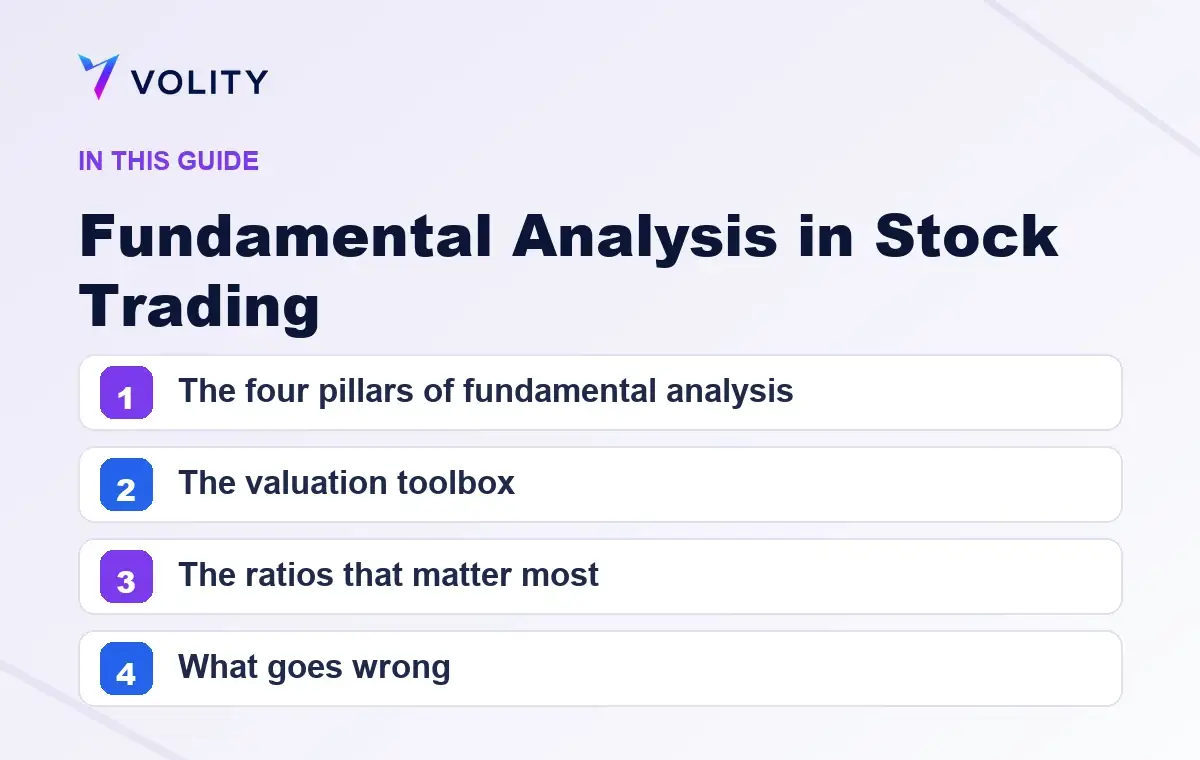
The four pillars of fundamental analysis
- Financial statements. Income statement (revenue, margins, earnings), balance sheet (assets, liabilities, equity), cash flow statement (operating, investing, financing cash flows). Five years of history minimum.
- Business model. How the company makes money. Unit economics, pricing power, customer concentration, recurring vs transactional revenue.
- Competitive position. Market share, switching costs, network effects, brand equity, regulatory moats. The five-forces lens (suppliers, buyers, entrants, substitutes, rivalry).
- Macro and sector context. Where the company sits in the cycle, sector tailwinds and headwinds, interest-rate sensitivity, currency exposure.
The valuation toolbox
- Multiples. P/E, EV/EBITDA, P/S, P/B compared to sector and historical averages. Fast and dirty; misleading at extremes.
- Discounted cash flow (DCF). Projects free cash flow forward 5-10 years, discounts back to present using a weighted average cost of capital. Sensitive to terminal-value assumptions.
- Sum of the parts. For conglomerates, value each segment separately and add. Useful for spin-off candidates.
- Peer comparables. Match the target to a peer set on growth, margin, and capital structure, then apply the peer multiple.
The ratios that matter most
- Return on equity. Sustainable ROE above the cost of equity creates value. Below it destroys.
- Free cash flow margin. Cash earnings divided by revenue. The first sanity check on accounting earnings.
- Net debt to EBITDA. Leverage. Above 4x raises a flag in most sectors.
- Revenue growth durability. Three-year and five-year compound growth, not the headline last-quarter number.
- Operating margin trend. Direction matters more than the absolute level.
When does fundamental analysis make sense?
- Holding periods of months to years. The market needs time to converge on intrinsic value.
- Quality and growth investing. Compounders, defensives, and dividend payers reward the patient analyst.
- Special situations. Spin-offs, restructurings, post-IPO lock-up expiries, where catalysts close the value gap on a known schedule.
- Hedging concentration. A long-time holder of a single stock uses fundamental work to decide when to trim or hedge.
What goes wrong
- Value trap. Cheap on every multiple, but the business is in structural decline. Cheap stays cheap and gets cheaper.
- Confirmation bias. The analyst falls in love with a story and ignores disconfirming evidence.
- DCF fragility. Small changes to terminal growth rates and discount rates produce 30-50% swings in fair value. The output is only as good as the assumptions.
- Mark-to-market patience. The market can stay irrational longer than you can stay solvent. Sizing matters as much as analysis.
- Catalyst absence. A correctly identified undervaluation can sit for years without a re-rating. Always know what closes the gap.
Stocks at Volity
Volity offers CFD exposure to thousands of US, European, and Asian listed equities. For a worked single-name example, see our guide on how to buy Visa stock. Trading is executed by UBK Markets Ltd, a Cyprus Investment Firm authorised by CySEC under licence 186/12. Retail leverage on individual equities is capped at 1:5 under ESMA product-intervention measures. Negative balance protection applies. Eligible retail clients are covered by the Cyprus Investor Compensation Fund up to EUR 20,000 per client per firm. Fundamental research, earnings calendars, and consensus estimates are available inside the platform alongside live charting and order execution.
Volity operates a trading platform and also publishes educational and analytical content about trading. The content on this page is for educational purposes only and should not be considered financial advice. Volity may benefit commercially when readers open trading accounts through links on this site.
Our content is produced and reviewed under documented editorial standards; see our comparison and review methodology.
Frequently asked questions
What data does fundamental analysis actually use?
Reported financial statements, the notes accompanying them, management guidance, and the industry and macro conditions the business operates in. The published accounts are the primary source; everything else is interpretation.
How is fundamental analysis different from technical analysis?
Fundamental analysis estimates what a business is worth and compares that with the price. Technical analysis studies the price and volume record itself. They answer different questions and are frequently used together.
How long does a fundamental view take to be reflected in the price?
Often much longer than expected, and sometimes never within a useful horizon. A valuation gap can persist for years, which is why fundamental analysis is generally paired with a defined holding period and a limit on position size.