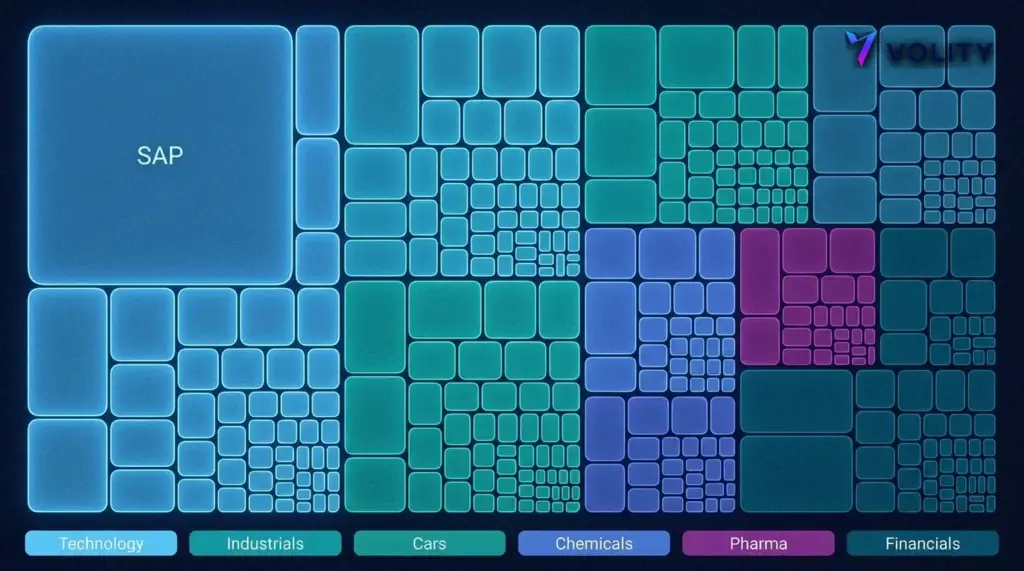
The DAX 40 companies are the 40 largest and most liquid businesses on the Frankfurt Stock Exchange, from SAP and Siemens to Allianz, Airbus and Mercedes-Benz. Together they account for roughly 80 percent of German listed market value, spread across technology, industry, cars, chemicals, pharmaceuticals and finance.
What are the DAX 40 companies?
The DAX 40 is Germany’s flagship stock index, and its constituents are the country’s blue-chip corporate names. Investors follow these 40 companies through a single number, so when you read that the DAX is up, you are seeing the combined movement of that basket. The benchmark held 30 members for decades before it grew to 40 in September 2021, widening its reach into technology and larger industrials. Deutsche Börse owns the index and STOXX calculates it, and membership is reviewed on a set schedule so the list keeps pace with the market. If this kind of instrument is new to you, our explainer on what indices trading is covers the basics first.
Which companies are in the DAX 40?
Membership shifts as companies grow, shrink or get taken over, so any list is a snapshot in time rather than a permanent roster. The table below groups the best-known constituents by sector to show the shape of the index, drawn from the official DAX constituents list. Software leads, though cars, industry, insurance and chemicals all carry real weight.
| Sector | Representative DAX 40 members |
| Technology and software | SAP, Infineon Technologies, Siemens Healthineers |
| Industrials and defence | Siemens, Airbus, Rheinmetall, MTU Aero Engines, Siemens Energy |
| Cars and parts | Mercedes-Benz Group, BMW, Volkswagen, Porsche AG, Continental, Daimler Truck |
| Chemicals and consumer | BASF, Henkel, Symrise, Adidas, Beiersdorf |
| Pharma and health | Bayer, Merck KGaA, Fresenius, Sartorius, Qiagen |
| Financials and insurance | Allianz, Munich Re, Deutsche Bank, Deutsche Börse, Commerzbank |
| Telecom, utilities, logistics | Deutsche Telekom, E.ON, RWE, DHL Group |
How does a company qualify for the DAX 40?
Membership is rules-based, and those rules tightened after the collapse of a former member exposed gaps in the old system. That episode pushed Deutsche Börse into a round of index reform, and today a company has to clear a defined set of hurdles to join the DAX.
- A listing in the Prime Standard segment of the Frankfurt Stock Exchange.
- A minimum free float of 10 percent, so enough shares trade publicly.
- Positive earnings before interest, taxes, depreciation and amortisation in its two most recent annual reports, a profitability test added in the reform.
- Timely audited annual reports and quarterly statements, with a fast-exit rule for firms that fall behind.
- Sufficient trading liquidity, ranked mainly on free-float market capitalisation.
STOXX reviews the index on a set calendar, adding companies that rise into contention and dropping those that no longer qualify. That is why the constituent list keeps evolving; strong performers get promoted and laggards fall out.
How is the DAX 40 weighted?
The DAX 40 is weighted by free-float market capitalisation, so larger, more widely held companies count for more than smaller ones. To stop any single name dominating, the index applies a cap of 15 percent per constituent. That cap earns its keep in practice, because the largest member, the software group SAP, would otherwise carry an outsized share. The headline DAX is also a total-return index, meaning it reinvests dividends into its value. That makes it look stronger over the long run than price-only benchmarks, which is worth remembering whenever you line the DAX chart up against another country’s index.
DAX 40 companies vs CAC 40 companies: how do they compare?
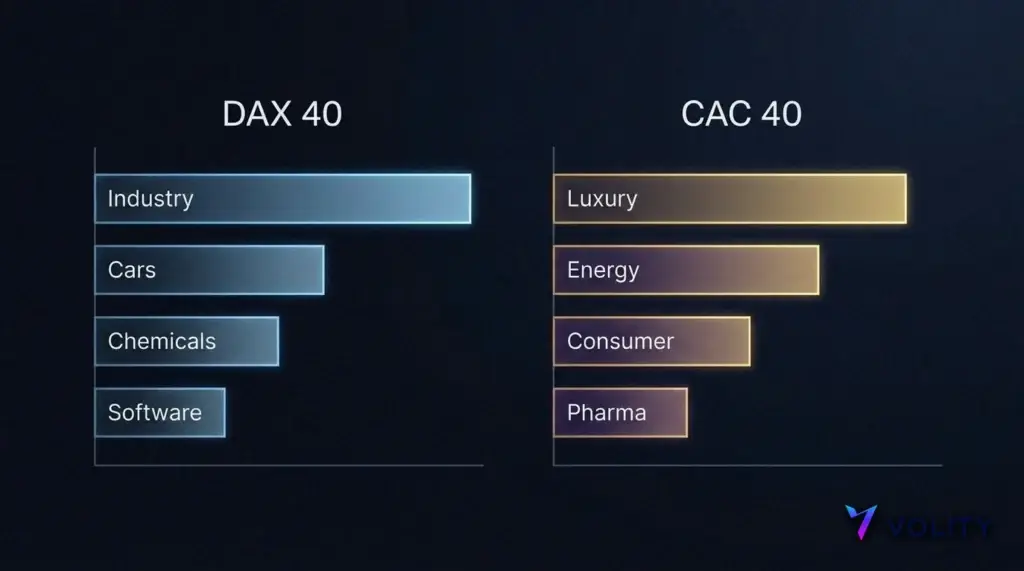
Germany’s DAX 40 and France’s CAC 40 are the two largest euro-area national benchmarks, and they are easy to confuse because both hold 40 companies. Their character is different. The CAC 40 companies, listed on Euronext Paris, lean heavily towards luxury, consumer and energy names such as LVMH, Hermès, L’Oréal, TotalEnergies and Sanofi. The DAX 40 leans towards industry, cars, chemicals and software. The two indices also measure returns differently: under the published index rules the headline CAC 40 is a price-return index, while the headline DAX reinvests dividends. Airbus is a rare name that appears in both.
| Feature | DAX 40 (Germany) | CAC 40 (France) |
| Exchange | Frankfurt Stock Exchange (Xetra) | Euronext Paris |
| Constituents | 40 largest German firms | 40 largest French firms |
| Sector tilt | Industry, cars, chemicals, software | Luxury, consumer, energy, pharma |
| Headline calculation | Total return (includes dividends) | Price return (excludes dividends) |
| Marquee names | SAP, Siemens, Allianz, Mercedes-Benz | LVMH, TotalEnergies, Hermès, Sanofi |
How often does the DAX 40 change?
The DAX 40 is reviewed on a set schedule, so its membership evolves as companies grow or fade. STOXX runs regular reviews, with the main reshuffle timed for September, and applies fast-entry and fast-exit rules that can move a company in or out sooner if its size changes sharply. A firm that climbs the rankings can be promoted into the index, while one that shrinks, is taken over or breaches the reporting rules can be dropped. Recent years have shown this in action, with defence and industrial names gaining weight as their fortunes improved and older members making way. The same German blue-chip index is quoted on data terminals under the ticker .GDAXI.
For a trader, the churn matters less than it might seem, because you are trading the index as a whole rather than betting on any single member staying in it. When a company is swapped, the index provider adjusts the basket and the divisor so the change does not create an artificial jump in the index level. What the reshuffles do reveal is where the German economy’s centre of gravity is shifting, from traditional manufacturing towards technology, defence or healthcare. Read the additions and removals over the years and you are quietly tracking that story, which is why the DAX of today looks different from the DAX of a decade ago.
One practical note follows from the rules. Because the DAX caps any single constituent at 15 percent and rebalances on schedule, no one company can quietly come to dominate the index between reviews. That cap, together with the regular review, keeps the DAX 40 broadly diversified even when a single stock enjoys a spectacular run.
No. Buying 40 separate German shares to mirror the index would be slow and costly. An index CFD tracks the whole DAX 40 in a single instrument. One position gives you exposure to every constituent at its index weight, and you can go long if you expect the German market to rise or short if you expect it to fall. Index CFDs are leveraged, so a smaller deposit controls a larger position; Volity offers leverage of up to 1:500 depending on the instrument, and because that leverage magnifies losses as much as gains it calls for disciplined sizing. You trade the DAX on Volity MT, where Germany’s index shows up as GER40 or DE40 depending on the view. Opening an account is free, you can fund from as little as $1 and start trading from $1, and execution is CySEC-regulated under UBK Markets (licence 186/12). You can trade index CFDs on Volity beside forex, commodities and crypto in one account, with margin and financing set out on the charges and fees page.
If the ticker labels trip you up, GER40, DE40 and Germany 40 all point to the same benchmark, quoted from the one underlying DAX. The German cash market runs on Xetra during Frankfurt hours and the CFD tracks that session, so the label on your platform never changes what you are actually trading.
Frequently asked questions
How many companies are in the DAX?
The DAX holds 40 companies. It tracked 30 for most of its history and expanded to 40 in September 2021. The 40 are the largest, most liquid businesses on the Frankfurt Stock Exchange, together making up around 80 percent of German listed market value.
What is the biggest company in the DAX 40?
The software group SAP is consistently the largest DAX 40 member by market value and index weight. Because the index caps any single constituent at 15 percent, SAP’s influence is limited even when its market capitalisation would otherwise push its weighting higher.
What is the difference between the DAX 40 and the CAC 40?
Both hold 40 companies, but the DAX 40 tracks German blue chips weighted towards industry, cars and software, while the CAC 40 companies are French and lean towards luxury, consumer and energy. The headline DAX includes dividends; the headline CAC 40 does not.
Can I trade the DAX 40 companies as one instrument?
Yes. An index CFD tracks all 40 constituents in a single position, so you gain exposure to the whole German market without buying individual shares. On Volity the instrument appears as GER40 or DE40 and trades on Volity MT. Index CFDs are leveraged and carry risk, so size positions carefully and consider a free demo first.