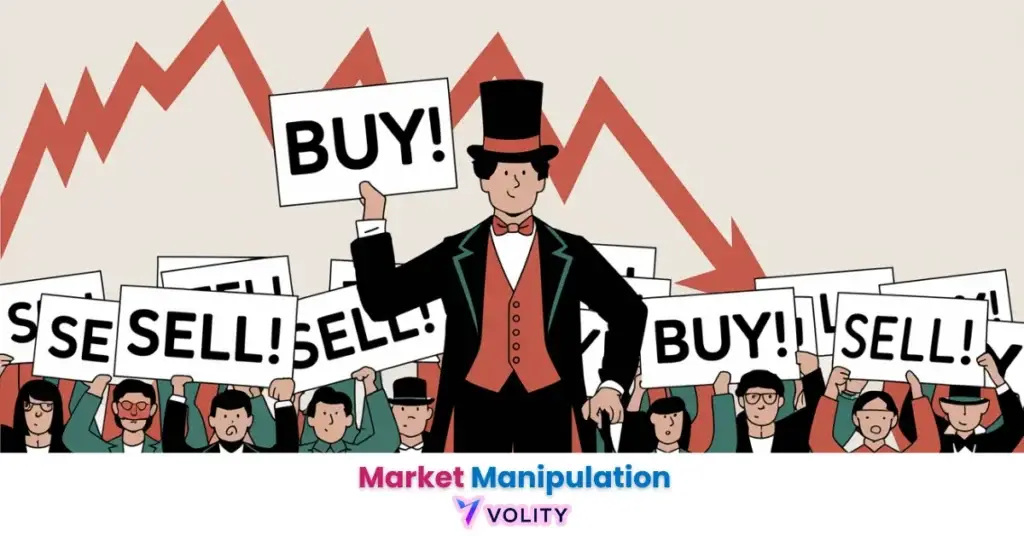
Market manipulation creates artificial price movements that deliberately mislead investors about the true value of securities. This deceptive practice violates market integrity across equity, options, and derivatives trading. Traders engaging with potentially manipulated securities face losses from engineered volatility, false breakouts, and coordinated fraud. Past performance is not indicative of future results. Capital at risk.
Market manipulation identifies the deceptive practices used to artificially influence security prices or trading volumes. This process functions as a direct violation of market integrity and investor trust. Enforcement has moved steadily toward personal accountability, with regulators on both sides of the Atlantic charging individuals alongside the firms they act for.
While understanding Market Abuse Surveillance is important, applying that knowledge is where the real growth happens. Create Your Free Forex Trading Account to practice with a free demo account and put your strategy to the test.
Market manipulation functions as a predatory distortion of the “Invisible Hand” of supply and demand. This methodology identifies recurring fraudulent patterns, such as wash trading in DeFi or layering in high-frequency order books, that lure unsuspecting investors into overvalued or undervalued positions. It serves as the primary target for modern regulatory surveillance systems in 2026.
The 2026 regulatory landscape has reached a technological turning point with the integration of the EU AI Act and the SEC’s enhanced data analytics. Investors utilize these oversight frameworks to distinguish between legitimate price discovery and artificial market noise engineered by bad actors.
What are the primary forms of market manipulation in 2026?
Market manipulation is the deliberate interference with the free and fair operation of the market, identifying the strategies used to create artificial price or volume signals. The primary forms of deceptive trading fall into three broad categories that define modern market abuse.
Pump-and-Dump schemes manufacture hype in micro-cap and cryptocurrency tokens by orchestrating coordinated buying followed by aggressive selling. Wash Trading operates when a single entity simultaneously buys and sells to create the false illusion of active liquidity and genuine market interest. Painting the Tape executes coordinated trading patterns specifically designed to attract retail investors through deceiving price chart visualization.
Enforcement attention has concentrated on standalone manipulation cases, particularly ramp-and-dump schemes run by identifiable individuals rather than by listed companies. The practical consequence for a retail participant is that taking part in a coordinated scheme carries personal legal exposure, not merely the risk of losing money on the trade.
“AI Washing” and Modern Deception
AI Washing identifies a new 2026 enforcement priority where firms misrepresent the role of artificial intelligence in their trading strategies or corporate performance. The practice manifests as exaggerated claims about AI-driven returns that cannot be verified or reproduced through independent analysis. Pump and Dump and Wash Trading schemes increasingly deploy AI-generated fake news and deepfake videos to amplify their deceptive campaigns.
Supervisors have also turned to cases where trading firms use machine learning to exploit predictable patterns in retail order flow. Automated strategy is not a defence: the conduct is judged by its effect on the order book, not by whether a human or a model placed the order.
Ready to Elevate Your Trading?
You have the information. Now, get the platform. Join thousands of successful traders who use Volity for its powerful tools, fast execution, and dedicated support.
Create Your Account in Under 3 MinutesOrder Book Manipulation: Spoofing and Layering
Spoofing and layering identify the practice of placing large, non-bona-fide orders to deceive other market participants into believing there is significant buying or selling pressure. These high-frequency manipulation tactics operate at millisecond speeds, creating false market conditions that are difficult to detect without institutional-grade surveillance tools.
Spoofing places an order and cancels it milliseconds before execution, creating fleeting liquidity that vanishes before legitimate traders can interact with it. Layering creates multiple “flickering” order levels that constantly shift to manufacture artificial price floors and ceilings. Both tactics force legitimate liquidity providers, Recognize Trading Chart Patterns, to widen their bid-ask spreads, ultimately increasing transaction costs for all market participants.
The impact extends beyond individual trades. Institutional execution desks now filter incoming liquidity through anti-manipulation logic designed to detect and step around spoofed orders, which tells you how routine the tactic has become: large firms spend compute purely on separating real depth from false depth.
How Regulators Detect Manipulation: The FINRA CAT
Consolidated market-surveillance systems track every order, modification, and execution across regulated equity, options, and derivatives markets. In the UK and EU, the FCA and ESMA operate transaction-reporting regimes under MiFIR and the Market Abuse Regulation (MAR); the US Consolidated Audit Trail (CAT) performs a comparable role. This surveillance infrastructure allows regulators to reconstruct the true source of manipulative activity within seconds, a technological capability that was impossible to achieve before 2024.
Stitched Views allow CAT to connect order flows across multiple trading venues, revealing cross-venue manipulation patterns that isolated surveillance systems could never identify. Anomaly Detection utilizes machine learning to spot “Flash Crash” signatures and unusual order clustering in real-time, flagging suspicious activity before it can cause systemic damage. The Cross-Border Task Force actively targets foreign-based manipulators by leveraging gatekeepers and clearing members in other jurisdictions.
How the pattern works: an offshore group circulates synthetic audio of a chief executive announcing a regulatory approval that never happened, on a micro-cap with a thin order book. Consolidated order-and-execution reporting is what makes this recoverable: because every order, modification and cancellation is reported with an identifier, investigators can reconstruct who traded around the announcement and in what sequence, rather than inferring it from price alone. This is an illustration of the mechanism, not a record of a specific case.
2026 Regulatory Enforcement Benchmarks: SEC vs. ESMA
Enforcement benchmarks identify the success rates and monetary relief ordered by global regulators in their fight against market abuse.
| Regulator | Primary focus | Legal basis | Typical sanctions | Reaches individuals |
| SEC (U.S.) | Intentional Wrongdoing | Securities Exchange Act, Rule 10b-5 | Disgorgement, civil penalties, officer bars | Yes |
| ESMA (EU) | Benchmark Integrity | Market Abuse Regulation (MAR) | Applied by national regulators | Through national regulators |
| FCA (UK) | Algorithmic Testing | UK MAR and FSMA | Fines, restitution, prohibition orders | Yes |
| SEBI (India) | Unregistered Traders | SEBI PFUTP Regulations | Disgorgement, penalties, debarment | Yes |
| CFTC (U.S.) | Crypto Spoofing | Commodity Exchange Act, section 4c(a)(5) | Civil penalties and restitution | Yes |
Legal bases above are the operative instruments in each jurisdiction. EU text: Market Abuse Regulation (EU) 596/2014. Definitions used here follow market manipulation and wash trading.
Read across the table, the common thread is that every one of these regimes reaches natural persons, not only the firms they work for. Manipulation is charged against the individual who placed or directed the orders, and the sanctions available run past fines to disgorgement, industry bars and, in the most serious cases, criminal liability.
The Role of the EU AI Act in Market Protection
The EU AI Act identifies the first comprehensive legal framework for ensuring that trading algorithms are transparent, explainable, and free from manipulative bias. The regulation represents a watershed moment in fintech compliance, extending governance beyond human traders to the algorithms themselves.
High-Risk AI Classification designates certain trading bots as requiring annual audits and continuous monitoring by third-party compliance firms. Transparency Obligations mandate disclosure of “Deepfake” or AI-generated financial content, preventing manipulators from using algorithmic disinformation to move markets. Mandatory Testing ensures that algorithms undergo stress-testing to prevent “Disorderly Markets”, situations where automated trading cascades trigger circuit breakers.
As of January 1, 2026, ESMA has become the sole supervisor for third-country benchmark administrators; any non-EU benchmark used by brokers must meet strict new recognition standards by September 30, 2026. Market Manipulation oversight now extends globally, with non-compliance triggering license revocation and substantial fines.
Turn Knowledge into Profit
You have done the reading, now it is time to act. The best way to learn is by doing. Open a free, no-risk demo account and practice your strategy with virtual funds today.
Open a Free Demo AccountHow to Identify Red Flags and Avoid Manipulation Traps
Verification protocols represent the most effective strategy for protecting your capital from coordinated manipulation schemes. Red flags appear most clearly when volume spikes dramatically without corresponding news or earnings catalysts.
Cross-checking volume means asking whether a volume spike is matched by anything in the public record: a filing, a results announcement, an index change. Identifying “flickering” orders uses Level-2 depth to spot spoofing patterns where large orders appear and vanish within milliseconds. Regulatory alerts means checking the warning and unauthorised-firm lists that national regulators publish before you act on a tip about an unfamiliar entity.
How to Read Stock Charts provides the foundational skills for visual pattern recognition, while understanding OTC Over the Counter Trading dynamics reveals where manipulation risks concentrate most heavily. OTC stocks face minimal surveillance compared to exchange-listed securities, creating ideal conditions for pump-and-dump schemes.
Key Takeaways
- Market manipulation is the intentional use of deceptive tactics like spoofing or wash trading to distort the price of a security.
- Individual liability is the centre of gravity in modern enforcement: manipulation cases are brought against the people who placed or directed the orders, not only against firms.
- AI Washing has become a primary target for the SEC, focusing on companies that exaggerate their artificial intelligence capabilities to boost stock prices.
- The EU AI Act now governs high-frequency trading algorithms, requiring them to be transparent and free from manipulative coding biases.
- Consolidated surveillance regimes such as the FCA/ESMA transaction-reporting framework and the US CAT provide a “stitched” regulatory view of every order in the market, making it nearly impossible for spoofing to go undetected.
- Cross-border task forces are actively targeting offshore manipulation schemes that utilize international gatekeepers to funnel illicit trading profits.
Frequently Asked Questions
This article contains references to Market Manipulation and Volity, a regulated CFD trading platform. This content is produced for educational purposes only and does not constitute financial advice or a recommendation to buy or sell any financial instrument. Always verify current regulatory status and platform details before using any trading service. Some links in this article may be affiliate links.