OTC trading operates outside the regulatory supervision of major exchanges, creating risks of extreme slippage, illiquidity crises, and counterparty defaults when market makers vanish during volatile moves. Pink Sheet stocks frequently experience 20-50% intraday price swings driven by rumor rather than data, forcing retail traders into losses during liquidity evaporation. Atomic settlement on blockchain rails eliminates two-day banking risk but creates new smart-contract vulnerabilities, a failed settlement instruction can trap capital indefinitely. Past performance is not indicative of future results. Capital at risk.
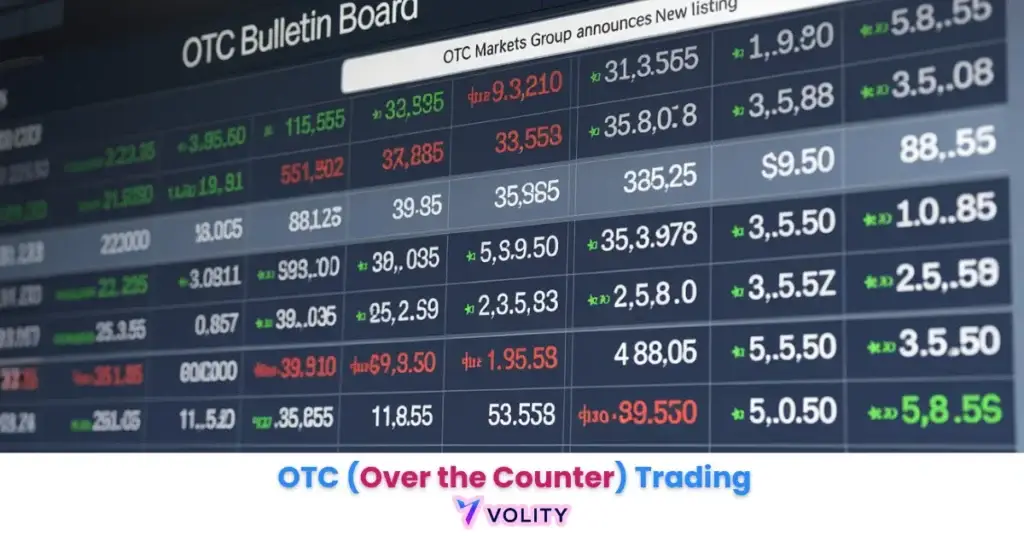
OTC trading identifies the decentralized process of exchanging financial instruments, such as unlisted stocks, bonds, and tokenized assets, directly between two parties without the supervision of a formal exchange like the NYSE. In 2026, the OTC market has undergone a structural transformation driven by RWA tokenization and the SEC’s Rule 15c2-11 transparency mandates. By utilizing blockchain-based atomic settlement and stablecoin-native rails, modern OTC desks now provide institutional-grade liquidity for a wider array of private and emerging assets. Growth in this market is driven by tokenised real-world assets and by settlement moving onto blockchain rails.
While understanding OTC Market Infrastructure is important, applying that knowledge is where the real growth happens. Create Your Free Forex Trading Account to practice with a free demo account and put your strategy to the test.
OTC trading functions as the foundational decentralized network for modern capital allocation and private asset discovery. This methodology identifies securities that do not meet the stringent listing requirements of major boards, ranging from “Pink Sheet” equities to institutional Real-World Asset (RWA) tokens. It serves as a primary vehicle for deep-liquidity block trades and customized financial engineering in 2026.
The 2026 OTC landscape is defined by the integration of blockchain transparency with traditional regulatory oversight. Investors use these venues to reduce settlement risk, negotiate a tighter bid-ask spread on size, and limit the market impact that a large order would create on a public order book.
What is OTC trading and how does it function in 2026?
OTC trading is a decentralized process where securities are exchanged directly between brokers and dealers, identifying the market for instruments not listed on formal exchanges. This direct-negotiation model replaces the public order book with individual price discovery between market makers, allowing for specialized pricing and custom contract terms unavailable on the NYSE or Nasdaq. Penny stocks and emerging small-caps dominate the OTC venue because listing requirements on major exchanges remain prohibitively expensive for early-stage or distressed companies.
The OTC Market Group operates three distinct tiers, OTCQX (Premier), OTCQB (Venture), and Pink Sheets (Open Market), each with varying financial disclosure standards. A growing share of institutional OTC settlement now runs on stablecoin rails rather than through correspondent banking. Alternative Trading Systems (ATS) platforms like OTC Link facilitate high-speed execution and price transparency without the regulatory burden of formal exchange membership, explaining why institutional desks increasingly route block orders through decentralized rails.
The Shift to Atomic Settlement
Atomic settlement identifies the 2026 transition toward blockchain-based rails that allow for the near-instantaneous exchange of assets and capital. A conventional securities trade settles a set number of days after execution, and default risk stays live for the whole of that window. US equities moved from a two-day to a one-day cycle on 28 May 2024, while UK and EU markets remain on two days. Atomic settlement collapses that window to the length of a single blockchain transaction, because the asset leg and the cash leg either both complete or neither does. The trade-off is that the risk moves rather than disappears: a defect in the settlement contract can strand capital instead.
Ready to Elevate Your Trading?
You have the information. Now, get the platform. Join thousands of successful traders who use Volity for its powerful tools, fast execution, and dedicated support.
Create Your Account in Under 3 MinutesSEC Rule 15c2-11: Enhancing Pink Sheets Transparency
SEC Rule 15c2-11 identifies the regulatory requirement for broker-dealers to verify current public information before publishing quotes for unlisted securities. This mandate emerged after decades of pump-and-dump schemes where unregistered companies issued misleading financial statements and paid promoters to coordinate buying volume, tactics that devastated retail investors throughout the 2010s. The amendments adopted in 2020 tightened those verification standards, so an issuer that does not keep current public information available can lose its public quotation altogether and end up quoted only on an unsolicited basis.
Since those transparency rules took full effect, a quote on an OTC marketplace carries a verification step that did not previously exist. Market Manipulation tactics like wash trading and layering remain detectable on OTC venues through the SEC’s advanced surveillance systems, explaining why regulated OTC brokers now integrate AI-driven trade surveillance into their core operations. SEC enforcement priorities have shifted toward identifying “Caveat Emptor” (Buyer Beware) status companies that fail to meet current public information thresholds, a designation that automatically disqualifies them from most institutional liquidity providers.
The Rise of Real-World Asset (RWA) Tokenization
RWA tokenization identifies the process of bringing off-chain assets, such as US Treasuries and Gold, onto blockchain rails to facilitate 24/7 OTC trading. Traditional Treasuries and commodity positions require institutional bank accounts and significant minimum trade sizes; tokenized versions break these barriers by allowing fractional ownership and peer-to-peer settlement in real-time. A desk moving a large block can settle against a stablecoin leg in a single transaction rather than waiting on a wire and a repo leg to clear separately.
Tokenisation has grown fastest in the categories that were hardest to trade in the first place: private equity, real estate and commodity positions. Token standards like ERC-3643 (T-REX) enable built-in regulatory whitelisting, allowing tokenized assets to enforce AML checks and sanctions screening directly on-chain without requiring centralized intermediaries. Fractional ownership models have unlocked liquidity in traditionally illiquid categories, a $1 million real estate property can now be divided into 1,000 tokens worth $1,000 each, enabling real-world asset OTC desks to manage sophisticated liquidity for ultra-high-net-worth clients seeking diversification.
Worked example: a desk that needs overnight liquidity can sell tokenised Treasuries against a stablecoin leg instead of financing the position in the repo market. The saving is the funding cost it would otherwise pay for the days the conventional settlement cycle takes, less whatever spread it gives up on a thinner tokenised market. Past performance is not indicative of future results.
Exchange execution compared with OTC execution
The structural differences between an exchange and an OTC desk decide which venue suits a given order. They are worth setting out side by side, because the trade-offs are not obvious from a price screen.
| Attribute | Exchange-traded | OTC (bilateral) |
| Price formation | Central order book, one public price | Quote negotiated between two parties |
| Counterparty | A central clearing house stands between buyer and seller | The dealer on the other side of your trade |
| Contract terms | Standardised by the exchange | Negotiable, including size, currency and settlement date |
| Pre-trade transparency | Full order-book depth is published | Quote-driven; depth is not published |
| Issuer disclosure | Set by the exchange listing rules | Set by the marketplace tier the security is quoted on |
| Settlement | The market-standard cycle for that asset class | Agreed bilaterally, from same-day to a negotiated date |
For the wider shift this table sits inside, see the Bank for International Settlements, III. Blueprint for the future monetary system: improving the old, enabling the new.
Read the table as a decision tree rather than a ranking. An exchange gives you a single published price and a clearing house behind it, which is what you want for a standard-sized order in a liquid name. An OTC desk gives you a negotiated price and terms you can shape, which is what you want when the order is large enough that showing it on a public book would move the price against you. The cost of that flexibility is that you take credit risk on the dealer instead of on a clearing house.
Managing Counterparty and Bilateral Risk
Counterparty credit risk identifies the potential for one party to default on their contractual obligations during a private OTC transaction. Unlike exchange-traded securities where a central clearinghouse guarantees both sides of every trade, bilateral OTC transactions create direct exposure to the financial health and operational stability of your counterparty. A major OTC dealer insolvency can wipe out 100% of a trader’s position if the institution defaults before settlement completes, explaining why institutional OTC desks now mandate atomic settlement as the standard execution method.
Unified Risk Orchestration integrates AML, fraud, and credit risk screening into a single data view, allowing modern OTC desks to identify geopolitical exposure and sanctions violations before they execute the first trade instruction. Basel IV Compliance requires OTC dealers to apply the CCR-SA (Counterparty Credit Risk Standardized Approach) framework, which mandates that every bilateral transaction be assessed against potential default scenarios. Where a central counterparty is used, it novates the trade and stands between the two sides, which converts bilateral credit risk into an exposure to the clearing house and its default waterfall.
Turn Knowledge into Profit
You have done the reading, now it is time to act. The best way to learn is by doing. Open a free, no-risk demo account and practice your strategy with virtual funds today.
Open a Free Demo AccountStep-by-Step: How to Access the OTC Markets
Brokerage selection represents the most critical step for retail investors seeking to participate in the OTC venture and premier tiers. Many mainstream brokers restrict or exclude OTC securities entirely, so the first thing to check is whether the venue you already use routes to OTC market makers at all. The distinction matters because a broker without that access cannot show you a live OTCQB or Pink quote, which leaves you working from stale prices.
Overnight and around-the-clock sessions are the practical reason traders look at OTC venues at all. Listed exchanges keep fixed hours, while blockchain-settled OTC desks can run continuously, which matters if you are trading from a time zone that does not overlap the primary session. Managing liquidity through limit orders becomes mandatory in thin OTC markets where market-maker spreads can exceed 5-10%, a market order executed without limit protection can result in devastating slippage during fast-moving intraday moves.
How to Analyze Shares requires a fundamentals-first approach because OTC companies typically lack the analyst coverage available for NYSE-listed firms. Recognize Trading Chart Patterns serves as a secondary confirmation tool, Pink Sheet price action often exhibits classic technical formations, but sentiment-driven moves can overwhelm chart-based signals without fundamental analysis validating the move.
Key Takeaways
- OTC trading occurs directly between parties outside of centralized exchanges, providing a primary market for unlisted and private assets.
- RWA tokenisation puts instruments such as Treasuries and gold onto blockchain rails, which is what allows them to trade outside exchange hours.
- SEC Rule 15c2-11 mandates that companies provide current public information, identifying a critical transparency floor for the Pink Sheets.
- Atomic settlement completes the asset and cash legs together, removing the window in which a counterparty can fail between execution and delivery.
- Stablecoins have become a significant settlement layer for institutional OTC transactions, alongside conventional banking rails.
- Execution efficiency is the point of an OTC desk: a negotiated block avoids the market impact the same order would create on a public order book.
Frequently Asked Questions
This article contains references to OTC Over-the-Counter Trading and Volity, a regulated CFD trading platform. This content is produced for educational purposes only and does not constitute financial advice or a recommendation to buy or sell any financial instrument. Always verify current regulatory status and platform details before using any trading service. Some links in this article may be affiliate links.