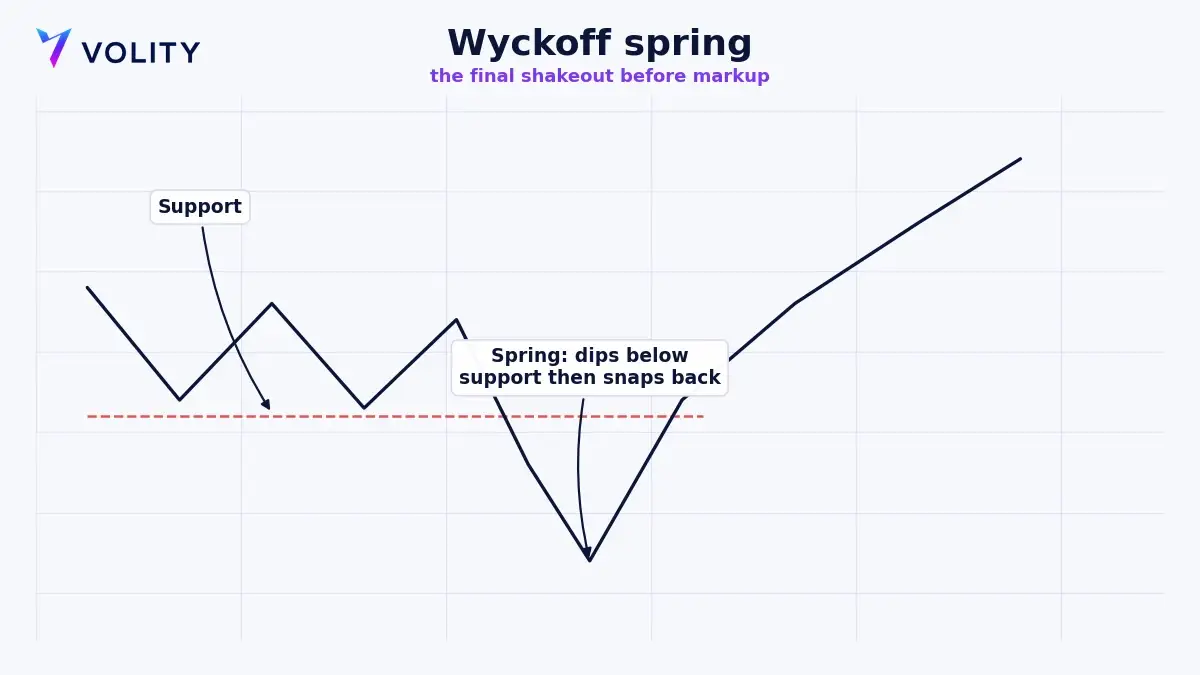
A Wyckoff spring is a shakeout that drops price below the support of a trading range, trips the stop orders resting there, and then reverses back inside almost as fast as it left. It catches sellers at the low while the market tests whether any real supply is left, and a clean spring often marks one of the lowest-risk entries before a markup. That is why traders call it the shakeout before the rally.
What is a Wyckoff spring?
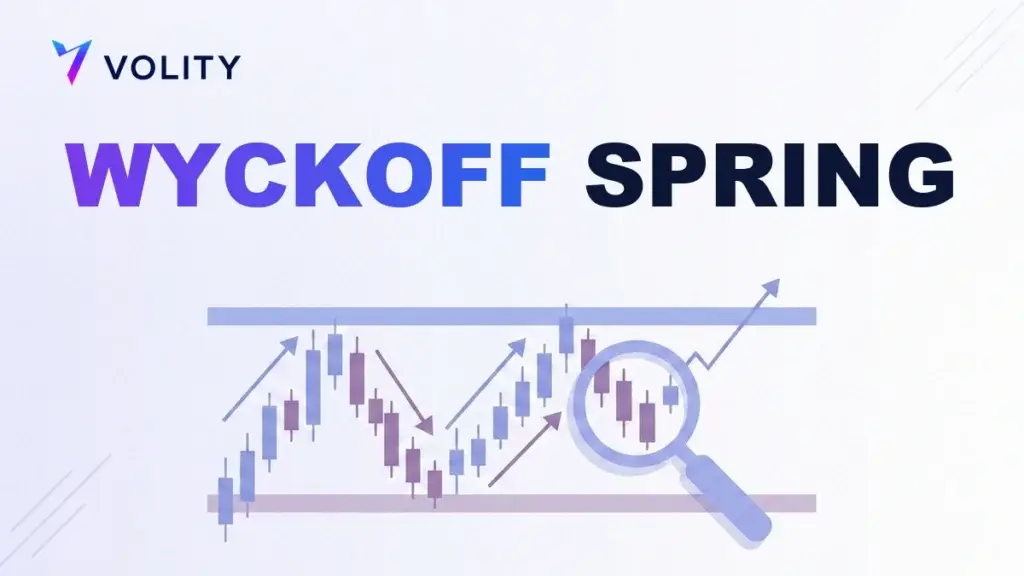
The Wyckoff spring is a specific move inside an accumulation range. Price has spent time building a base after a downtrend, with a clear floor of support. The spring is the moment price dips below that floor, just far enough to convince the crowd the base has failed, before it springs back up into the range on renewed demand. That false break does two jobs at once. It shakes out weak holders who sell at the low, and it traps the breakout sellers who bet on support giving way. Both groups become fuel for the rally that follows. In spring Wyckoff terms, it is the market’s final test that supply has been exhausted before the operator marks price up.
Where does the spring fit in Wyckoff accumulation?
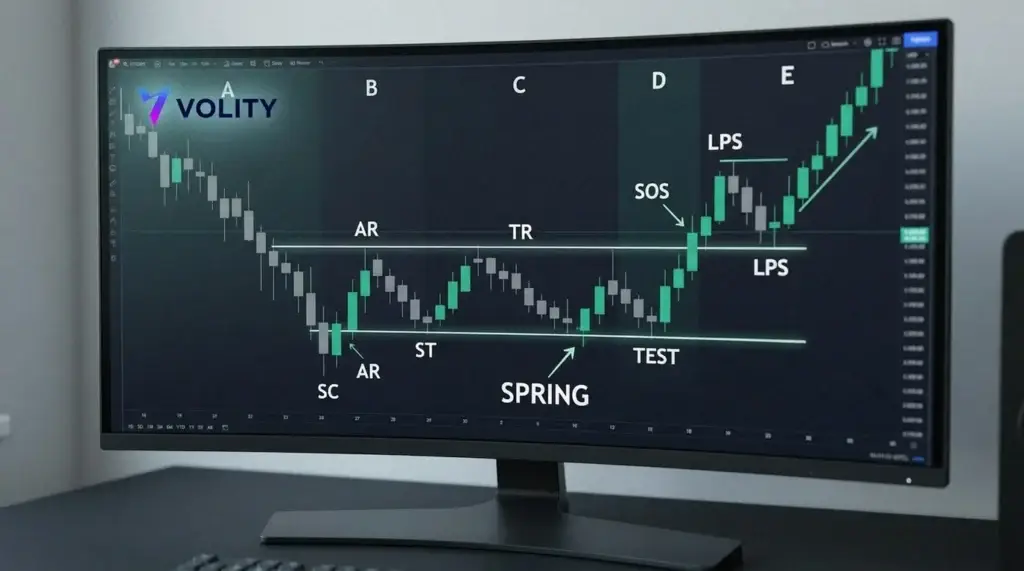
The spring belongs to Phase C of the Wyckoff accumulation schematic, the testing phase. By the time it appears, the range has already produced a selling climax, an automatic rally and a secondary test in the earlier phases, so the groundwork is laid. It is the last shakeout before Phase D, where signs of strength break resistance and a fresh market structure takes shape to the upside. Not every accumulation range contains a textbook spring, and some bases build strength without one. When a clean spring does appear and holds, though, it offers a precise entry with a tight, logical stop just below the shakeout low.
Who was Richard Wyckoff and what is Wyckoff theory?
Richard D. Wyckoff was an early-twentieth-century trader and publisher who reverse-engineered how the great operators of his era moved markets, then taught what he found. Wyckoff theory rests on three laws. The law of supply and demand sets direction, the law of cause and effect links the width of a range to the size of the move that follows, and the law of effort versus result weighs volume against price to show whether a move is genuine. He also gave students the Composite Operator, an imaginary single entity that stands in for all the large, informed money in a market. The spring is Wyckoff theory in miniature, a deliberate test of supply read through the link between effort and result at the moment price probes below support.
What are the types of Wyckoff spring?
Springs are graded by how much supply they reveal, which shows up in the depth of the dip and the volume behind it. Richard Wyckoff’s method reads all three the same way, through effort against result.
- A terminal shakeout is the deepest kind, a sharp and wide plunge far below support on heavy volume. Supply is still forcing its way out, so it takes a strong, decisive reversal to prove demand has finally overwhelmed it.
- A moderate spring is a middling dip below support on moderate volume. Some supply lingers, which makes the follow-up test especially important before you trust the low.
- A minor spring is the shallowest, a small dip below support on light volume. Little supply is left to shake out, and that is the most bullish reading of the three.
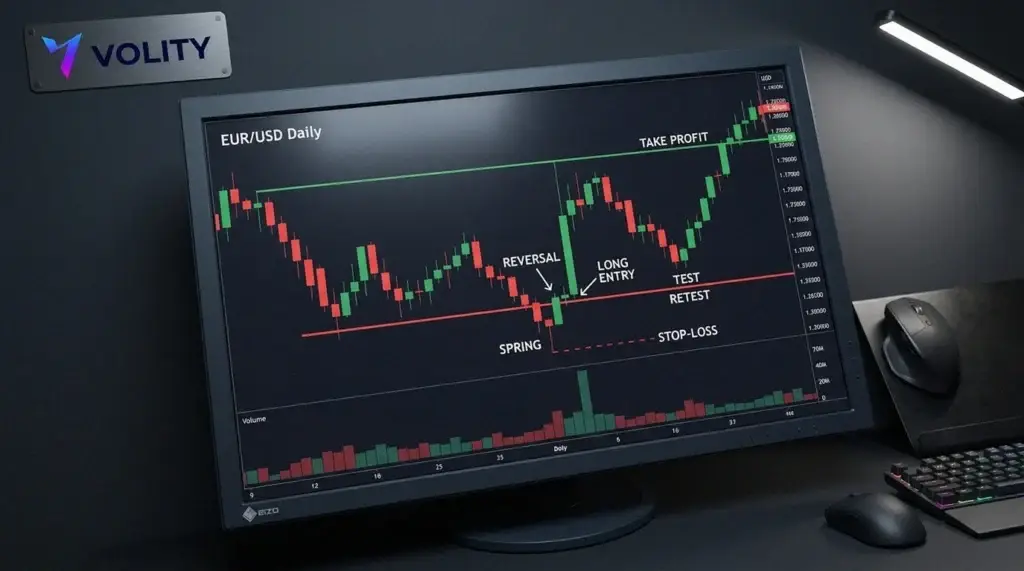
Whatever the type, the highest-quality springs are followed by a test, a return toward the spring low on lighter volume that holds above it. That test confirms sellers have given up, and it hands you a second entry that often carries lower risk.
How do you spot and trade a Wyckoff spring?
Wyckoff trading comes down to reading the test correctly, then acting with risk that is defined in advance. A repeatable routine for the spring looks like this.
- Confirm you are in an accumulation range after a downtrend, with a clear support floor to work from.
- Watch for price to dip below support, and read the volume as it does. Lighter volume is more bullish, because it signals that little supply is left.
- Require a fast reversal back inside the range. A candlestick that closes back above support is the key tell.
- Look for the test, a lighter-volume return toward the spring low that holds. Enter on the test, or on the reversal itself if you are more aggressive.
- Place the stop just below the spring low, the price that proves the setup wrong.
- Target the top of the range first, then trail the rest into the Phase D and E markup.
How is a spring different from an upthrust or a liquidity sweep?
| Concept | Direction | What it does |
| Wyckoff spring | Dip below support, then up | Shakes out sellers before a markup |
| Upthrust (distribution) | Spike above resistance, then down | Traps buyers before a markdown |
| Liquidity sweep (SMC) | Either direction | Same idea in smart money vocabulary |
The spring is the accumulation cousin of the upthrust in Wyckoff distribution, and both describe the same behaviour that smart money traders label a liquidity sweep or a stop hunt. Wyckoff mapped it a century before the modern label existed. Seeing that these are one idea in three dialects makes the whole wyckoff pattern family far easier to read.
What are the risks, and where can you trade the Wyckoff spring?
A spring can fail. Sometimes the dip below support is the start of a real breakdown, price keeps falling, the low never holds, and the spring you hoped for turns out to be a bear trap. That risk is exactly why the reversal and the stop below the spring low matter so much. Never assume a low will hold, and wait for the close back inside the range and, where you can, the test that follows. These setups are usually traded with leverage through contracts for difference, which magnify losses just as much as gains. Size every position from its stop distance so a failed spring costs only what you planned. Major markets are also deep and liquid enough that large operators can absorb supply without tipping their hand, part of why a spring only looks obvious after price has already turned.
On Volity you can trade Wyckoff setups across forex, indices, crypto and commodities on Volity MT, with spreads from 0.6 pips, 99.6% of orders filled in under a second, and leverage up to 1:500 on selected forex pairs, all regulated by CySEC through UBK Markets (licence 186/12). You can open an account for $0 and rehearse on a free demo for as long as you like. When you are ready, fund from $1 and start trading live from $1. Check your costs against the published charges and fees, and practise the entry on that demo before you risk capital on a live spring inside a real trading range.
Related patterns
Frequently asked questions about the Wyckoff spring
What is a Wyckoff spring in simple terms?
A Wyckoff spring is a quick dip below the support of a range that reverses back up almost immediately. It fools traders into selling at the low, then rallies against them. It marks the end of accumulation and often gives one of the best entries before an uptrend begins.
What is the difference between a spring and a test?
The spring is the initial dip below support that reverses. The test is the follow-up move, a return toward the spring low on lighter volume that holds above it. The spring shakes out supply; the test confirms the supply is gone. Many traders prefer to enter on the test for lower risk.
Is a Wyckoff spring the same as a liquidity sweep?
Practically, yes. A spring sweeps the sell-side liquidity resting below support, which is exactly what smart money traders call a liquidity sweep or stop hunt. Wyckoff named the behaviour decades earlier. Only the vocabulary is newer; the mechanics and the trading response are identical.
How reliable is the Wyckoff spring?
A spring that reverses sharply and passes its test is a high-quality signal, but none is guaranteed and springs do fail into breakdowns. Reliability improves when the spring occurs in a clear accumulation range, on convincing volume, with a stop below the low and confirmation before entry.