Investing in financial products involves risk. Losses may exceed the value of your original investment.
Quick answer
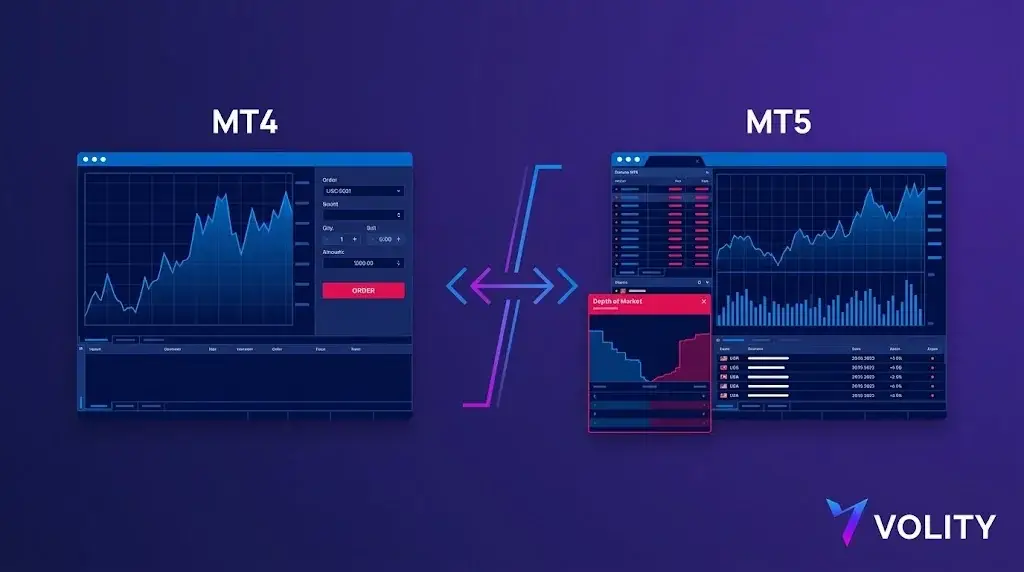
MT5 vs MT4 is a choice between platforms, not eras. MT4 (2005) is forex-focused with hedging accounts and the MQL4 language. MT5 (2010) is multi-asset with netting accounts, MQL5, a faster backtester, and depth-of-market support. Forex-only retail traders running legacy EAs often stay on MT4; multi-asset and modern strategy developers move to MT5.
MT5 is the newer platform with more asset classes, better order tools, and a different programming language. MT4 is the older platform with stronger broker support, lighter resource use, and a massive library of legacy expert advisors. Most active retail traders end up using both. The question is which one to start with for your specific use case. The honest answer for most readers in 2026: MT5, unless your strategy depends on a specific MT4-only EA or your broker only supports MT4.
Side-by-side
| Feature | MT4 | MT5 |
|---|---|---|
| Released | 2005 | 2010 |
| Asset classes | Forex + CFDs | Forex, CFDs, equities, futures, options |
| Timeframes | 9 | 21 |
| Order types | 4 (market, pending limit, stop, stop-limit) | 6 (adds buy/sell stop-limit) |
| Hedging support | Yes (default) | Yes (account-level toggle) |
| Netting accounts | No | Yes |
| Depth of market | No (broker-dependent add-ons) | Yes, native |
| Economic calendar | No | Yes, native |
| Programming language | MQL4 | MQL5 (C++ syntax, multi-threaded) |
| Strategy tester | Single thread | Multi-thread, multi-currency |
| Broker support | Wider in 2026, especially in EM | Wider in EU/UK/AU; growing globally |
| EA library | 20+ years of accumulated EAs | Newer; many MT4 EAs not ported |
The case for MT5
Three reasons most new traders should start here:
- Multi-asset by design. Stocks, futures, options, forex on one platform. MT4 cannot do this without broker hacks.
- Better backtesting. The multi-threaded strategy tester runs 5-10x faster than MT4 on the same hardware. Multi-currency tests run natively.
- Native depth-of-market and economic calendar. MT4 needs broker plugins for both.
The case for MT4
Two reasons it still matters:
- Legacy EA library. Twenty years of community-built indicators and expert advisors. Many never got ported to MT5.
- Broker availability in emerging markets. Some brokers still default to MT4 in LATAM, MENA, and parts of Asia.
What is MQL5 and is it harder than MQL4?
MQL5 is closer to standard C++ than MQL4. The good: object-oriented programming, faster execution, multi-threading. The trade-off: a steeper learning curve, and you cannot port an MT4 EA to MT5 with a copy-paste. Custom logic must be re-implemented. If you do not code your own EAs, this is not your concern. If you do, budget two to four weeks of learning to port a non-trivial strategy.
Hedging vs netting accounts
MT5 introduced netting: only one position per symbol, opposing trades close existing positions. Hedging: multiple positions per symbol, can be long and short simultaneously. Most retail traders prefer hedging. The choice is set per account at the broker. MT4 only does hedging.
Which one fits your strategy?
| Strategy | Better fit |
|---|---|
| Pure FX scalping with EAs | MT4 (legacy EA library) |
| Multi-asset (FX + indices + stocks) | MT5 |
| Algo backtesting and optimisation | MT5 (faster tester) |
| Discretionary swing trading | Either; MT5 has more order types |
| Crypto CFDs | MT5 (broader native support) |
| Copy trading without EA dev | Either; depends on broker |
MT4 and MT5 at Volity
Volity provides MetaTrader 4 and MetaTrader 5 on desktop, web, and mobile (iOS and Android). Both platforms support automated trading, custom indicators, and advanced charting. Trading is executed by UBK Markets Ltd, a Cyprus Investment Firm authorised by CySEC under licence 186/12. Retail leverage is set under ESMA rules: 1:30 on major currency pairs, 1:20 on non-major currencies and major indices, 1:10 on other commodities, 1:5 on individual equities, 1:2 on cryptoassets.
Volity operates a trading platform and also publishes educational and analytical content about trading. The content on this page is for educational purposes only and should not be considered financial advice. Volity may benefit commercially when readers open trading accounts through links on this site.
Our content is produced and reviewed under documented editorial standards; see our comparison and review methodology.