Investing in financial products involves risk. Losses may exceed the value of your original investment.
Quick answer
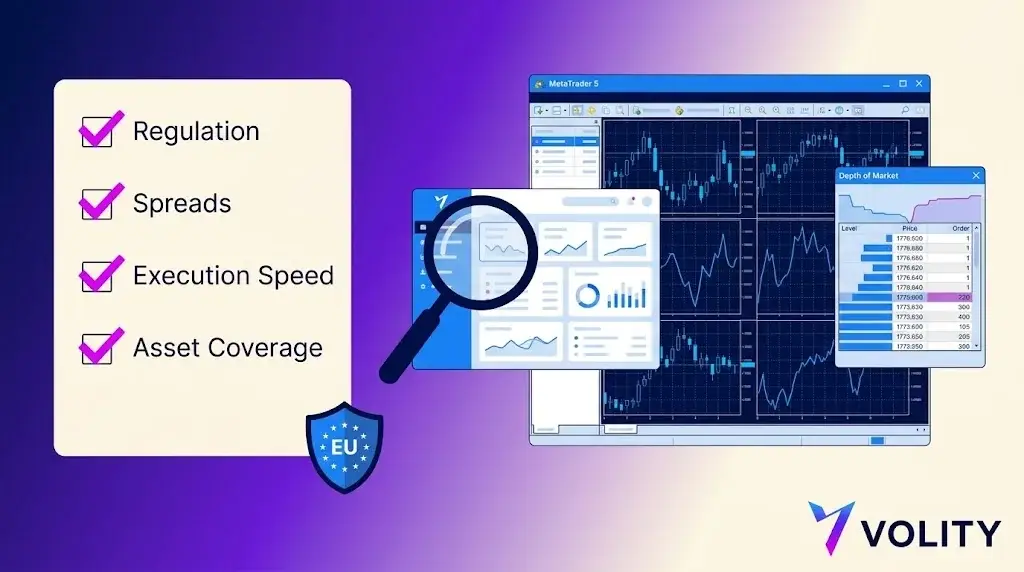
Picking a MetaTrader 5 broker comes down to four practical filters: tier-1 regulation (CySEC, FCA, ASIC), genuine A-Book or ECN execution (not synthetic dealing-desk spreads), all-in cost under 0.6 pips on EUR/USD including commission, and a clear Expert Advisor policy. Marketing copy rarely separates these; check the regulator’s register and demand spread reports before committing capital.
A MetaTrader 5 broker is the regulated firm that connects your MT5 terminal to live markets. The platform itself is built by MetaQuotes Software Corp and licensed to brokers; what differs from one provider to another is the licence, the execution model, the asset book, the funding rails, and the cost stack. In 2026 there are several hundred brokers offering MT5 worldwide. The filter that matters reduces that list to a handful very quickly.
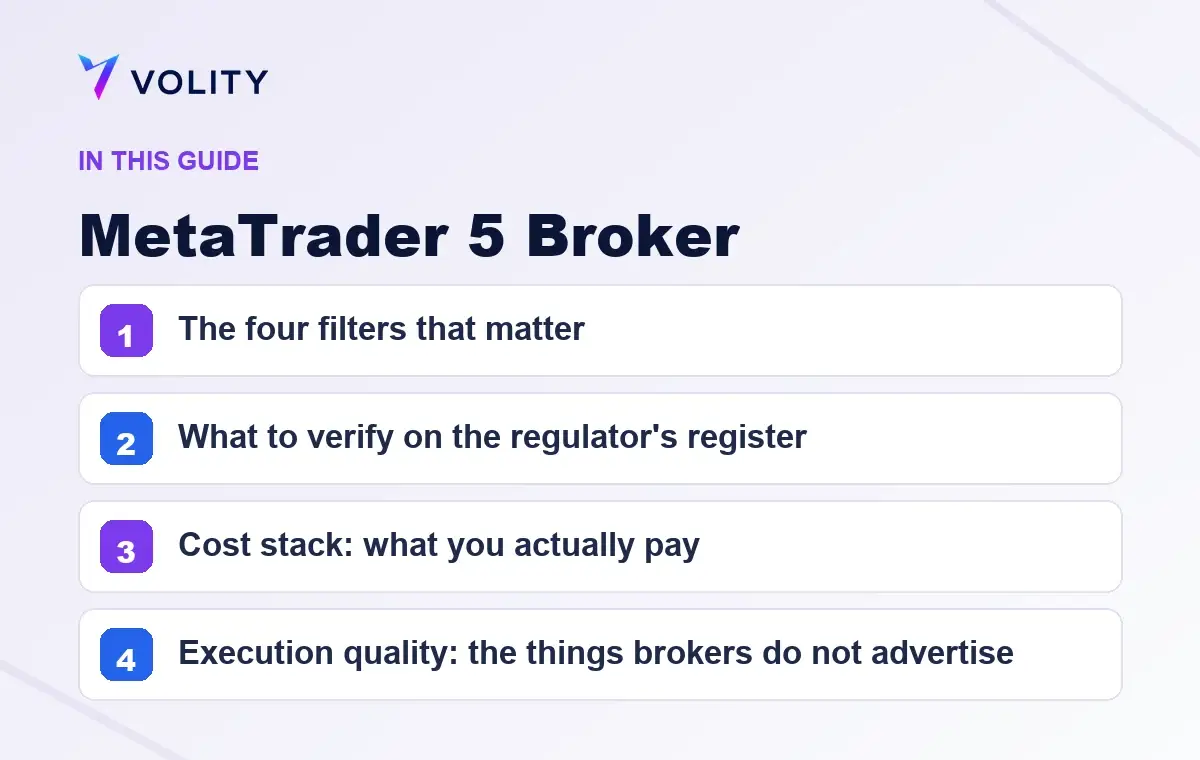
The four filters that matter
- Regulation. A tier-1 European licence (CySEC, BaFin, AMF, FCA equivalents) is the floor. Look for an authorised firm with a licence number you can verify on the regulator’s public register. CySEC’s register, for example, lists every Cyprus Investment Firm and the services it is permitted to offer.
- Execution model. Two variants matter. Market execution (your order is filled at the best available price, slippage possible). Instant execution (your order is filled at the quoted price or rejected, requote possible). MT5 supports both; the broker chooses.
- Asset coverage. MT5’s selling point is multi-asset. Verify the broker supports forex, indices, commodities, equities, and crypto CFDs on the same MT5 login, not split across two terminals.
- Withdrawal rails and timing. SEPA in EUR, bank wire in USD, card refunds, crypto withdrawals where supported. Published target time matters more than the absolute floor: a broker that says funds clear in 4 hours and hits 4 hours is more useful than one that says “up to 24 hours” and hits 18.
What to verify on the regulator’s register
Three data points before you fund:
- The exact corporate name on the licence matches the entity that will hold your funds.
- The licence covers reception and transmission of orders, plus dealing on own account if the broker runs a B-book.
- The firm is current (not in suspension, not in withdrawal of authorisation, not under administrative measures).
Cypriot CIFs are searchable on the CySEC register at cysec.gov.cy. UK firms on the FCA register at register.fca.org.uk. German firms via BaFin’s company database.
Cost stack: what you actually pay
Three components, in order of typical size for an active retail account:
- Spread. The bid-ask gap quoted on the platform. EUR/USD at 0.6-1.2 pips on a tier-1 desk during London hours; wider at session change, wider on minors and exotics.
- Commission. Often zero on “standard” accounts (commission baked into spread) and a few dollars per round-turn lot on “raw” accounts.
- Swap. Overnight financing on positions held past 22:00 server time. Triple swap on Wednesday for FX (covers weekend rollover). Swap rates are published by the broker and update with central-bank rate moves.
Execution quality: the things brokers do not advertise
Three numbers tell you whether a broker’s MT5 setup is desk-grade or retail-trap:
- Average execution time. Sub-100ms is a serious infrastructure. 200-500ms is workable. Beyond that, a momentum trader will feel it on every fill.
- Slippage statistics. Some regulated brokers publish quarterly best-execution reports under MiFID II RTS 27/28. Slippage skew should be roughly symmetric. If 80% of slippage is against the client, that is a tell.
- Requote frequency. On instant-execution accounts, a broker that requotes during volatility is unsuitable for news traders.
Hedging vs netting at the broker level
MT5 supports both account models, but the broker decides which to enable. Hedging accounts allow simultaneous long and short positions on the same symbol. Netting accounts allow only one net position per symbol. Most retail traders prefer hedging. Verify before opening the live account; the model is set at sign-up and cannot be changed without opening a new account.
Leverage: what European retail clients can actually access
ESMA product-intervention measures cap retail CFD leverage in the EEA:
- 1:30 on major currency pairs
- 1:20 on non-major currency pairs, major indices, and gold
- 1:10 on commodities other than gold and on non-major equity indices
- 1:5 on individual equities
- 1:2 on cryptoassets
A broker advertising 1:500 to EU retail is either offering it through an offshore entity or non-compliant. Either case is a filter, not a feature.
What MT5 features the broker has to enable
Five MT5 capabilities depend on the broker, not the platform:
- Depth of market (level 2). Native to MT5, but populated only if the broker streams the data.
- One-click trading. Available on MT5 by default; some brokers gate it on KYC tier.
- Algorithmic trading (EAs). Some brokers cap concurrent EA accounts or block specific EA categories.
- VPS hosting. MetaQuotes’ VPS service runs $10-20 per month; many brokers bundle it free above a volume threshold.
- Signal copy trading. The MetaQuotes signals marketplace works only if the broker has signed the integration.
Negative balance protection
For EU retail clients, negative balance protection is mandatory under ESMA. Your loss is capped at the cash funded. A broker offering MT5 to EU retail without negative balance protection is non-compliant. Outside the EEA the rule varies; verify in the client agreement.
The shortlist test
Once you have three to four candidate brokers, fund the smallest viable amount on each, run twenty trades over two weeks across different sessions, and measure: average fill speed, slippage skew, spread at session change, and the time from withdrawal request to bank credit. The broker that wins on all four is your broker. The cost of running this test is the spread on forty round trips, roughly $50-150 depending on size. The value is years of decisions made on data rather than marketing.
MetaTrader 5 at Volity
Volity provides MetaTrader 5 on desktop, web, and mobile (iOS and Android), with multi-asset access on a single login: forex, indices, commodities, equities, and crypto CFDs. Trading is executed by UBK Markets Ltd, a Cyprus Investment Firm authorised by CySEC under licence 186/12. Retail leverage follows ESMA caps. Negative balance protection applies. Eligible retail clients are covered by the Cyprus Investor Compensation Fund up to EUR 20,000 per client per firm.
Volity operates a trading platform and also publishes educational and analytical content about trading. The content on this page is for educational purposes only and should not be considered financial advice. Volity may benefit commercially when readers open trading accounts through links on this site.
Our content is produced and reviewed under documented editorial standards; see our comparison and review methodology.
Frequently asked questions
What should I check first when choosing an MT5 broker?
Start with the regulator, not the platform. Confirm the entity you would actually contract with holds a licence you can look up on a public register, then check whether client money is held in segregated accounts. Platform features matter, but they cannot compensate for a weak counterparty.
Does every MT5 broker offer the same spreads?
No. MT5 is the terminal, not the pricing. Two brokers running identical MT5 builds can quote very different spreads and commissions because pricing depends on their liquidity relationships and mark-up policy. Always compare the all-in cost of a round turn, not the headline spread.
Can I move my MT5 account between brokers?
Your login is tied to a specific broker's server, so the account itself does not transfer. Your charts, indicators and Expert Advisors are portable: they live in your local MT5 data folder and can be copied into a new installation.