Bull markets represent extended periods of rising asset prices, but sustained gains depend on fundamental economic conditions that can shift rapidly. Leveraged trading amplifies both gains and losses, and overconfidence during euphoric market phases often precedes sharp reversals that destroy capital. The transition from bull to bear markets can occur with minimal warning, particularly when valuations become disconnected from earnings fundamentals. Past performance is not indicative of future results. Capital at risk.
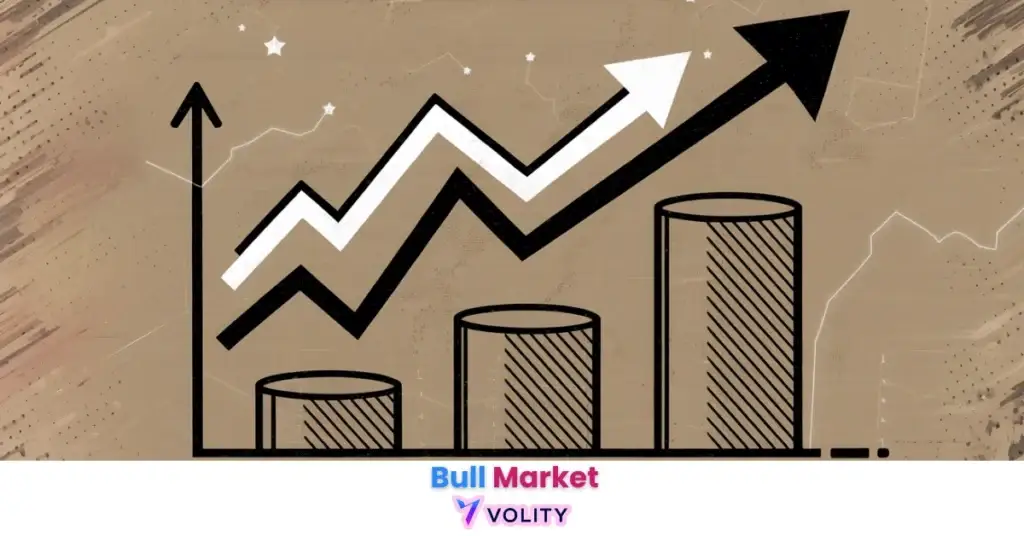
Bull market cycles are extended periods of upward price momentum fueled by positive economic indicators. These phases represent the “expansion” stage of the broader business cycle. Bull phases have historically run for years rather than months, and have delivered the bulk of long-run equity returns to investors who stayed invested through them.
Bull market dynamics function as the primary engine for global wealth creation and institutional capital growth. This phase identifies a market regime where demand consistently outweighs supply, pushing indices to new record highs. It serves as the ultimate benchmark for risk-on investor sentiment in 2026.
The 2026 investment landscape is currently navigating a secular bull run driven by the rapid integration of generative artificial intelligence across industrial sectors. Traders utilize Fundamental Analysis and various technical filters to confirm the strength of the trend and to avoid the pitfalls of temporary price corrections.
While understanding Bull Market is important, applying that knowledge is where the real growth happens. Create Your Free Forex Trading Account to practice with a free demo account and put your strategy to the test.
What is a bull market and how is it defined?
A bull market is a financial condition characterized by a sustained increase in asset prices and a widespread expectation of future growth among market participants. The 20% gain rule represents the foundational metric: when an index or stock rises at least 20% from a recent low, analysts formally classify this as a bull market entry. Psychological factors drive much of the early momentum, confidence, greed, and the “Fear of Missing Out” (FOMO) collectively create a self-reinforcing cycle where rising prices attract new buyers.
Economic fundamentals anchor a genuine bull market in reality. GDP growth, low unemployment, and rising corporate profitability establish the structural conditions that sustain upward price pressure over months and years. The longest bull market in modern US history ran from March 2009 to February 2020 before the COVID-19 pandemic triggered a bear phase. The NBER record of US business cycle expansions and contractions is the reference series for dating the underlying economic expansion.
The Anatomy of Market Momentum
Market momentum is the tendency for prices to continue moving in a specific direction due to the aggregate behavior of institutional and retail traders. Buy the Dip strategies sustain this upward momentum by creating demand at lower prices, preventing severe corrections from derailing the overall trend. Short-covering during the early stages of a bull run amplifies the move upward as traders who bet against the market are forced to exit positions at losses.
Ready to Elevate Your Trading?
You have the information. Now, get the platform. Join thousands of successful traders who use Volity for its powerful tools, fast execution, and dedicated support.
Create Your Account in Under 3 MinutesWhat causes a bull market in 2026?
Accommodative monetary policy and technological breakthroughs represent the primary drivers of modern bull market cycles. Low interest rates (or the expectation of rate cuts) directly fuel borrowing and spending by both corporations and consumers, increasing the present value of future cash flows. The AI Revolution is creating a new secular growth narrative in 2026, with generative artificial intelligence generating unprecedented productivity gains across manufacturing, healthcare, finance, and professional services.
Fiscal stimulus amplifies the bull cycle by channeling government spending into infrastructure, energy transition, and research initiatives that support long-term economic expansion. Corporate earnings growth provides the fundamental anchor for valuations, with Best AI Stocks for Investment leading the way as capital allocates toward the highest-growth sectors. Index gains have concentrated in a small group of large AI and semiconductor names, which is why a cap-weighted index can rise while most of its constituents do not.
How can I profit from a bull market?
Buy-and-hold investing and trend-following represent the most effective strategies for capturing long-term gains during a bull market cycle. Adding to positions during minor pullbacks reduces average entry costs while maintaining exposure to the overall upward trend, a discipline that compounds gains over time. Growth investing focuses on companies with rapid revenue and earnings expansion, identifying businesses that benefit most from the favorable economic environment.
Leveraged ETFs amplify returns during extended bull runs, but these instruments carry compounding risk that intensifies drawdowns when the trend reverses. Regular rebalancing ensures that concentrated positions do not become dominant during euphoric market phases, preserving capital for the inevitable transition to lower-return environments.
How the rule behaves, as an illustration: an investor who treats the 20% recovery threshold as an entry signal is by construction buying after the first fifth of the move has already happened, and is relying on the remainder of the trend to pay for that delay. That is the trade-off the threshold makes, and it is the reason trend rules underperform at turning points and outperform in the middle of long moves. Past performance is not indicative of future results.
Bull Market Benchmarks: Comparing Historical Cycles
Bull market benchmarks identify the diverse duration and performance characteristics of previous growth cycles. The comparison reveals that early bull runs typically deliver explosive returns as investors rotate from cash into equities, while later stages often exhibit slower gains as valuations tighten and economic surprises become rarer.
| Cycle Start | Duration (Months) | Total Return (S&P 500) | Primary Driver |
| Oct 1990 | 113 | +417% | Dot-Com / Internet |
| Oct 2002 | 60 | +101% | Housing / Credit |
| Mar 2009 | 131 | +400% | Tech / Low Rates |
| Oct 2022 | Ongoing | Ongoing, not yet a closed cycle | AI / Fiscal Stimulus |
| Mar 2020 | 21 | +114% | Pandemic Recovery |
Start dates, durations and index returns above are the widely reported S&P 500 cycle boundaries. The economic expansions underlying them are dated by the NBER Business Cycle Dating Committee. The current cycle is still running, so its figures move.
The dangers of a “Blow-off Top” and market bubbles
A blow-off top represents a parabolic price increase followed by a rapid and steep decline, often signaling the end of a bull market cycle. Over-valuation emerges when price-to-earnings ratios exceed historical norms by 30-50%, indicating that current prices reflect unrealistic assumptions about future growth. Retail speculation accelerates this pattern, when brokerage account openings surge sharply, it often signals Market Volatility extremes as inexperienced traders chase returns at the worst possible time.
Stock Market Bubble formation represents a systemic risk to capital preservation, as the eventual reversal can wipe out years of cumulative gains in weeks. The 2000 Nasdaq peak demonstrated this danger: the index fell 78% from its March 2000 high, destroying wealth across an entire generation of retail investors.
Turn Knowledge into Profit
You have done the reading, now it is time to act. The best way to learn is by doing. Open a free, no-risk demo account and practice your strategy with virtual funds today.
Open a Free Demo AccountPreparing for the Transition to a Bear Market
Portfolio rebalancing represents the most critical discipline for investors seeking to lock in bull market profits before a trend reversal occurs. Recognizing warning signs, inverted yield curves and slowing earnings growth, provides time to rotate capital into defensive assets before the market recognizes the shift. Rotating into “Defensive Assets” including Bonds, Gold, and Consumer Staples preserves capital while reducing exposure to sectors most vulnerable to cyclical downturns.
Portfolio Rebalancing forces discipline by mechanically selling winners and buying losers, a process that naturally reduces risk near market peaks when valuations have become stretched. Understanding the distinction between a correction and a Bull Trap prevents the costly mistake of re-entering positions too early after a sharp reversal begins.
Key Takeaways
- [Bull markets] are sustained periods of rising asset prices characterized by high investor confidence and economic expansion.
- [The technical definition] of a bull market is a twenty percent increase in stock prices from a recent market low.
- [Monetary policy] is a primary catalyst, as lower interest rates typically encourage business investment and increase equity valuations.
- [Trend-following strategies] allow investors to maximize gains by staying invested as long as the market remains above key technical levels.
- [Irrational exuberance] often marks the final phase of a bull run, leading to inflated valuations and the formation of speculative bubbles.
- [Locking in profits] through periodic rebalancing is essential to protect capital from the eventual transition into a bear market cycle.
Frequently Asked Questions
This article contains references to bull markets and Volity, a regulated CFD trading platform. This content is produced for educational purposes only and does not constitute financial advice or a recommendation to buy or sell any financial instrument. Always verify current regulatory status and platform details before using any trading service. Some links in this article may be affiliate links.