Quick answer
Oil trading is buying and selling crude oil and its benchmarks, Brent and WTI, usually as CFDs or futures rather than physical barrels, with leverage and the ability to go long or short. Oil prices swing on supply, OPEC decisions, demand and geopolitics. As a leveraged, news-driven market, oil trading offers opportunity and real risk, so use stops.
What is oil trading? Oil trading is speculating on the price of crude oil through futures, ETFs, options, or CFDs. The two retail-accessible benchmarks are WTI crude oil trading (US) and Brent (international). Volity offers both as CFDs with 1:100 leverage, no expiry, and CySEC-regulated execution under UBK Markets.
Oil trading lets you speculate on the price of crude oil without physical delivery. Volity is your all-in-one money hub. Trade WTI and Brent crude as CFDs on Volity MT with leverage up to 1:100, tight spreads, no expiry, and CySEC-regulated execution under UBK Markets.
Oil trading: what you actually trade
Three retail oil products exist; their differences matter:
1. WTI crude (West Texas Intermediate). The US benchmark. Lighter, sweeter. Delivered at Cushing, Oklahoma. Pricing is in USD per barrel.
2. Brent crude. The international benchmark. Heavier, more sour than WTI. Delivered in the North Sea. Pricing in USD per barrel. Often trades at a premium or discount to WTI based on geopolitical and refinery economics.
3. Refined products. Heating oil, gasoline, jet fuel. Less common for retail trading; more institutional.
Volity offers WTI and Brent CFDs. Spreads are competitive, leverage tops at 1:100 on selected products, markets follow the underlying futures schedule (typically Sunday 23:00 GMT through Friday 22:00 GMT with brief settlement breaks).
Why traders choose oil trading
Three motivations:
1. Macro thesis trades. Oil prices reflect global growth, OPEC+ supply decisions, geopolitical risk (Middle East, Russia-Ukraine), and US shale economics. A trader with a view on any of these drivers can express it directly through oil.
2. Inflation hedge. Oil prices feed through to consumer inflation. Long oil positions partially hedge equity portfolios against inflation regime changes.
3. Volatility opportunity. Oil routinely moves 2-5% in a day on news (OPEC+ announcements, EIA inventory reports, geopolitical events). For traders comfortable with that volatility, oil offers tradable swings.
What moves the oil price
Five primary drivers:
1. OPEC+ supply decisions. OPEC+ ministerial meetings (typically monthly) set production quotas. Surprise cuts push prices up; surprise releases or quota hikes push prices down.
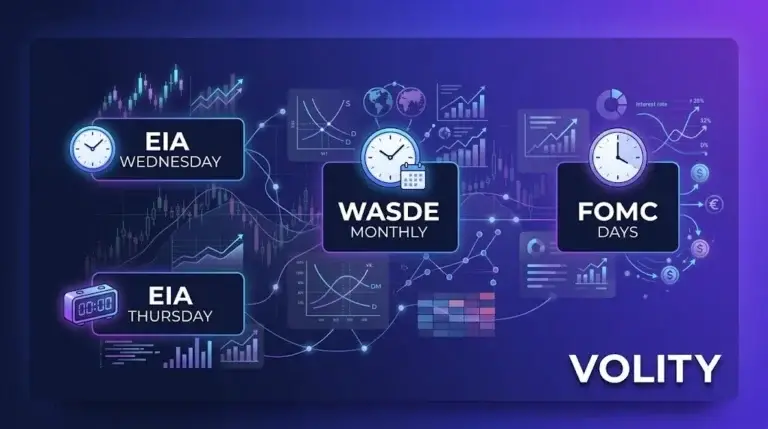
2. EIA weekly inventory data. Every Wednesday at 10:30 EST, the US Energy Information Administration publishes weekly crude inventory changes. A bigger-than-expected draw is bullish; a bigger-than-expected build is bearish.
3. Geopolitical risk premia. Middle East tensions, shipping disruptions in the Strait of Hormuz, Russia-Ukraine developments, US sanctions on Iran or Venezuela.
4. US dollar strength. Oil is priced in USD. A stronger dollar makes oil more expensive for non-USD buyers, dampening demand.
5. Global demand signals. China economic data, US manufacturing PMI, summer driving season demand, winter heating demand.
Trading hours and economic calendar
WTI and Brent CFDs on Volity follow underlying futures schedules:
- Open: Sunday 23:00 GMT
- Close: Friday 22:00 GMT
- Daily settlement: brief break around 22:00 GMT daily
Key economic events to watch:
| Event | Frequency | Time (EST) |
|---|---|---|
| EIA Weekly Petroleum Status | Weekly | Wednesday 10:30 |
| API Inventory (private) | Weekly | Tuesday 16:30 |
| OPEC+ Ministerial Meetings | Monthly-ish | Varies |
| US Drilling Rig Count (Baker Hughes) | Weekly | Friday 13:00 |
| IEA Monthly Oil Market Report | Monthly | Mid-month |
Trading around these events: oil typically moves 1-3% in the 30 minutes after a significant data release. Volatility expands; spreads briefly widen. Plan position sizing accordingly.
Leverage on oil
Volity supports up to 1:100 leverage on selected oil products. The math:
- 1 standard CFD lot = 1,000 barrels at WTI/Brent prices
- At $70/barrel, 1 lot notional = $70,000
- At 1:100 leverage, required margin = $700
- A $700 move (1% price change) at 1:100 = 100% margin destruction
Oil routinely moves more than 1% intraday. Position sizing and stop-losses are essential at high leverage. Most retail traders work better at 1:10 to 1:20 on oil unless very short-term.
Costs
- Spread: competitive on WTI and Brent (the most liquid oil CFDs). Live spread shown before order entry
- Swap: applied to positions held past 22:00 GMT. Can be positive or negative
- Commission: $0 on Standard accounts
- FX conversion: 1% if funding in EUR/GBP and trading USD-quoted oil
Risk specific to oil
- Geopolitical gaps. Surprise announcements (war, sanctions, OPEC) can gap oil 5-10% before retail traders react. Hold positions with awareness
- Storage cycle dynamics. Spring and autumn shoulder seasons have lower demand; storage builds, prices weaken
- Contango/backwardation. When near-month futures trade below or above further-month, the swap mechanic reflects this
- Single-asset concentration. Trading only oil concentrates exposure to one volatile commodity. Combine with other instruments in your account
Sample trade flow on Volity
A retail trader expecting a bullish EIA report:
- Open Volity MT, navigate to WTI CFD
- Check current price ($72.00 indicative)
- Set position size: 0.1 lot (= 100 barrels = $7,200 notional)
- Set leverage: 1:10 (margin required = $720)
- Place buy order with stop-loss at $71.20 (1% risk) and take-profit at $73.50 (2% target)
- Risk/reward: ~$80 risk for $150 target on a 0.1-lot position
- Trade fills in under 1 second
- Wait for EIA print at 10:30 EST
- If bigger draw than expected: take-profit triggers; trade closes profitable
- If smaller draw or build: stop-loss triggers; trade closes at planned loss
This is one example, not a strategy recommendation. Real trade planning depends on your edge and risk-per-trade rule.
Sources
Related Volity platforms
- Crude Oil Trading: WTI CFDs on Volity
- Natural Gas Trading: Henry Hub CFDs on Volity
- Silver Trading on Volity: XAG/USD CFDs
- Commodity Trading Platform on Volity: 150+ Markets
Frequently asked questions
What is oil trading?
Oil trading is speculating on the price of crude oil through futures, ETFs, options, or CFDs. CFDs let you go long or short oil with leverage, without physical delivery or contract expiry management. Volity offers WTI and Brent oil CFDs with up to 1:100 leverage under CySEC regulation.
Can I trade oil on Volity?
Yes. WTI crude oil and Brent crude oil are both available as CFDs on Volity MT, with leverage up to 1:100, tight spreads, no expiry, and 24/5 trading hours following the underlying futures schedule.
What leverage does Volity offer on oil?
Up to 1:100 on selected oil products. At 1:100, a 1% adverse price move wipes 100% of margin. Most retail oil strategies work better at 1:10 to 1:20 with disciplined position sizing.
What is the difference between WTI and Brent?
WTI (West Texas Intermediate) is the US benchmark, lighter and sweeter, delivered at Cushing Oklahoma. Brent is the international benchmark, slightly heavier, delivered in the North Sea. The two trade at a varying spread based on geopolitical and refinery economics. Most global oil pricing references one or both.
When does oil trading happen?
WTI and Brent CFDs on Volity trade Sunday 23:00 GMT to Friday 22:00 GMT, with a brief daily settlement break around 22:00 GMT. The most active hours are during US session (13:00-21:00 GMT) and around the weekly EIA inventory release on Wednesday 10:30 EST.
What moves the oil price most?
Five primary drivers: OPEC+ production decisions, EIA weekly inventory data, geopolitical risk, US dollar strength, and global demand signals (China data, manufacturing PMI, seasonal demand). The EIA Wednesday release is the most predictable retail-tradable catalyst.
Are oil trading profits taxable?
Yes, in most jurisdictions. CFD profits on oil are typically treated as derivatives gains. Treatment varies by country. Volity provides annual P&L statements for tax filing; consult a local tax advisor for specifics.