Quick answer
Crude oil trading speculates on the price of crude, mainly the WTI and Brent benchmarks, typically through CFDs or futures with leverage, going long or short. Crude is highly liquid and volatile, moving on inventories, OPEC output, the dollar and geopolitics. Its sharp moves create opportunity and risk, so position sizing and stops are essential.
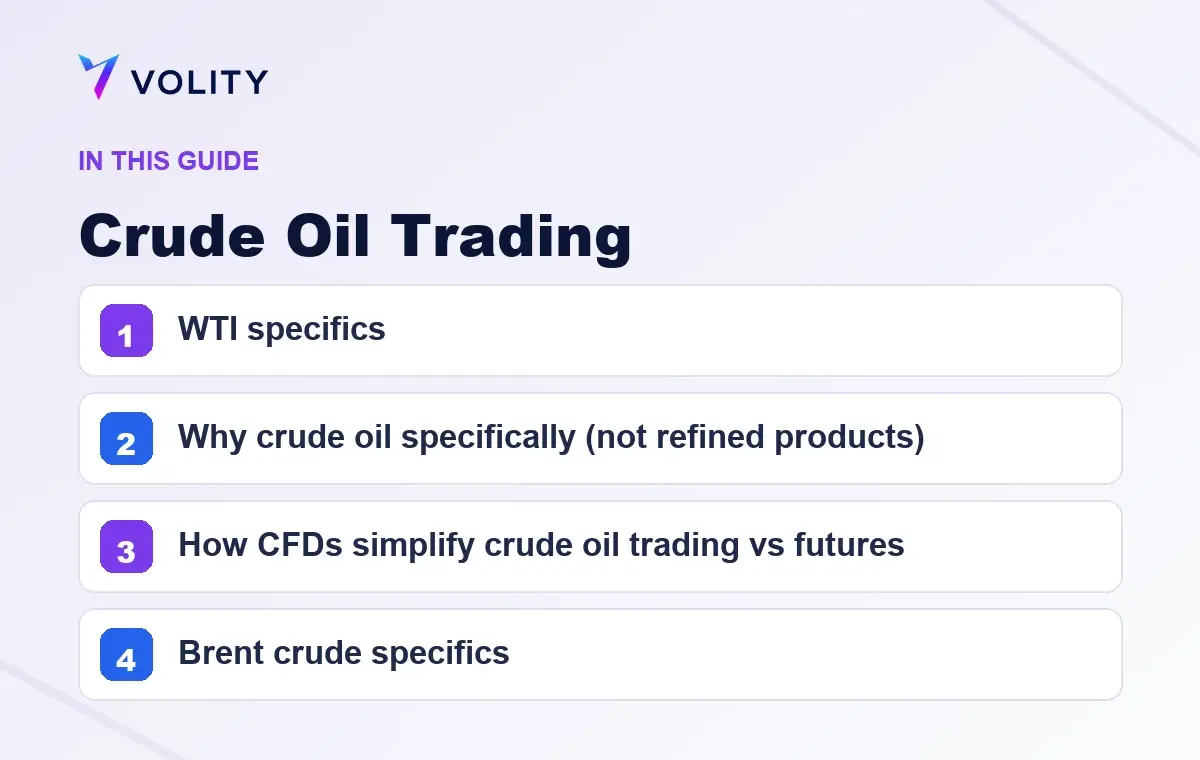
Crude oil trading speculates on the price of light sweet crude (WTI) or international Brent oil trading crude. Volity offers both as CFDs on Volity MT, with leverage up to 1:500, no contract expiry, tight spreads, and CySEC-regulated execution under UBK Markets. This page focuses on WTI specifically and the broader crude-oil trading workflow.
WTI specifics
West Texas Intermediate (WTI) is the US benchmark crude. Key facts:
- API gravity: 39.6 (light)
- Sulphur content: 0.24% (sweet)
- Delivery point: Cushing, Oklahoma
- Standard futures contract: 1,000 barrels (CL on NYMEX)
- Tick size: $0.01 per barrel ($10 per tick per contract)
- Trading hours (Volity CFD): Sunday 23:00 GMT through Friday 22:00 GMT
WTI prices are quoted in USD per barrel. Recent ranges have spanned $60-$95 across 2024-2025. The contract is highly liquid, especially around US session (13:00-21:00 GMT).
Why crude oil specifically (not refined products)
Three reasons retail traders focus on crude rather than refined products:
1. Liquidity. WTI and Brent crude have the deepest retail-accessible liquidity in the energy complex. Refined products (gasoline, heating oil, jet fuel) have wider spreads and thinner books.
2. Macro purity. Crude reflects supply-demand fundamentals directly. Refined products are downstream of crude plus refining margins (the crack spread), adding a second variable that complicates the trade thesis.
3. Volatility. WTI moves 1-3% in a typical day. That is enough volatility to make CFD trading meaningful at moderate leverage.
How CFDs simplify crude oil trading vs futures
Compared to CL futures on NYMEX:
| Feature | NYMEX CL futures | Volity WTI CFD |
|---|---|---|
| Contract size | 1,000 barrels | Flexible (0.01 lot = 10 barrels) |
| Expiry | Monthly | None |
| Margin requirement | ~$5,000-7,000 per contract | ~$7 at 1:100 on 0.01 lot |
| Settlement | Physical or cash by venue | Cash, broker-settled |
| Brokerage | Per-contract commission | Spread-based, no commission |
| Available globally | Limited by broker | Volity in its regulatory footprint |
For retail position sizes ($1,000-$50,000), CFDs are simpler and lower-friction than futures.
Brent crude specifics
Brent crude is the international benchmark:
- API gravity: 38 (slightly heavier than WTI)
- Sulphur content: 0.37% (slightly more sour than WTI)
- Delivery point: North Sea
- Standard futures contract: 1,000 barrels (B on ICE)
- Pricing premium vs WTI: typically $3-7/barrel based on geopolitical and refinery economics
Brent is the reference price for about two-thirds of internationally traded crude. WTI dominates US pricing. Trading both lets you express views on the WTI-Brent spread itself.
WTI-Brent spread as a tradable view
The WTI-Brent spread is a tradable instrument in its own right:
- Brent at premium to WTI: typical (Europe pays more for crude, US has shale supply abundance)
- WTI at premium to Brent: unusual, indicates US supply tightness or international oversupply
- Spread widens during geopolitical events: Middle East tensions raise Brent more than WTI
A spread trade: long Brent + short WTI, sized so the dollar exposure is matched. Profit if the spread widens; loss if it narrows. Volity supports this via separate CFD positions; the margin requirement for the combined position depends on the underlying contracts.
Common trade setups
1. Inventory-driven trades. EIA weekly crude inventory report (Wednesdays 10:30 EST). Bigger-than-expected draw is bullish; bigger-than-expected build is bearish. Median reaction: 1-2% in the 30 minutes after release.
2. OPEC+ meeting trades. OPEC+ ministerial meetings periodically reset production quotas. Surprise cuts push prices up; surprise additions push prices down. Timing varies; check the OPEC calendar.
3. Geopolitical risk-on/risk-off. Middle East flare-ups, Russia-Ukraine developments, US sanctions on Iran or Venezuela. These move prices on news within minutes.
4. Storage-cycle seasonality. Spring (Mar-Apr) and autumn (Sep-Oct) shoulder seasons see lower demand and storage builds, weakening prices. Summer driving season and winter heating demand tend to support prices.
5. Cross-asset correlation trades. Oil correlates with broader risk assets during stress events. Pair trades vs equities or vs USD can express macro views.
Risk specific to crude oil
- Overnight gaps. Oil futures roll over with brief settlement breaks; news during these breaks can produce gaps when markets reopen
- OPEC announcement surprises. OPEC+ meetings are scheduled but outcomes are not. Position sizing should account for surprise potential
- Refinery disruption events. Hurricanes, fires, technical failures at major refineries cause regional supply shocks
- Sanctions and embargo events. New sanctions on producer countries can shift supply expectations dramatically
Cost structure summary
- Spread on WTI/Brent: competitive, visible before order entry
- Swap on overnight positions: applied at 22:00 GMT, positive or negative
- Commission: $0 on Markets
- FX conversion: 1% if funding non-USD and trading USD-quoted
Sources
Related Volity platforms
- Oil Trading on Volity: WTI & Brent CFDs
- Natural Gas Trading: Henry Hub CFDs on Volity
- Silver Trading on Volity: XAG/USD CFDs
- Commodity Trading Platform on Volity: 150+ Markets
Frequently asked questions
What is crude oil trading?
Crude oil trading is speculating on the price of unrefined oil through futures, ETFs, options, or CFDs. The two retail-accessible benchmarks are WTI (US) and Brent (international). Volity offers both as CFDs with 1:500 leverage and no expiry.
What is the difference between crude oil and oil trading?
“Oil trading” is a broader term that includes crude oil plus refined products (gasoline, heating oil, jet fuel). “Crude oil trading” specifically refers to unrefined crude, WTI and Brent are the two main benchmarks. Most retail oil trading is on crude rather than refined products because crude liquidity is deeper.
Can I trade WTI crude oil on Volity?
Yes. WTI crude oil is available as a CFD on Volity MT with leverage up to 1:500. Contract size is flexible (0.01 lot minimum = 10 barrels). No expiry, so no contract roll. CySEC-regulated execution.
How much capital do I need to trade crude oil?
With CFDs at 1:100 leverage, a 0.01-lot position (10 barrels at $70/barrel = $700 notional) requires about $7 margin. At more practical 1:10 leverage on a 0.1-lot position (100 barrels = $7,000 notional), margin is around $700. Volity’s live trading minimum is $1 to open an account.
What is the WTI-Brent spread?
The WTI-Brent spread is the price difference between the two benchmarks. Brent typically trades at a $3-7 premium to WTI based on geopolitical and refinery economics. Trading the spread directly involves matched positions long Brent and short WTI (or vice versa).
When does crude oil trading happen?
WTI and Brent CFDs on Volity follow underlying futures schedules: Sunday 23:00 GMT to Friday 22:00 GMT, with a brief daily settlement break around 22:00 GMT. The most liquid hours are US session (13:00-21:00 GMT) and around weekly EIA inventory releases.
What moves crude oil prices most?
Five primary drivers: OPEC+ production decisions, EIA weekly inventory data, geopolitical risk (Middle East, Russia-Ukraine, sanctions), US dollar strength, and global demand signals. The Wednesday EIA release is the most predictable scheduled volatility window.