Quick answer
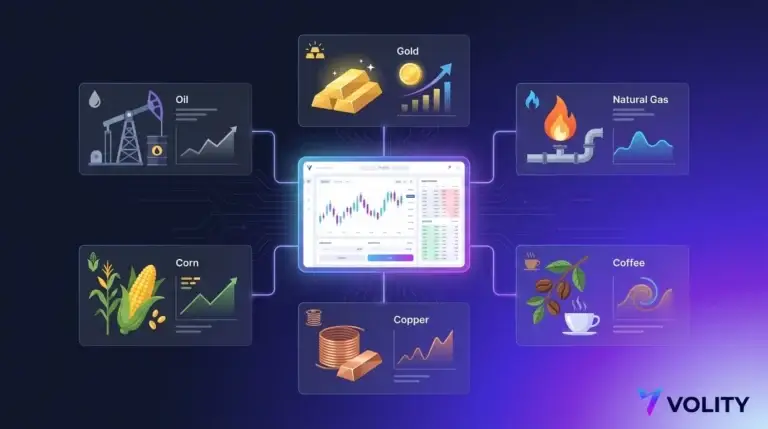
Agricultural commodities trading covers crops and softs like wheat, corn, soybeans, coffee, sugar and cotton, usually traded as CFDs or futures. Prices swing on weather, harvests, demand and geopolitics, creating opportunity and risk. As leveraged products, agricultural commodity trades amplify gains and losses, so use stops and size positions carefully.
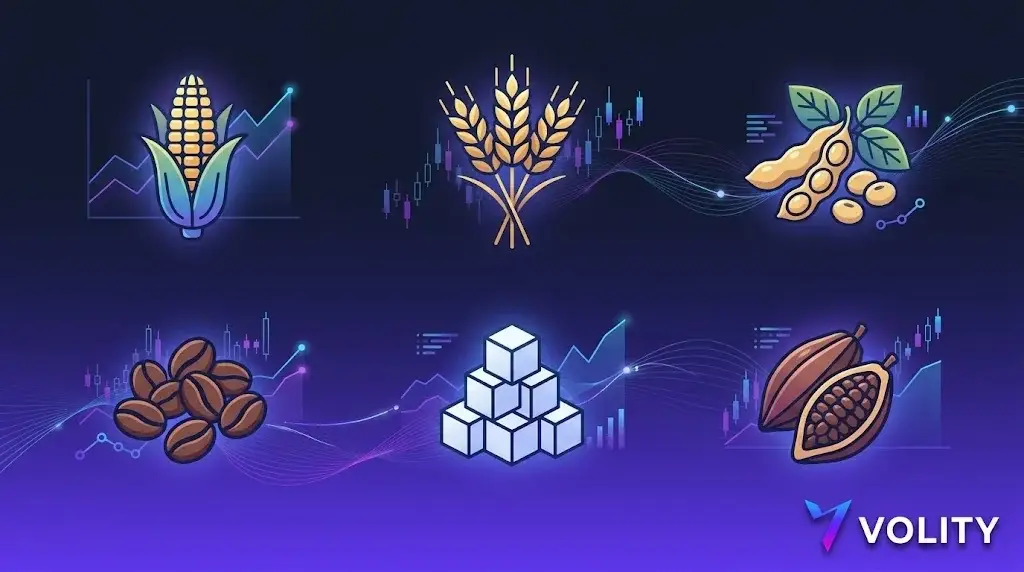
Agricultural commodities trading covers grains (corn, wheat, soybeans), softs (coffee, sugar, cocoa, cotton), and livestock (cattle, hogs). Volity offers agricultural CFDs on Volity MT with leverage up to 1:500, no expiry, and CySEC-regulated execution. Agricultural markets are weather-driven, USDA-report driven, and seasonal in ways that create predictable volatility windows.
Three sub-categories
1. Grains. Corn, wheat, soybeans, rice. The primary global feed and food crops. Pricing reflects US Midwest production, global stocks (Black Sea, South America, India, China), and end-use demand from animal feed and biofuel.
2. Softs (soft commodities). Coffee, sugar, cocoa, cotton, orange juice. Tropical or sub-tropical crops with concentrated production geography (Brazil for coffee, West Africa for cocoa). Weather and political risk in producer countries drives prices.
3. Livestock. Live cattle, feeder cattle, lean hogs. Reflects animal-protein supply and demand. USDA cattle inventory reports and outbreak events (avian flu, swine fever) drive prices.
Volity supports the most liquid contracts in each category. Smaller agricultural CFDs may have wider spreads and lower retail interest.
Why agricultural commodities trade differently
Three structural differences from energy/metals:
1. Annual production cycle. Crops are planted and harvested on annual cycles. Production for the year is largely determined by planting decisions and weather during the growing season. This creates predictable seasonal patterns.
2. Weather risk concentration. Most production is concentrated in specific regions. US Midwest for corn and soybeans; Brazil and Argentina for soybeans and coffee; West Africa for cocoa. Weather events in these regions move prices sharply.
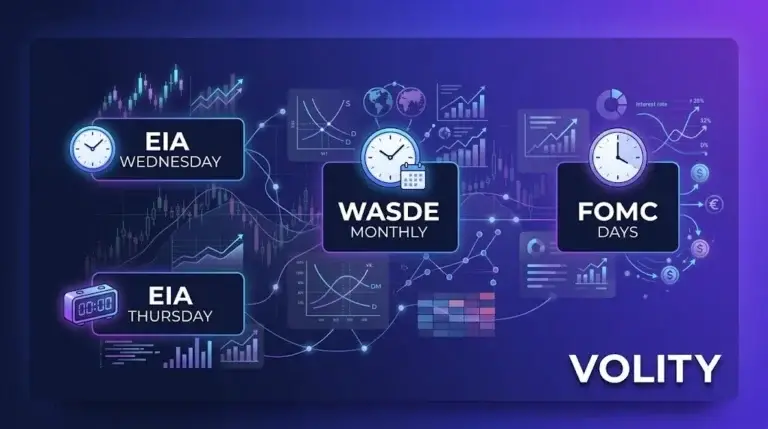
3. USDA-driven volatility. The USDA’s monthly World Agricultural Supply and Demand Estimates (WASDE) report is the single most important data release. Surprise revisions move corn, wheat, and soybeans 2-5% in 30 minutes.
Key calendar for agricultural traders
| Event | Frequency | Time (EST) |
|---|---|---|
| USDA WASDE Report | Monthly | Mid-month, 12:00 |
| USDA Crop Progress | Weekly (April-October) | Monday 16:00 |
| USDA Cattle on Feed | Monthly | Last Friday of month, 15:00 |
| USDA Grain Stocks | Quarterly | Varies |
| ICE Coffee Stocks | Daily | Continuous |
Seasonality:
| Crop | Plant | Harvest | Volatility peak |
|---|---|---|---|
| Corn | April-May (US) | Sep-Oct | June-August (pollination) |
| Soybeans | May-June (US) | Sep-Nov | July-August (pod fill) |
| Wheat | Sep-Oct (winter), Mar-May (spring) | Jun-Jul (winter), Aug-Sep (spring) | Pre-harvest |
| Coffee | Year-round (different regions) | Variable | Brazilian frost season (May-July) |
| Cocoa | Year-round (West Africa) | Oct-Mar | Harmattan season (Dec-Feb) |
| Sugar | Year-round (Brazil, India) | Variable | Brazilian harvest season (May-Nov) |
Common trade setups
1. WASDE event trades. Position before the monthly report based on consensus; profit if actual diverges from consensus. High-volatility short-term play.
2. Weather-forecast trades. Heat dome forecasts during US corn pollination, frost forecasts in Brazil coffee belts, drought patterns. Longer-horizon than WASDE trades, often days to weeks.
3. Seasonal cycle trades. Plant new corn long positions during planting, exit before harvest. Reverse for short positions. Multi-month holds.
4. Spread trades. Long corn vs short wheat (or other combinations) based on supply-demand thesis on each individually. Lower volatility than outright positions.
Risk specific to agricultural
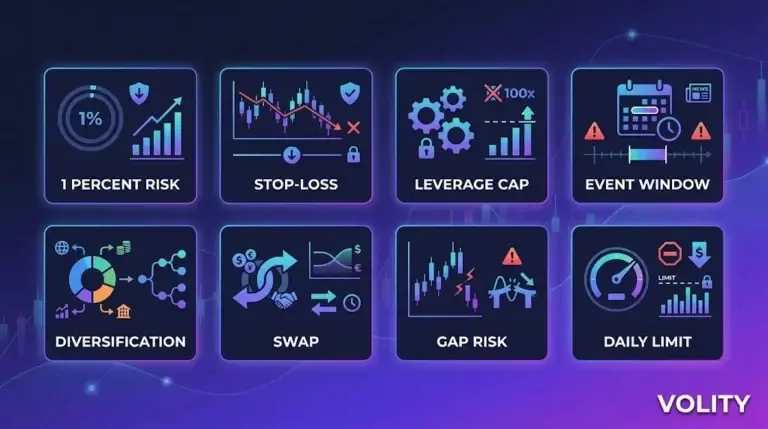
- Weather event surprises. Frost in Brazilian coffee belts can move prices 10-20% in days. Position size to allow surviving these
- USDA revision risk. WASDE revisions reflect changing estimates, sometimes by large amounts. Holding through WASDE is its own decision
- Political risk. Russian wheat export restrictions, Ukrainian war effects, Argentine export taxes. Geopolitical events move agriculturals heavily
- Concentration risk. Trading a single crop concentrates exposure. Diversification across categories reduces but does not eliminate this
Costs
- Spread: varies by contract; grain spreads competitive, softs and livestock wider
- Swap: applied at 22:00 GMT on overnight leveraged positions
- Commission: $0 on Markets
- FX conversion: 1% on non-USD funding
Why retail-friendly agricultural CFDs matter
Traditional agricultural futures are large contracts (5,000 bushels of corn per contract, 5 tonnes of cocoa per contract). At typical prices, single contracts are $25,000-$100,000 notional. CFDs let retail traders scale down to fractional positions ($1,000 notional or less) while maintaining the same market exposure characteristics.
Sources
Related Volity commodity guides
- Coffee CFD Trading: Arabica, Robusta, Harvest Cycle
- Commodity ETFs Explained vs CFD Trading
- Agricultural Commodities Trading on Volity
- Commodity Trading Platform on Volity
- Oil Trading on Volity: WTI and Brent CFDs
- Silver Trading on Volity: XAG/USD CFDs
Frequently asked questions
What is agricultural commodities trading?
Agricultural commodities trading speculates on prices of crops and livestock products: corn, wheat, soybeans, coffee, sugar, cocoa, cattle, hogs. Trading happens via futures, ETFs, or CFDs. Volity offers agricultural CFDs with up to 1:500 leverage and no expiry.
Can I trade corn or wheat on Volity?
Yes. Major agricultural commodities including corn, wheat, soybeans, coffee, sugar, and cocoa are available as CFDs on Volity MT. Leverage up to 1:500 product-dependent. Markets follow underlying futures schedules.
When does agricultural commodity trading happen?
Most agricultural CFD markets on Volity follow underlying Chicago Mercantile Exchange (CME) and ICE futures schedules. Grains trade Sunday 23:00 GMT to Friday 22:00 GMT with brief settlement breaks. Softs trade during US session primarily (13:00-19:00 GMT).
What is the USDA WASDE report?
The USDA World Agricultural Supply and Demand Estimates report is released monthly with updated supply, demand, and stocks estimates for major crops. It is the single most important data release for grain markets, often moving corn, wheat, and soybeans 2-5% in 30 minutes after release.
Which agricultural commodity is most volatile?
Coffee and cocoa tend to be among the most volatile due to concentrated production geography and weather sensitivity. Corn and soybeans have more moderate volatility but spike around WASDE releases and weather events. Livestock products have moderate but persistent volatility.
How much capital do I need for agricultural trading?
With CFDs at typical 1:10 leverage, a 0.01 lot corn position requires modest margin (corn at $5/bushel × 5,000 bushels = $25,000 notional per standard lot; 0.01 lot = $250 notional, ~$25 margin at 1:10). Volity’s live trading minimum is $1.
Are agricultural CFDs taxable?
Yes, in most jurisdictions. Treatment is typically as derivatives gains. Country-specific. Volity provides annual statements for tax filing. Consult a local tax advisor.