Crypto Day: Bitcoin Gaps Meet Quantum Nerves
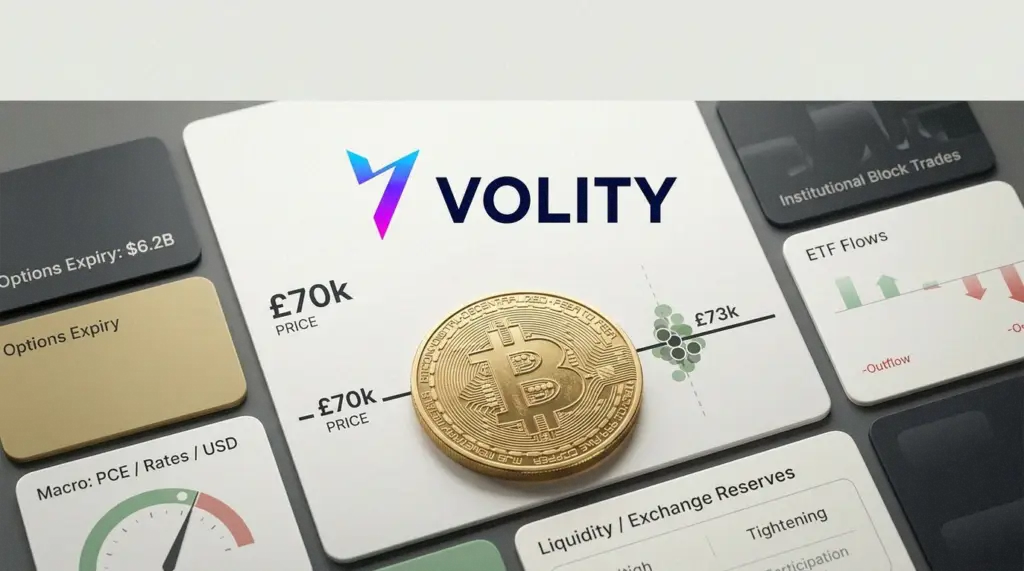
Crypto markets look jumpy today, but the noise has a structure. Bitcoin is again testing the $70,000 to $73,000 zone. Meanwhile, traders are watching options, ETF flows, inflation data and fresh regulatory pressure. The market has a tired look, yet the big money keeps building rails under it.
Bitcoin: Options, Etfs and a Thinner Spot Market
The main question is simple. Can bitcoin hold above $70,000 while derivatives traders reset risk?
More than $6.2bn of bitcoin options are heading towards expiry. Therefore, dealers and funds are adjusting hedges. That can sharpen intraday moves, especially near crowded strike prices.
At the same time, parts of the spot ETF complex are seeing outflows after the spring rush. That matters because ETF demand has become one of bitcoin’s cleanest institutional transmission channels. When flows cool, price momentum often cools with them.
However, exchange balances tell a different story. Bitcoin reserves on centralised venues remain tight while spot trades near $73,000. In plain English, fewer coins appear ready for sale on exchanges. That does not guarantee a rally. Still, it gives any demand shock more room to bite.
Macro: Pce is the Next Stress Test
Macro is again sitting in the driver’s seat. Banks are bracing for a potentially firm US PCE inflation reading. The Federal Reserve watches that gauge closely, so crypto traders must watch it too.
If inflation lands hotter than expected, rate-cut hopes may fade again. As a result, the dollar could strengthen and risk assets could wobble. Bitcoin and larger altcoins often behave like long-duration risk trades during such moments.
Still, the reaction may not be linear. A mild surprise could already be priced into derivatives. A large surprise, however, would likely hit ETF flows and leveraged positions quickly.
By the Numbers
- $73,000 – the upper area bitcoin is trying to reclaim.
- $70,000 – the nearby line traders are treating as a sentiment floor.
- $6.2bn – bitcoin options value approaching expiry.
- $1.3bn – reported dark-pool activity tied to BlackRock’s IBIT.
- $5mn – the Gemini settlement figure now back in regulatory focus.
Market Structure: Cme Moves Towards Weekend Crypto
CME’s push towards round-the-clock bitcoin futures trading would close one of crypto’s oddest habits. For years, traders obsessed over weekend gaps between crypto spot markets and Monday futures opens.
That gap created easy chart theatre and occasional real pressure. However, deeper weekend futures trading would smooth risk transfer for institutions. It would also make bitcoin look less like a side market and more like a global macro instrument.
For traders, the change cuts both ways. Fewer gaps may reduce simple mean-reversion setups. Meanwhile, liquidity at awkward hours could improve, especially for funds that cannot trade on offshore venues.
Tradfi: Samsung, Aave and Cash App Build Quietly
The loudest traders still live online. Yet the quieter story is corporate and financial infrastructure.
Samsung’s $408mn move involving Dunamu, the operator of Upbit, points to a broader Asian trend. Big technology groups are no longer circling crypto only through chips, wallets or advertising. Instead, they are moving closer to exchange infrastructure and customer flow.
Meanwhile, Aave Labs’ UK expansion after FCA-linked approval adds another layer to regulated DeFi. London has long understood derivatives, collateral and structured risk. Now, those habits are meeting smart-contract credit markets.
Cash App’s rollout of USDC payments to nearly 60mn users may prove more important than another token launch. Stablecoins become powerful when they leave exchange accounts and enter ordinary payments. Therefore, Block’s distribution could lift USDC usage beyond trading and treasury parking.
That shift also sharpens the USDC versus USDT contest. USDT remains dominant, especially offshore. However, USDC has better access to regulated US consumer channels. That distinction will matter if stablecoin legislation tightens.
Etfs: the Quiet Plumbing Behind Ibit
Bitcoin ETFs are increasingly behaving like mature market products. The reported $1.3bn dark-pool trade tied to BlackRock’s IBIT shows how large accounts prefer to move risk discreetly.
Dark-pool activity is not sinister by itself. In equities, it is routine. However, its use in bitcoin products shows how far the asset has travelled. The same tools used for megacap stocks are now being applied to digital assets.
For price action, the effect can feel strange. Large demand or supply may not appear in the visible order book. Then, later, the market seems to move without an obvious public trigger.
Regulation: Gemini and Polymarket Stay in View
The regulatory backdrop remains busy. The CFTC’s attempt to revisit a $5mn Gemini settlement keeps old disputes alive. It also reminds exchanges that settlements may not always end the story cleanly.
Meanwhile, Polymarket’s position on mandatory KYC keeps prediction markets in a tense category. These platforms thrive on speed, anonymity and topical markets. However, regulators prefer identity, surveillance and audit trails.
That tension will not disappear before the US election cycle intensifies. As a result, prediction-market tokens and related platforms may trade more on legal headlines than revenue.
Risk: Hacks, Aml and the Quantum Question
Security headlines remain a tax on crypto’s credibility. Stake DAO has reported an exploit, while saying core products were not affected and a bridge was closed. That limits the damage, but it does not erase the warning.
Smart contracts still fail in small, expensive ways. Bridges remain especially sensitive. As a result, investors should treat yield as a risk premium, not free income.
Separately, quantum-computing fears are drifting back into bitcoin discussions. This is not a “tomorrow morning” threat. Still, the relevant question is timing. If the industry waits too long to prepare quantum-resistant systems, the eventual migration could become messy.
AML pressure is also rising. Compliance tools have improved, yet illicit flows still adapt. Regulators are focusing on the overlap between DeFi, stablecoins and offshore liquidity. That means more scrutiny for mixers, bridges and lightly supervised venues.
Xrp: Legal Leftovers and Staking Dreams
XRP remains its own market theatre. The long-running legal saga is closer to its final phase, though loose ends remain. Traders now know more about the legal frame than they did two years ago. Still, certainty is not the same as freedom from risk.
David Schwartz’s discussion of an XRP staking model adds another angle. Yield could attract holders, but tax treatment matters. In the US, staking rewards can create complex reporting issues. Therefore, income-hungry holders should read the small print before celebrating.
Stablecoins: the Payment Layer Fight
The stablecoin battle is shifting from issuance to settlement. Tron continues to position itself as a cheap payment rail. Its strength is simple: large stablecoin flows, low fees and broad emerging-market use.
Sui, meanwhile, is pushing USDsui as a native stablecoin for its own ecosystem. That model binds the chain and the money layer more tightly. If it works, Sui gets stickier liquidity and more recurring fee activity.
For investors, the winner is not always the chain with the loudest community. It is often the network that processes boring, repeatable payments at scale.
Retail: Beware the Miracle Income Pitch
Speculative retail marketing is heating up again. Claims of $3,700 a day in passive income from an “XRP Power” app should raise eyebrows. The combination of huge daily income, vague mechanics and fashionable branding is a classic warning sign.
Meanwhile, political tokens and gaming rumours continue to pull in fast money. WORLD, WLFI and talk around crypto-native gaming all feed the same appetite. However, these trades rely more on narrative speed than durable cash flow.
Related coverage on Volity
- APLD Surges on $7.5bn AI Deal as NVDA Gauges Risk-On Mood
- Bitcoin Price Today: Crypto Outflows as RWA Tokenisation Soars
- NVDA & TSM: 26 Daily Watchlists to Spot Risk and Profit Fast
- Bitcoin Price Slips as ETF Outflows Hit Yearly High
- Zoom (ZM) Earnings Gap in Focus: Top Trade Levels
Key Takeaways
- Bitcoin traders should watch $70,000 and $73,000 around options expiry and PCE.
- ETF flows remain a cleaner signal than social chatter for institutional demand.
- Stablecoins are moving from trading tools into payment infrastructure.
- DeFi yields still require bridge, contract and regulatory risk checks.
- Retail narratives can run hard, but position size should stay modest.
Today’s crypto market is not calm. However, it is not random either. Derivatives are pulling one way, infrastructure is pushing another, and regulators are still pacing the room.