Watchlist Shows a Market Split Between Ai Leaders and Weaker Cyclicals
Wall Street enters the next session with two markets running at once.
One still pays up for artificial intelligence, semiconductors and anything with a credible growth motor. The other quietly marks down soft consumers, tired industrials and stocks hit by downgrades.
That split gives today’s watchlist its shape. It is not a menu of instant buys and sells. Instead, it shows where attention, liquidity and nerves may gather first.
For active traders, that matters more than a neat narrative. A stock with fresh news can move fast. However, a stock with fresh news and market permission can travel much further.
Bullish Catalyst Board
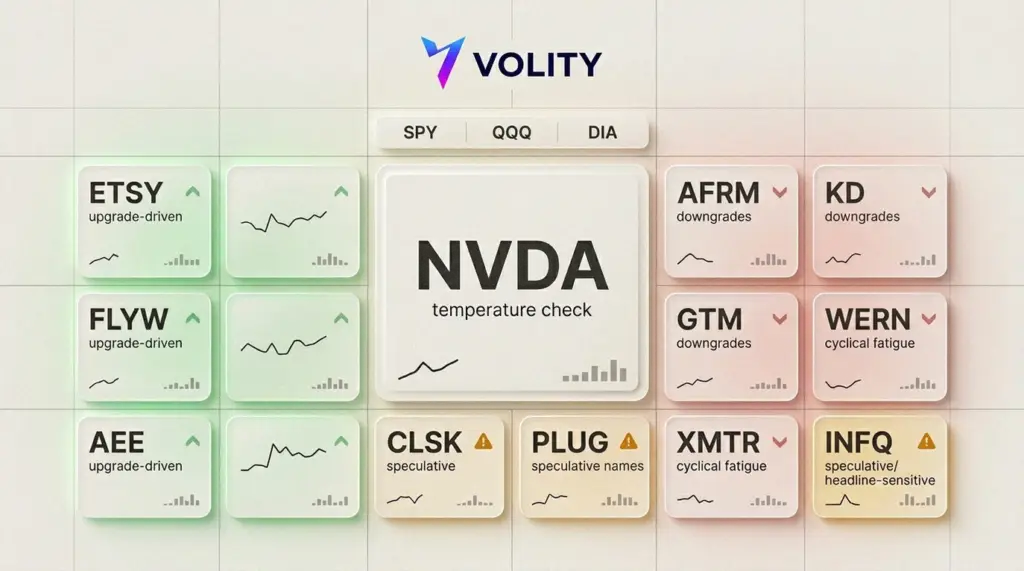
Upgrades put Etsy (ETSY), Flywire (FLYW) and Ameren (AEE) near the top of trading screens.
Still, upgrades rarely work in isolation. They tend to add fuel when a chart already leans higher. Traders will watch early volume closely. A strong open that holds through mid-morning would matter. A gap that fades by lunch would say something else.
Etsy remains a consumer sentiment test as much as an e-commerce story. If buyers reward the upgrade, traders may read it as tolerance for selective retail risk. If sellers fade it, the market may be saying discretionary spending still looks thin.
Flywire, meanwhile, sits in the higher-growth payments lane. That group can rally sharply when risk appetite improves. However, it can also lose sponsorship when rates, guidance or credit worries return.
Ameren offers a different signal. Utilities do not usually lead speculative rallies. So, interest in AEE may point to investors seeking cleaner earnings visibility and regulated cash flow.
Fresh attention around SailPoint-style cybersecurity exposure (SAIL) adds another momentum candidate. New coverage can draw fast money, especially when shares sit near a clean technical level. Yet cybersecurity has become selective. Traders now reward durable billings and punish vague growth talk.
Ai Still Sets the Temperature
The market’s main mood gauge remains Nvidia (NVDA).
NVDA is no longer just a semiconductor stock on a hot streak. It has become a daily referendum on AI capital spending, data-centre demand and risk appetite. When Nvidia holds firm, traders often push into adjacent names. When it wobbles, the whole high-beta complex feels it.
That influence reaches Apple (AAPL), even though its AI story looks different. Traders keep watching handset demand, supply-chain tone and any sign that on-device AI can revive upgrade cycles. Meanwhile, Samsung read-throughs still matter for memory, screens and broader hardware demand.
Intuit (INTU) and NBIS also sit in the post-earnings leader bucket. Their behaviour matters because leadership now looks narrow. If these stocks consolidate calmly, bulls can argue the rally still has breadth under the surface. If they start distributing, risk managers will notice quickly.
Speculation Remains Alive
The riskier corner of the board has not gone quiet.
CleanSpark (CLSK) appears after a hedge fund disclosed a larger stake. That ties the stock directly to Bitcoin, miner economics and energy costs. As a result, CLSK may trade less like a company and more like a leveraged crypto expression.
That can help when Bitcoin strength pulls in momentum accounts. However, thin patience cuts both ways. If crypto stalls, miners often lose support before slower investors react.
Plug Power (PLUG) also returns to screens after a U.K. project win. The headline is positive. Still, the flat early reaction suggests investors want proof, not promises. PLUG has trained the market to demand execution, funding discipline and cleaner margins.
Small-cap INFQ brings a sharper edge. The stock links to a proposed U.S. CHIPS-related funding deal of roughly $100 million. That figure gives traders a headline to chase. Yet liquidity can turn a modest order into a large move. INFQ belongs on a volatility list, not in a sleepy long-term basket.
Retail Faces a Margin Test
Ross Stores (ROST) lands in the watchlist as an earnings volatility candidate.
Off-price retail has held up better than many consumer names. Shoppers still want bargains, and trade-down behaviour helps the model. However, the next report must support that story with margins, traffic and inventory discipline.
A clean beat could keep ROST in the defensive-consumer winner camp. A weak guide, however, may raise questions beyond one chain. It would hint that even bargain hunters have limits.
Caution List
Downgrades put Affirm (AFRM), Kyndryl (KD) and GTM on the weaker side of the ledger.
Downgrades rarely shock professionals. Still, they can accelerate an existing move. The key test is simple. Do early bounces attract real buyers, or do larger holders use strength to sell?
Affirm remains the most sensitive of the three. It sits at the intersection of consumer credit, rates and growth-stock appetite. Price action after a downgrade may reveal more than the note itself.
Kyndryl trades with a more enterprise-heavy rhythm. Investors will focus on contract momentum, free cash flow and any sign that turnaround enthusiasm has peaked.
Cisco (CSCO) makes the caution board on technical grounds. Traders are watching a possible gap-fill setup after its recent earnings move. If shares drift into that open pocket, short-term sellers may press. Buyers need to defend the zone quickly.
Industrials Show Quiet Fatigue
Werner Enterprises (WERN) and Xometry (XMTR) tell a less dramatic story, but it may prove useful.
Both sit near economically sensitive parts of the market. Werner reflects freight, trucking utilisation and rate pressure. Xometry points toward manufacturing demand and small-business capital spending.
Neither name needs a crisis to underperform. Sometimes soft data and weak tape do enough damage. As a result, traders looking for shorts or pairs trades may keep both on screen if macro numbers soften.
Index Backbone
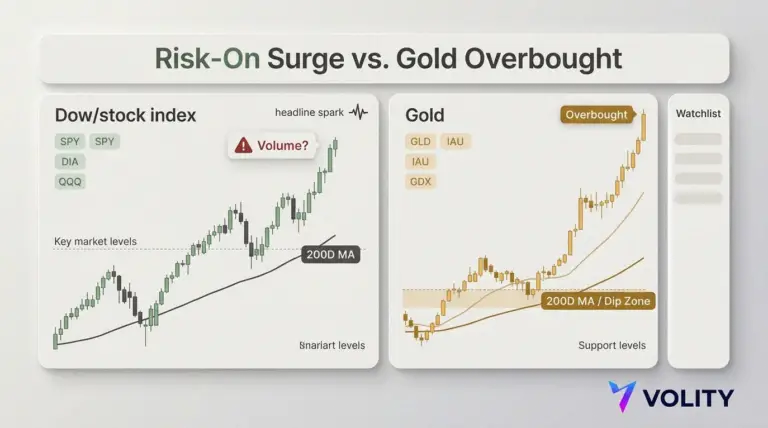
The single-stock map still depends on SPY, QQQ and DIA.
These ETFs control the background music. If QQQ holds a strong bid, traders may forgive flaws in growth names. If SPY and DIA lose traction, cyclical weakness could spread quickly.
Meanwhile, leadership concentration remains the market’s quiet problem. The tape looks healthy when mega-cap tech rises. Yet many smaller groups lag. That gap can persist for months. However, it raises the cost of being late to crowded trades.
Income and Value in Tech
The watchlist also includes a slower rotation into mature technology names.
AudioCodes (AUDC), HP Inc. (HPQ) and Opera (OPRA) fit that frame. They are not pure bond substitutes. Still, they offer a different pitch from unprofitable growth: valuations, cash flow, dividends or buybacks.
HPQ carries the cleanest large-cap recognition in that group. Investors know the personal-computer cycle remains uneven. However, capital returns can cushion dull revenue periods.
AUDC and OPRA require more selectivity. Their yields, payout policies and balance sheets can change. Investors should verify current income metrics before treating either as a dividend idea.
Private Credit Stays in the Background
The heaviest money theme on the list moves more slowly.
Apollo Global (APO), Ares Management (ARES), BlackRock (BLK) and Blue Owl (OWL) sit at the centre of private credit’s expansion.
These firms increasingly supply financing that banks once dominated. Tighter regulation, higher capital standards and borrower demand have pushed more lending into private hands. As a result, their stocks tell investors something about who controls the credit spigot now.
Day traders should not expect them to behave like small-cap miners. However, six-to-24-month investors may treat them as structural positioning stories. Fee growth, fundraising and credit quality will matter more than one morning’s tape.
By the Numbers
- $100 million – reported size of the proposed CHIPS-linked funding tied to INFQ.
- 3 main ETFs – SPY, QQQ and DIA set the trading backdrop.
- 4 private credit names – APO, ARES, BLK and OWL anchor the medium-term theme.
- 2 miner and hydrogen trades – CLSK and PLUG carry high-volatility headline risk.
- 6-to-24 months – the more sensible horizon for private credit positioning.
Related coverage on Volity
- Green Tape Trap: NVDA, CCL & SOFI Trades to Watch
- Crypto Market Today: Bridge Hacks, MiCA, Solana ETF Bid
- Bitcoin Below $80k as ETF Flows, Tokenised Treasuries Grow
- Master Crypto Investments: Navigating Risk and Opportunities
- Bitcoin Dips Below $77k as ETFs Shed $1bn
Key Takeaways
- Use upgrades as confirmation, not automatic entry signals.
- Watch NVDA first for AI risk appetite across semis and growth.
- Treat INFQ, CLSK and PLUG as volatility trades with tight discipline.
- Monitor AFRM, KD and GTM for failed bounces after downgrades.
- Keep SPY, QQQ and DIA on screen before acting on single-stock setups.
The useful watchlist is not a prediction sheet. It is a pressure map. Today, the pressure sits around AI leadership, downgrade risk, speculative headlines and the slow migration of credit outside banks.
Price and volume still get the final vote.