Crypto market digest: bitcoin steadies, stablecoins go institutional, and regulation redraws the map
The crypto market looks calm at first glance. Underneath, though, money keeps moving into the machinery.
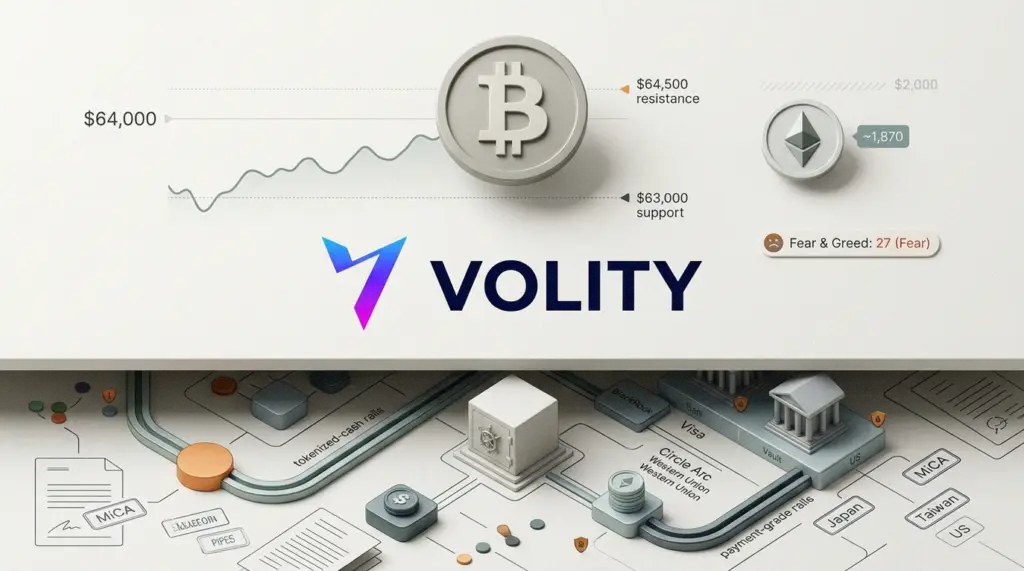
Bitcoin is holding above the $64,000 area after a choppy rebound. Ethereum sits near $1,870, still below the round $2,000 mark that traders keep watching. Meanwhile, the broader market value is near $2.27 trillion, with daily volume around $52.2 billion.
That is not euphoric tape. The Fear and Greed Index is at 27, which still signals fear. However, prices have stopped sliding for now, and the market is again rewarding specific stories.
Those stories now stretch well beyond token charts. Stablecoins, tokenised deposits, licences, staking services and bank-grade settlement rails are becoming the main plot. In other words, crypto is trading like a market, but developing like financial infrastructure.
Bitcoin holds the line
Bitcoin recently traded around $64,104, after finding support near $63,000. Buyers have defended that zone, but sellers still appear near $64,500.
So far, that leaves BTC in a holding pattern. The move looks better than last week’s weakness, but it is not a clean breakout.
Traders have a simple map. A sustained move above $64,500 would improve momentum. However, a slide back through $63,000 would reopen the lower range and test dip buyers again.
Recent price action also shows why positioning matters. Bitcoin touched roughly $64,160, its highest level since 31 July, then settled into the $63,800 to $63,900 area. That is progress, not conviction.
For now, the market seems to be asking one question. Is Bitcoin building a base, or merely taking a breather?
Stablecoins enter the main corridor
The more durable news sits away from the candle charts. Stablecoins are moving from crypto exchanges into payment networks and bank conversations.
Circle plans a 16 September launch for Arc, its blockchain aimed at stablecoin finance. BlackRock and Visa are joining the validator group. That pairing will not be lost on institutions.
Meanwhile, Western Union has launched a USDPT Visa card with Rain. Wells Fargo, for its part, plans tokenised deposits this autumn. The message is plain: old finance no longer wants only access to crypto assets. It wants the pipes too.
This matters because stablecoins solve a rather boring but expensive problem. They move digital dollars quickly, often outside banking hours, and across borders with less friction. They attract builders, not just speculators.
Still, the race has risks. Regulators want reserves, disclosures and custody standards. Banks want compliance controls. Crypto firms want speed. The winners will be those that can satisfy all three without turning the product into yesterday’s wire transfer.
Banks push deeper into crypto services
Institutional adoption is becoming less theatrical and more practical. That is probably healthier for the market.
BNY has tapped Galaxy for institutional crypto staking services. Taurus has expanded its Hedera stack to more than 40 banks. Boerse Stuttgart Digital has completed its Tradias merger, creating a larger regulated crypto business.
Meanwhile, large banks are circling tokenisation with fresh urgency. JPMorgan, Citi and Wells Fargo are working on settlement and deposit structures rather than crypto branding. That shift is easy to miss, but important.
The old question was whether Wall Street would “embrace crypto”. The better question is now different. Which parts of crypto will Wall Street quietly absorb?
Tokenised deposits, staking, custody and real-time settlement each offer different economics. However, they all point in the same direction. The industry is trying to make crypto rails usable for large pools of capital.
Policy becomes a trading factor
Washington remains a live catalyst. The CLARITY Act still hangs over the sector, with political support uncertain and passage prospects clouded into 2026.
That uncertainty matters for valuations. Clearer rules could support exchanges, custodians and token issuers. However, stricter boundaries could also hurt projects that depend on regulatory fog.
Prediction markets are another flashpoint. Lawmakers continue to debate who should police them, while the SEC angle refuses to fade. Traders should treat that as market structure risk, not background noise.
Outside the United States, the rulebook is also shifting. Japan’s Financial Services Agency has launched a standalone crypto and stablecoin division. Taiwan is enforcing the Travel Rule across domestic platforms. The European Union now provides a searchable MiCA CASP tracker for crypto licences.
These moves are not glamorous. Yet they decide which firms can serve clients, list assets, hold reserves and advertise products. In crypto, plumbing often becomes price action later.
Altcoins show selective appetite
Speculative money has not disappeared. It has become choosier.
PUMP has reportedly gained about 35% over the week and tested the top of its trading channel. That move shows how quickly liquidity still gathers around a hot retail narrative.
XRP is pressing near $1.06 to $1.08, though open interest sits at a six-month low. That combination suggests a market trying to move without much leverage behind it.
Solana looks more mixed. Spot selling has capped rallies below $75. However, the network’s supporters continue to point to tokenisation work and faster finality ambitions.
Ethereum remains stuck below $2,000. Meanwhile, debate around staking rewards has added another layer to the ETH story. Investors want yield, but they also want predictable monetary design.
That makes ETH’s next move especially important. A break above $2,000 would not solve every concern. Still, it would help repair sentiment after months of relative underperformance.
Security remains the market’s bad smell
Security headlines continue to shadow the sector. Bitcoin-related crime cases keep surfacing, including one involving a former LAPD reserve officer who received a life sentence.
Another case involves charges against three Missouri men. Separately, the Coldcard attack remains a heavy talking point, with Galaxy reportedly identifying at least 15 actors tied to the exploit.
These stories do not always move prices immediately. However, they affect trust, especially among newer investors and institutions with long approval chains.
Elsewhere, Proof of Play has shut down despite backing from a16z. The founder of the Eliza token said its foundation is being wound down after a legal settlement.
There is a blunt lesson here. Crypto can raise capital quickly. Endurance takes product fit, legal discipline and security habits that survive the first hype cycle.
By the numbers
- BTC: around $64,104, with resistance near $64,500.
- ETH: around $1,870, still below the $2,000 level.
- Market value: roughly $2.27 trillion across crypto assets.
- Daily volume: close to $52.2 billion.
- Fear and greed: 27, still in fear territory.
Key takeaways
- Bitcoin: bulls need a clean hold above $64,500 to shift momentum.
- Stablecoins: Circle, Visa, Western Union and banks are making the theme harder to ignore.
- Regulation: policy risk remains central, especially for exchanges and token issuers.
- Altcoins: liquidity is rotating, but leverage looks uneven across major names.
- Security: custody and wallet risk remain serious barriers for institutional adoption.
The day’s market is not roaring. It is reorganising. Bitcoin traders are watching $64,000; banks are watching settlement rails; regulators are watching everyone. That mix may feel untidy, but it is now the crypto market’s normal weather.
Related coverage on Volity
- How to Avoid Crypto Scams: A Beginner Safety Checklist
- How to Choose a Trading Platform: A 10-Point Checklist
- Demo vs Live Trading Account: A 7-Step Checklist Before You Go Live
- How to Size a Trade: Position Sizing and Risk Per Trade for Beginners
- Risk-Reward Ratio Explained: How to Set It and Why It Matters
- ETF vs Index Fund: The Difference and Which to Pick