Crypto Markets Today: Law, Liquidity and a Nervous Bitcoin
Crypto ends the week with a twitchy pulse. Prices look soft, liquidity has not vanished, and regulation suddenly matters again. Meanwhile, macro traders have stopped treating rate cuts as a sure thing.
For Bitcoin, the result is an uncomfortable middle ground. The market has not broken. However, it no longer has the easy fuel that carried the early-year rally.
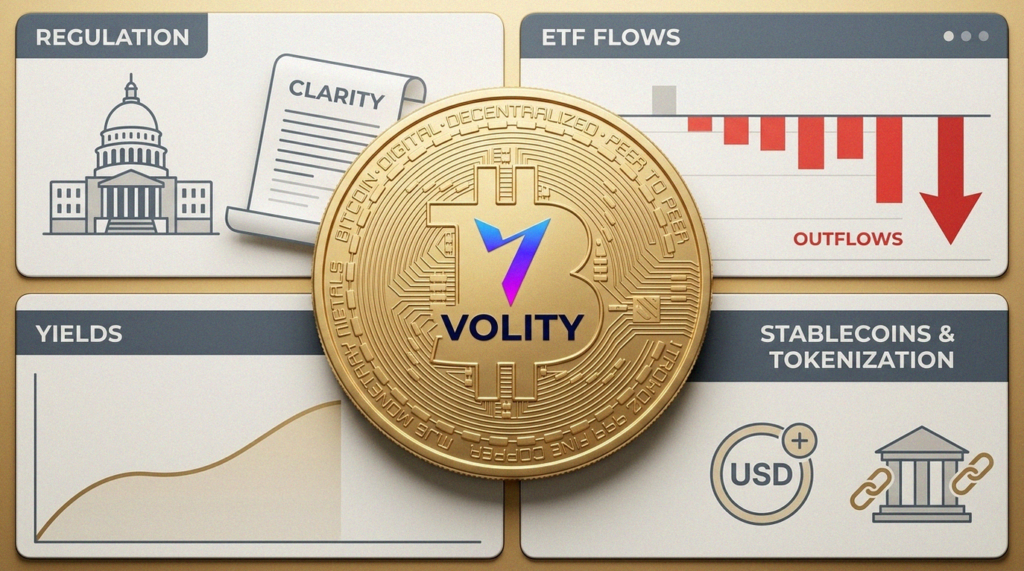
The Clarity Act Moves from Background Noise to Trading Catalyst
The main story is legal, not technical. The CLARITY Act, Congress’s effort to sort securities, commodities and payment tokens, has moved to the Senate floor. A handful of Democratic swing votes now carry unusual weight for crypto markets.
For years, traders treated Washington as a slow weather system. It mattered, but rarely by Friday’s close. Now, however, U.S. lawmaking has become a near-term price driver.
A softer version of the bill could give exchanges, issuers and custodians workable rules. In that case, institutions may find it easier to increase exposure to Bitcoin, Ethereum, stablecoins and tokenised products.
A stricter version would cut differently. It could favour BTC, ETH and larger regulated stablecoins. Meanwhile, thinner tokens may face delistings, liquidity gaps or fresh legal questions.
That divide matters for portfolios. The next phase may not lift every coin with the same tide. Instead, traders may sort tokens by legal durability, exchange access and custody comfort.
Macro Pressure Spoils the Rate-cut Trade
Macro has also turned less friendly. Firm U.S. employment data and hawkish rate talk have cooled hopes for quick Federal Reserve cuts. As a result, the easy version of the risk-on trade has lost force.
Bitcoin has reacted less like an inflation hedge and more like high-beta tech. When real yields rise, crypto feels the squeeze. When the dollar firms, speculative appetite fades quickly.
ETF flows show the shift clearly. U.S. spot Bitcoin funds have posted roughly three straight weeks of net redemptions. About $1.67bn left in the latest week, while more than $4.2bn exited over three weeks.
That is a sharp change from the early-year flow story. Then, spot ETFs supplied a steady bid and a clean institutional narrative. Now, the same products transmit selling pressure with equal efficiency.
Still, this is not a disorderly retreat. Liquidity remains decent in major pairs. However, traders have become more selective, and leverage looks less forgiving.
Market Snapshot
The market is grinding rather than collapsing. Volatility has risen, but panic has not taken over. Most large tokens still trade well above their hardest winter levels.
Bitcoin remains the benchmark. It anchors ETF flows, institutional custody decisions and most macro hedging in the sector. Ethereum remains the core smart-contract asset, with exposure to DeFi, tokenisation and staking economics.
Meanwhile, stablecoins continue to do the unglamorous work. Tether’s USDT and Circle’s USDC provide the dollar plumbing for retail traders, market makers and funds.
Beyond the majors, risk appetite looks more uneven. XRP, BNB, Solana, TRON and Dogecoin still act as altcoin sentiment gauges. Newer infrastructure names, including Hyperliquid’s HYPE, tell traders where speculative liquidity wants to play.
However, money appears to be moving up the quality ladder. Flows favour liquid names, cleaner custody and clearer use cases. That rotation often comes before a calmer market, though not always before a cheaper one.
By the Numbers
- $1.67bn – estimated net redemptions from U.S. spot Bitcoin ETFs in the latest week.
- $4.2bn-plus – estimated outflows from those funds over roughly three weeks.
- 3 weeks – approximate run of net ETF redemptions now weighing on Bitcoin sentiment.
- 4 core assets – BTC, ETH, USDT and USDC still dominate institutional market structure.
- 2 policy paths – soft clarity could unlock demand; hard clarity could force token triage.
Infrastructure Keeps Building While Prices Sulk
Under the price action, the plumbing keeps improving. This is easy to miss during red screens. Yet it may shape the next profit pool.
Stablecoin and tokenisation projects are advancing in Europe, including euro-area and Nordic initiatives under MiCA-style rules. Banks are also testing tokenised deposits and settlement tokens. Crypto’s infrastructure story remains alive, even when token prices wobble.
Asset managers are also tinkering with product design. Some are exploring Bitcoin-linked reinvestment structures. Others are looking at staking features for Ethereum and Solana funds, where rules allow.
That matters because yield is now part of the competitive fight. Plain price exposure may not satisfy investors if markets move sideways. As a result, funds will keep packaging crypto in ways that resemble familiar financial products.
Exchanges and derivatives venues continue to chase volume as well. Asian listings, perpetual futures and prediction-style markets are deepening the menu. However, more instruments also create more ways for crowded trades to unwind.
Enforcement Raises the Cost of Being Casual
Regulators have not eased their grip. European and Irish authorities are putting crypto inside tougher anti-money-laundering programmes. That raises costs for platforms, but it may also clear space for regulated products.
In the United States, enforcement has increasingly targeted individuals as well as firms. Lifetime bans tied to collapsed lending platforms send a blunt message. Founder risk is now an investable variable, not gossip.
Security risk remains just as real. Wallet-hijacking malware still appears through simple routes, including infected USB devices. For funds, family offices and wealthy holders, custody discipline is not optional.
That means cold storage checks, withdrawal whitelists and exchange exposure limits deserve regular attention. In a nervous market, operational mistakes become more expensive.
Trading Playbook
First, watch ETF flows daily. Persistent redemptions can weigh on spot prices, especially when funding rates weaken. Options skew also deserves attention, because it shows whether traders are paying up for protection.
Second, treat the CLARITY Act as a live risk event. Model both a soft outcome and a strict outcome. Then test each token against classification risk, venue access and likely grandfathering periods.
Third, separate liquid majors from speculative tail positions. BTC and ETH do not carry the same risk profile as thin altcoins. They should not share the same limits.
Fourth, avoid using leverage as the only expression of conviction. Options can define risk better around votes, ETF flow shifts and major expiries. They also stop one headline from wrecking an entire book.
Finally, keep an eye on the dollar and real yields. If rate-cut expectations move further out, high-beta crypto should stay fragile. If yields retreat, the ETF bid may matter again.
Related coverage on Volity
- Bitcoin Dips as Fed Dims Rate Cuts; XRP ETF Hopes Rise
- Bitcoin Holds $65K as Japan Cuts Crypto Tax and Litecoin ETF Launches
- Bitcoin Price Holds $65K as Whales Buy, XRP CLARITY Act in Focus
- Crypto Regulation 2026: USDC, Solana and CLARITY Act
- Bitcoin Falls as Crypto Week, XRP ETF Buzz Build
Key Takeaways
- Bitcoin is not in free-fall, but ETF outflows have changed the tone.
- The CLARITY Act could split compliant majors from legally awkward long-tail tokens.
- Higher real yields make crypto trade more like high-beta growth than hard money.
- Stablecoins and tokenisation remain the strongest infrastructure themes beneath the sell-off.
- Risk control matters more now, because law, rates and liquidity can all move together.
The market has grown up, but not grown calm. Its next move may come from a Senate vote, a Fed repricing or an ETF flow reversal. For now, the best traders are not chasing noise. They are watching the plumbing, the law and the exits.