Crypto Daily: Fed Aftershocks, XRP Hopes and a Market on Edge
Crypto traders came in today to a market that looked bruised, not broken. Bitcoin had lost altitude, rate-cut hopes had thinned, and XRP was suddenly wearing a Wall Street suit. The mood was not panic. However, it was no longer the easy risk-on tape that forgives every late entry.
The main pressure came from Washington. Kevin Warsh’s first Federal Reserve outing delivered no rate move, yet his tone did the damage. He kept policy steady, but he gave traders little reason to expect quick easing. The market had to reprice the old comfort trade: lower rates, weaker dollar, higher crypto.
Citadel added to the chill by warning that markets may be too relaxed about future US rate increases. That matters because crypto still trades like a long-duration risk asset. When real yields rise, speculative capital becomes pickier. Meanwhile, leverage turns from friend to trap.
Bitcoin Loses Its Footing
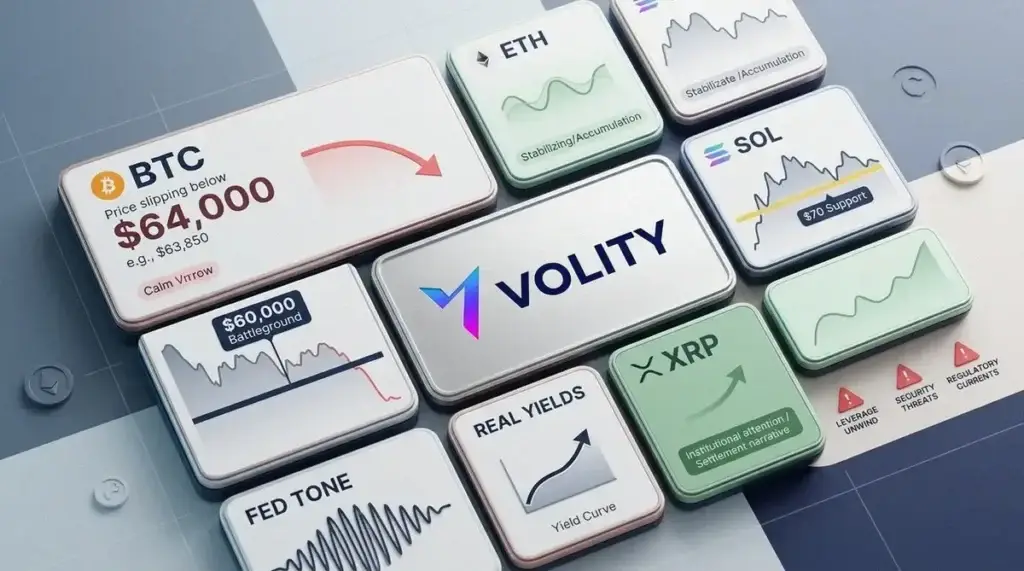
Bitcoin, ticker BTC, slipped below the $64,000 area after the Fed shock. That level had carried both technical and psychological weight. Once it failed, liquidations picked up across leveraged long positions. The next obvious line sits near $60,000, where dip buyers and forced sellers may collide.
The structure looks familiar. First, macro pressure hits the tape. Then, derivatives traders cut risk. Finally, spot buyers wait for cleaner entries. In thinner liquidity, that sequence can turn a normal pullback into a fast wick.
There is also a fresh supply worry. QCP flagged the risk that Strategy, the Bitcoin-heavy company tied to Michael Saylor, may sell more BTC to fund dividends. That does not mean a flood of coins is imminent. Still, traders dislike any new seller when momentum already points lower.
By the Numbers
- BTC support: $60,000 is the next major downside level.
- BTC resistance: $64,000 now becomes the first rebound test.
- SOL support: $70 is the level traders are watching closely.
- XRP fund flows: Standard Chartered sees potential ETF demand near $8 billion.
- Worldcoin move: WLD has recently jumped about 120%.
Ethereum and Solana Split the Mood
Ethereum, ticker ETH, is showing a rare on-chain bottom signal as whale activity drops sharply. That can sound bearish at first glance. However, quiet whales sometimes mark capitulation, boredom or position exhaustion. Historically, those conditions have often appeared near medium-term lows.
Still, a signal is not a trade by itself. ETH needs price confirmation before cautious buyers can call a turn. Until then, it remains caught between improving on-chain texture and a rough macro backdrop.
Solana, ticker SOL, looks more fragile. The $70 area has become the market’s line in the sand. If that level fails, chart traders expect another leg lower. Conversely, a firm hold could force short-term shorts to cover quickly.
XRP Steps Into the Institutional Conversation
XRP is the odd bright patch in a darker market. The token’s story today centres on settlement, tokenised Treasuries and potential ETFs. In other words, it is trying to move from crypto argument to financial plumbing.
Part of the attention comes from claims around XRPL-based Treasury settlement. The pitch is simple. XRP need not replace stablecoins to matter. Instead, it can act as a bridge or settlement asset inside tokenised markets.
That distinction matters for regulators and banks. Stablecoins mostly imitate cash. XRP’s backers want it judged as infrastructure. The debate has shifted from “coin or token” towards compliance, settlement speed and balance-sheet treatment.
Standard Chartered gave the story a sharper number. It said XRP exchange-traded funds could attract about $8 billion if the proposed CLARITY framework passes. That estimate assumes traditional advisory channels can allocate once compliance teams have cover.
The chart is less triumphant. XRP is testing trendline support while momentum indicators show bullish divergence. That can precede a bounce. However, if support breaks, the ETF story may not stop another mechanical sell-off.
Orders Matter Again
This is the kind of market where order type stops being beginner material. A market order gives immediate execution, but not a guaranteed price. In a fast BTC drop, that can mean ugly slippage.
A limit order gives price control, but not certainty of execution. That trade-off matters around visible levels such as BTC at $60,000 or SOL at $70. Traders who chase with size may find themselves filled at the worst tick.
Short-term players are leaning towards limit orders near defined support and resistance. Market orders still have a place, especially for urgent exits. But they deserve caution when liquidity is jumpy.
Yield Is Not a Hiding Place
Staking is also back in the conversation as prices stall. On proof-of-stake chains, holders can delegate coins to validators and earn yield. That can soften the cost of waiting through a choppy market.
However, yield is not free money. Native staking carries validator and protocol risk. Exchange staking adds platform risk. Liquid staking can add smart-contract and rehypothecation risk. Meanwhile, rewards can fall as more participants join.
For longer-term holders, staking can still make sense. Yet it should complement a risk plan, not replace one. A 4% yield offers little comfort after a 20% drawdown.
Big Finance Keeps Building
Away from the charts, traditional finance continues to assemble the rails. Capital B shareholders approved up to €100 billion in debt capacity, partly to expand its Bitcoin treasury strategy. That pushes the corporate BTC balance-sheet trade further into the mainstream.
Fidelity launched a stablecoin reserve fund under the emerging US GENIUS Act framework. The product aims to park backing assets in a structure institutions can understand. Meanwhile, Italy’s Conio secured a MiCAR licence before the European Union’s key crypto deadline.
In the Gulf, CoinMENA added Standard Chartered payment rails in the UAE. That link should improve fiat access for regional customers. It also shows how regulated exchanges now compete on banking depth, not just token listings.
Custody is changing too. BitGo hired a former Monetary Authority of Singapore regulator to drive APAC expansion. The message is plain: regulatory fluency has become a commercial weapon.
Security Risks Get Nastier
The security beat carries a darker note. Microsoft warned that a known crypto clipper malware strain has evolved into a broader backdoor. It no longer only swaps wallet addresses. It can maintain access and keep watching.
For traders, the advice is not glamorous. Use hardware wallets for serious balances. Separate trading devices from everyday browsing. Verify downloads. Also, do not trust copied addresses without checking the first and last characters.
Meanwhile, France is planning a 2027 quantum encryption test. Crypto developers will watch closely because quantum-resistant signatures remain an unresolved long-term issue. It is not tomorrow’s trading catalyst. However, it may shape future chain upgrades.
Regulators Crowd the Tape
Legal and regulatory stories are piling up. CME is preparing to sue the CFTC over US perpetual futures approvals. The case could shape who lists crypto derivatives, and under which rules.
Kentucky is testing CFTC authority through actions involving prediction markets Kalshi and Polymarket. At the same time, Kalshi is working with StarCompliance to monitor employee trading. Prediction markets are no longer a side show.
The SEC is also moving towards an exemption framework for tokenised stocks. Coinbase is watching closely for a possible US launch. If that door opens, equities and on-chain assets may become harder to separate.
Singapore’s MAS added Bybit to its investor alert list over licensing status. For retail traders, that is a reminder that venue risk now includes jurisdiction, not just fees and spreads.
Culture Still Has Teeth
Crypto has not lost its strange humour. Rakuten Wallet is turning dog photos into SHIB and DOGE rewards. Users upload pet pictures, then receive meme-coin incentives. It is absurd, but engagement often moves faster than fundamentals here.
Worldcoin, ticker WLD, has surged about 120% recently. That has revived the argument over biometric identity and Sam Altman’s global network. Supporters see useful identity rails. Critics see a vast data honeypot.
Chainlink, ticker LINK, is also gaining attention through World Cup-related oracle functions. The chart may not excite every trader. However, real-world integrations remain the core case for patient holders.
Key Takeaways
- Respect the Fed: higher-for-longer rates remain the base case until policy language changes.
- Watch BTC: $64,000 is resistance now, while $60,000 is the next major test.
- Treat SOL carefully: a break below $70 could trigger another leveraged flush.
- Do not ignore XRP: ETF talk and settlement use are giving it institutional oxygen.
- Tighten operations: malware risk makes wallet hygiene a trading issue, not an IT chore.