Investing in financial products involves risk. Losses may exceed the value of your original investment.
Ai patent plays is a core topic for traders in 2026. The complete guide follows.
Patent wins and AI plumbing jolt traders, as ARAI pops and Intel catches a bid
Speculation returned to the tape this week, but it did not arrive evenly. Meanwhile, one micro-cap rode a clean headline into a violent spike. However, a mega-cap old timer also found fresh momentum, helped by the market’s obsession with AI infrastructure. The best setups right now split neatly into two buckets: patent-fuelled froth and “picks and shovels” re-rating.
Arrive AI, ticker ARAI, put itself on every momentum scanner after the company said it had secured its tenth US patent tied to autonomous delivery infrastructure. The new grant, US Patent No. 12,591,840, covers shared-use delivery endpoints, with storage and secure handoff features.
In plain English, it is the sort of unglamorous hardware and software combo that could sit between drones, robots and couriers. So, traders did what they do.
They bought the headline and they chased the move.
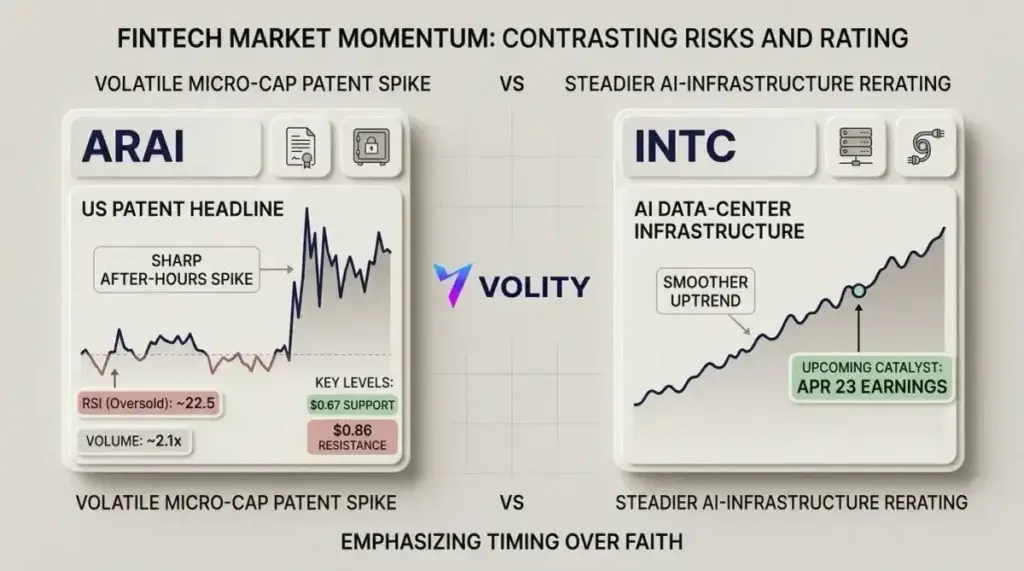
ARAI shares jumped 32.39% after hours on Wednesday. That is a proper jolt, not a sleepy grind.
Yet the chart carries a warning label. The stock still trades near a 52-week low around $0.70 and it’s down roughly 94.6% over the past year.
Even a big green candle can still be a bounce inside a long downtrend.
Technicals also argue for discipline. Earlier readings put ARAI at an RSI near 22.5, with volume running about 2.1 times normal.
That is classic “oversold relief” territory. However, that does not make it untradeable.
It simply changes the game from investing to risk management, where exits matter more than narratives.
For short-term levels, traders have been circling support near $0.67 and resistance near $0.86. If the stock cannot hold above the prior base quickly, the market will treat the patent as a one-day story. On the other hand, if it consolidates above resistance, it can trigger another leg, as micro-caps often do when they hook fresh momentum.
Intel, ticker INTC, tells a different story. The stock is up about 20% over the past month, with roughly 16% of that move packed into the last five sessions.
Meanwhile, the catalyst list looks more structural than speculative. Traders have leaned on talk of Intel’s role as host CPU for Nvidia’s DGX B300 systems, plus Xeon 6 design wins, plus renewed attention on foundry ambitions.
The bid has felt less like a squeeze and more like a slow re-pricing of “Intel still matters”.
Intel also tried to steer the conversation towards connectivity and data-centre plumbing at the Optical Fiber Communication Conference 2026, where it discussed optical and interconnect technology for AI workloads. That is not a consumer story. However, it sits directly in the capex stream that keeps showing up in earnings calls across the market. If investors keep paying for “AI enablement”, Intel can keep piggybacking on that theme into its next catalyst.
The next hard timestamp is Intel’s April 23 earnings. Ahead of that, the stock’s recent speed matters. A fast run into results can invite profit-taking on any guidance wobble. Yet if the company confirms demand signals, the market may give the move more runway, since the positioning has shifted from despair to cautious belief.
Not every “momentum” ticker deserves oxygen. GameSquare, ticker GAME, has been dragged into some trading chatter on what looks like crossed wires and stale framing. The stock has traded roughly in the $0.25 to $0.91 zone, and it remains deep in the penalty box after heavy losses. Traders looking for clean catalysts should be careful not to confuse it with louder, better-covered names that sit nearby in the collective memory.
By the numbers
- ARAI: +32.39% after hours Wednesday on patent news
- ARAI: near $0.70 52-week low area, about -94.6% over one year
- ARAI: RSI cited near 22.5, volume about 2.1x normal
- INTC: about +20% in a month, about +16% in five sessions
- INTC: next key date, April 23 earnings
Key takeaways
- ARAI is a catalyst trade first, not a fundamentals trade. Treat it like a momentum instrument with tight levels.
- Watch $0.67 support and $0.86 resistance on ARAI. However, expect whipsaw risk around any halt-prone volatility.
- Intel’s move has multiple supports, so dips can attract buyers. Yet a fast run into April 23 raises the odds of a “sell the news” flush.
- Avoid setups built on stale or mislabelled catalysts. Meanwhile, keep your watchlist clean.
The through-line is simple. Patents can light a fuse in tiny stocks, while AI infrastructure can rehabilitate old giants. However, both trades reward timing, not faith.
For more on this topic see our deep-dives on Enterprise AI Software Stocks: Why Productivity Plays Compete With Crypto, NVIDIA Blackwell GPU: Architecture, Specs, AI and Gaming Impact, and Sector Rotation Trades: Reading Tech vs Energy Moves Like a Pro.
What our analysts watch: The Volity desk reads any AI catalyst trade through three filters. Float and average daily volume (a one-day spike on volume above three times the trailing 30-day average flags a true catalyst rather than noise).
Position in the prior trend (a 52-week-low pop on RSI below 30 is an oversold relief setup; a fresh breakout on heavy volume after a multi-week base is a re-rating). Catalyst durability (a single patent grant decays within days; multiple structural design wins extend over quarters).
Each combination requires a different position-sizing approach, not a single playbook.
Frequently asked questions
How quickly does a patent-driven micro-cap pop usually fade?
Most decay within one to three trading sessions if no follow-up news arrives. The pop is driven by momentum scanners and short-term traders rather than fundamental allocators, so without a second catalyst the buyers exit and the float sells back to range. The SEC EDGAR filings database is the primary source for confirming patent-related 8-K disclosures.
What separates a real Intel re-rating from a dead-cat bounce?
Multiple, independent structural inputs printing positive over several weeks: design wins, customer announcements, foundry capacity reservations, and credible roadmap milestones. A single positive headline followed by silence usually fades. The Investopedia re-rating reference covers the broader equity-market mechanics.
How should retail traders size a momentum micro-cap position?
Smaller than feels comfortable, with predefined exits at both the support and resistance levels. ARAI-style names can move 30 percent in either direction within hours, so position sizes that work in liquid mid-caps become liquidation magnets here. The FINRA day-trading guidance covers the broader risk-management framework for high-volatility instruments.
Are AI infrastructure plays still attractive after a multi-week run?
Conditionally yes, after a healthy consolidation. Stocks that run 15 to 20 percent in five sessions usually need a base-building period of two to four weeks before the next leg. Buying the breakout from that base on volume is structurally cleaner than chasing the original move. The BIS publishes research on tech-cycle valuation that contextualises the broader AI capex backdrop.
Related guides
- Best AI stocks to invest in
- How to buy Intel stock
- Stocks investing for beginners
- Best stock trading platforms in Europe
- Best trading platforms
- Swing trading platforms
Volity operates a trading platform and also publishes educational and analytical content about trading. The content on this page is for educational purposes only and should not be considered financial advice. Volity may benefit commercially when readers open trading accounts through links on this site.
Our content is produced and reviewed under documented editorial standards; see our comparison and review methodology.