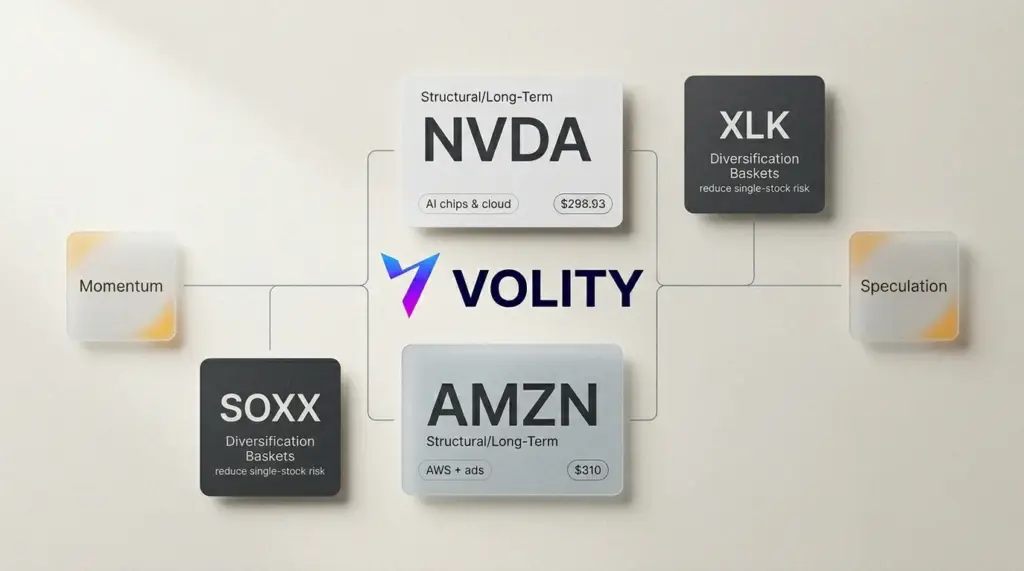
Market Watchlist: Separating Durable Winners from Fast Trades
Investors opened the session with a lively basket of tickers and three very different jobs for them.
Some names belong in the long-term drawer. Others suit traders watching price, volume and timing. Meanwhile, the smallest and newest ideas deserve a separate shelf marked speculative.
That distinction matters now. AI enthusiasm still pulls capital into semiconductors and cloud. However, higher-beta trades can punish late buyers quickly. Today’s list needs less noise and more sorting.
Long-term Names: Structural Themes, Not Lottery Tickets
The core watchlist starts with liquid companies and funds tied to durable spending cycles. These include AI infrastructure, cloud, financial services, energy, healthcare property, travel and industrial technology.
NVDA remains the central toll booth in the AI build-out. Demand for accelerators, networking and systems still frames the bull case. The stock carries broad Wall Street support, with an average rating around “Strong Buy” and a 12-month consensus target near $298.93.
However, Nvidia is no longer a hidden story. Traders should expect sharp swings around supply, margins and hyperscaler spending. Long-term holders, meanwhile, need the AI capex cycle to keep broadening.
AMZN offers a wider engine. E-commerce gives scale, AWS gives cloud leverage, and advertising gives margin upside. Bank of America recently reiterated Buy with a $310 target. That implied about 30.5% upside from the June 18 close near $237.50.
Still, Amazon’s appeal is not one product cycle. Instead, it rests on several profit pools improving together. If AWS growth holds and retail costs stay disciplined, the stock keeps a cleaner long-term case.
For investors who prefer baskets, SOXX and XLK keep exposure broad. SOXX tracks the semiconductor complex, while XLK captures large-cap technology leadership. They reduce single-stock execution risk, though they do not remove sector risk.
Financials and Cash-flow Stories
AXP and AMP sit in the financials bucket, but they travel different roads. American Express leans on affluent consumer spending and card economics. Ameriprise, meanwhile, ties more closely to wealth management, markets and advisory assets.
Both names suit investors watching earnings durability rather than headline bursts. However, neither is immune to consumer stress or market drawdowns. The setup looks earnings-driven, not meme-driven.
In energy, XOM and VLO remain cash-flow vehicles with commodity sensitivity. Exxon gives integrated oil exposure. Valero gives refining leverage, where margins can move faster than crude itself.
Energy traders should watch oil, crack spreads and geopolitical risk. Long-term investors, meanwhile, should focus on capital returns, balance sheets and project discipline.
Real Assets, Travel and the Useful Middle Layer
WELL brings healthcare real estate exposure, tied to demographics and senior housing demand. That makes it different from pure rate-sensitive property trades. However, REIT valuations still react quickly when bond yields move.
RCL offers a higher-beta route into travel and leisure. Cruise demand, pricing and onboard spending all matter. Yet the stock remains cyclical, because households still decide what holidays they can afford.
CASY looks quieter, but that is part of the point. Casey’s General Stores mixes convenience retail, fuel and local consumer demand. In choppy markets, steady operators can earn a place beside louder growth names.
Then comes the picks-and-shovels layer: KEYS, STM, ASX and FTAI. These companies sit around testing, semiconductors, manufacturing services and transport infrastructure. Investors can own parts of the supply chain without choosing every final winner.
- NVDA: AI hardware leader, consensus target near $298.93.
- AMZN: Bank of America target at $310 after a $237.50 close.
- SOXX: Broad semiconductor exposure without picking one chipmaker.
- WELL: Healthcare property exposure linked to ageing demographics.
- VLO: Refining margins matter as much as crude direction.
Momentum Names: Trades, Not Wedding Vows
Momentum deserves its own label. It rewards timing, liquidity and discipline. It does not reward emotional attachment to a chart.
SOXL is the cleanest example. The leveraged semiconductor ETF can move hard when chip stocks rally. However, it can also decay and reverse quickly when volatility turns hostile.
That makes SOXL a trading instrument, not a sleepy semiconductor allocation. Entry, exit and position size matter more than grand AI speeches. For many traders, the sensible holding period is hours or days, not quarters.
High-beta technology and growth stocks can enter this bucket too. Breakouts, pullbacks and volume spikes may create tactical setups. Still, those trades need clear stop levels and a reason to exit.
Meanwhile, traders should avoid smuggling momentum names into the long-term portfolio. A fast chart can become a stubborn loss when the story changes. The tape often votes before the earnings model catches up.
Speculative Names: Watch Items with Sharp Edges
The speculative sleeve needs the brightest warning label. These ideas can be interesting. However, they can also move on thin liquidity, promotional language or single press releases.
NVPS is a fresh example. The PurePlay Nvidia Ecosystem Picks & Shovels Index ETF began trading on June 18, 2026. It aims to track companies tied to Nvidia’s value chain. If you are weighing the stock itself, see how to invest in Nvidia.
The concept makes sense in a market obsessed with AI suppliers. Still, a new ETF has almost no trading history. Spreads, volume and tracking behaviour matter before anyone sizes it aggressively.
RLMD and IMMX sit in the smaller biotech-type category. Trial updates, FDA commentary and financing headlines can overwhelm chart patterns. These names fit a watchlist, not a high-conviction core list.
The SPCX and SpaceX-linked angle needs extra care. SpaceX is not a simple, listed common stock. Vehicles offering indirect exposure can carry complexity, illiquidity and marketing heat.
Readers should not confuse indirect exposure with owning SpaceX itself. Instead, they should examine structure, holdings, fees and liquidity. In speculative products, the wrapper often matters as much as the theme.
How to Organise the List
A cleaner daily format separates conviction from curiosity. It also helps readers understand risk before they click buy.
- High-conviction and long-term themes: NVDA, AMZN, SOXX, XLK, WELL, RCL, XOM, VLO, AXP, AMP, CASY, KEYS, STM, ASX, FTAI.
- Momentum and trading setups: SOXL, plus liquid breakouts or pullbacks confirmed by strong volume.
- Speculative and news catalysts: RLMD, IMMX, NVPS and SPCX or other SpaceX-linked instruments.
This structure keeps the watchlist honest. Long-term compounders can ride structural demand. Momentum trades need tight rules. Speculative names require patience, smaller sizing and better questions.
Related coverage on Volity
- Market Open Watchlist: INTC, UUUU, BE in Hawkish Fed Tape
- Morning Watchlist: EOSE, SOFI, MU, MRNA Catalysts
- Morning Watchlist: SMCI, DDOG, RKLB and 17 Other Stocks
- Dow Peace Rally, Oil Fade and OSS Contract: Morning Brief
- AI Earnings Test: Adobe (ADBE) and Oracle (ORCL) in Focus
Key Takeaways
- Keep NVDA and AMZN in the structural growth bucket, not the impulse-trade bucket.
- Use SOXX and XLK for broader tech exposure when single-stock risk feels too high.
- Treat SOXL as a short-term volatility vehicle, not a core semiconductor holding.
- Mark NVPS, RLMD, IMMX and SPCX as speculative watch items.
- Separate each idea by time horizon before judging upside, risk or suitable position size.