Investing in financial products involves risk. Losses may exceed the value of your original investment.
Hot stocks ai is a core topic for traders in 2026. The complete guide follows.
Hot stocks igniting today: AI GPUs, earnings beats, and momentum plays
New York – Stocks come into this Wednesday in April 2026 with that familiar earnings-season twitch. Futures are steady after a broad Tuesday lift, led by industrials and a still-buoyant tech tape. The Dow rose 0.87%, while the S&P 500 added 0.69% and the Nasdaq gained 0.70%. Meanwhile, the day’s trade map narrows to a handful of names with real catalysts and real volume.
At the top sits Axe Compute, a microcap with a megaphone. Elsewhere, GE Vernova reports before the bell, Northern Trust has already delivered, and IBM heads into results with Wall Street leaning bullish. However, Lucid remains a trader’s stock, not an investor’s one, because dilution risk never sleeps.
AGPU: contract ink meets thin float
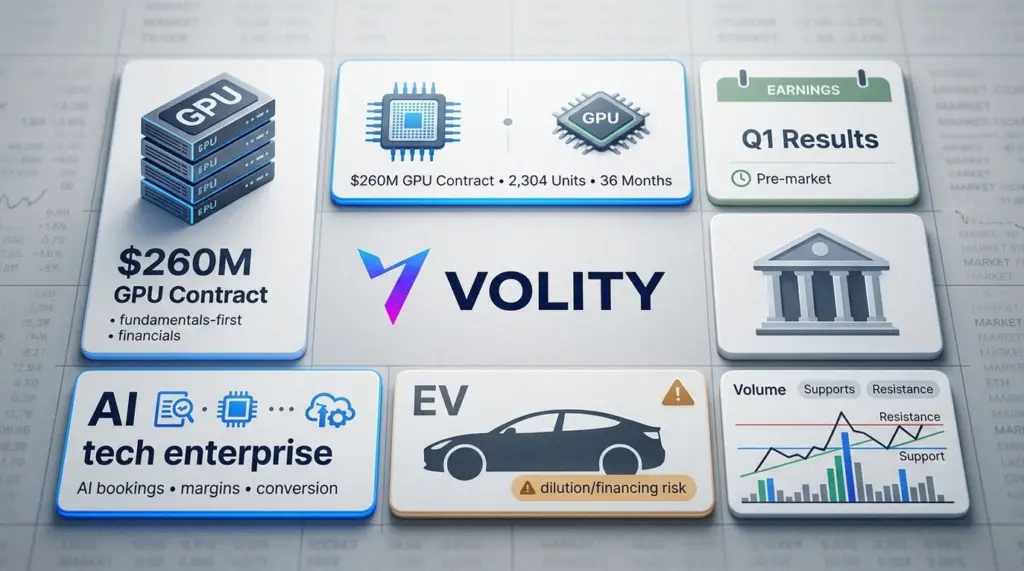
Axe Compute (NASDAQ: AGPU) is the tape’s headline act after announcing a $260 million contract over 36 months for 2,304 GPUs. That is the sort of number that forces shorts to do maths in public. The company has also stacked smaller deals recently, including a cited $12 million run of wins that management frames as roughly $835,000 per month flowing into Q2.
Technicals have cooperated. The 10-day moving average crossed above the 50-day on 7 April, while momentum reportedly flipped positive on 20 April.
When the contract hit, the stock did what crowded charts often do and jumped into air pockets. It traded up through $10.42 on the news, with volume described as multiples of its norm.
If volume stays elevated after the first wave, traders will watch whether buyers defend prior breakout levels rather than chase fresh highs.
GEV: the pre-bell tell
GE Vernova (NYSE: GEV) reports Q1 2026 before the open, with a webcast slated for 7:30 a.m. ET. Last quarter, revenue came in at $10.96 billion, up 3.8% year on year, while results topped expectations on both earnings and sales. The market will treat any miss as a surprise, and any raise as permission.
The bull case remains straightforward. Demand tied to gas turbines, grid gear, and storage has supported guidance optimism, while the stock still carries last year’s momentum, after an 84% gain following a weak 2024 patch. However, the real trade will sit in the details, including order commentary, margin progression, and management’s tone on project timing.
NTRS: a clean beat in a fussy sector
Northern Trust (NASDAQ: NTRS) has already handed traders a gift-wrapped catalyst with $2.71 EPS on $2.206 billion revenue for the quarter. Financials have struggled to lead, yet clean beats still travel, especially when the broader market is rotating rather than surging. Dip-buyers will look for follow-through that holds above the first post-print support zone, not just a one-day pop.
IBM: positioned for an AI-flavoured print
IBM (NYSE: IBM) reports later today, and sentiment leans constructive. Evercore ISI has an Outperform with a $345 price target, while Wedbush sits Outperform at $340. Consensus expectations cluster around $1.81 EPS and about $15.6 billion revenue, with the familiar debate over how quickly AI demand converts into recurring sales.
The stock has held around $256 to $257, which matters because it signals buyers are willing to stay put into the event. However, any earnings trade here depends less on “AI” as a slogan and more on bookings, backlog colour, and management’s confidence on margins. In other words, the print needs substance, not theatre.
LCID: bounce potential, balance-sheet gravity
Lucid (NASDAQ: LCID) is trying to rebound off lows amid chatter tied to Uber-related headlines and a generally risk-on mood. Still, this remains a high-beta setup with obvious financing risk. If you must trade it, treat it like a trade: demand volume confirmation, respect stops, and avoid marrying the story.
Materials as the reluctant hedge
While rotation has lifted utilities and kept tech afloat, materials risk looking like the odd man out. Nucor (NYSE: NUE) and Steel Dynamics (NASDAQ: STLD) sit in the “watch for breakdowns” bucket if the market keeps favouring defensives plus AI-adjacent growth. However, both can reverse quickly if macro data or tariffs chatter swing the group.
By the numbers
- S&P 500 on Tuesday: +0.69%
- Nasdaq on Tuesday: +0.70%
- Dow on Tuesday: +0.87%
- AGPU contract: $260m over 36 months for 2,304 GPUs
- NTRS quarter: $2.71 EPS on $2.206b revenue
Key takeaways
- AGPU is a volume story first, valuation debate second. Let liquidity, not excitement, set entries.
- GEV will trade on guidance texture and order commentary, not the headline EPS alone.
- NTRS offers a cleaner earnings trend than most financials, so support levels matter more than targets.
- IBM needs tangible AI conversion and margin control to justify the bullish positioning.
- LCID is only for disciplined risk budgets, because capital raises can erase chart patterns overnight.
For more on this topic see our deep-dives on QQQ Momentum and Tech: How Gold and Bitcoin Shape Risk Sentiment, NVIDIA Stock Analysis: Price Drivers and Buy/Sell Framework, and Intel Stock and Defensive Rotation: How Investors Position Pre-Earnings.
What our analysts watch: For an AI-tilted earnings tape, we lean on three filters. First, moving-average crosses on light floats such as AGPU, where the 10-day clearing the 50-day on a contract print often precedes short-covering.
Second, pre-bell tells from industrials such as GE Vernova, where order commentary and margin progression matter more than headline EPS. Third, the IBM bookings print, because AI demand only rerates legacy software when it converts to recurring revenue.
When all three are constructive, we rotate from defensive cash into momentum continuation.
Frequently asked questions
How do I trade a microcap such as AGPU after a contract announcement?
Wait for the second wave of volume after the initial gap, watch whether price defends prior breakout levels rather than chasing fresh highs, and avoid sizing up into the close. The Investopedia primer on microcap stocks covers liquidity and dilution risks that decide whether a contract win actually compounds.
Why does GE Vernova matter beyond its own print?
GEV is a clean read on grid, gas-turbine, and storage demand tied to AI data-centre power loads. The Federal Reserve monetary-policy page sets the rate backdrop that decides whether industrial capex stays elevated. Order commentary from GEV often rerates utilities and select industrials within the same session.
What signals a clean financial-sector beat in a fussy market?
Numbers like NTRS at $2.71 EPS on $2.206b revenue qualify when net interest income, fee income, and credit costs are all inside or above guidance. The Nasdaq NTRS quote page tracks the post-print reaction, which usually reveals whether the beat travels or fades by noon.
How should I treat high-beta names such as Lucid into headlines?
Treat them as trades, not investments. Demand volume confirmation, respect stops, and assume financing risk has not gone away. CySEC-licensed brokers operating under MiFID rules, including UBK Markets (CySEC 186/12), publish margin schedules and negative-balance protection terms that retail traders should read before adding leverage to a name with obvious dilution risk.
Related guides
- Best AI stocks to invest in
- Stocks investing for beginners
- Best stock trading platforms in Europe
- Day trading platforms
- Best trading platforms
Volity operates a trading platform and also publishes educational and analytical content about trading. The content on this page is for educational purposes only and should not be considered financial advice. Volity may benefit commercially when readers open trading accounts through links on this site.
Our content is produced and reviewed under documented editorial standards; see our comparison and review methodology.