Investing in financial products involves risk. Losses may exceed the value of your original investment.
Intel stock defensive is a core topic for traders in 2026. The complete guide follows.
Market momentum: Intel’s sprint, an industrial bid, and the week’s earnings traps
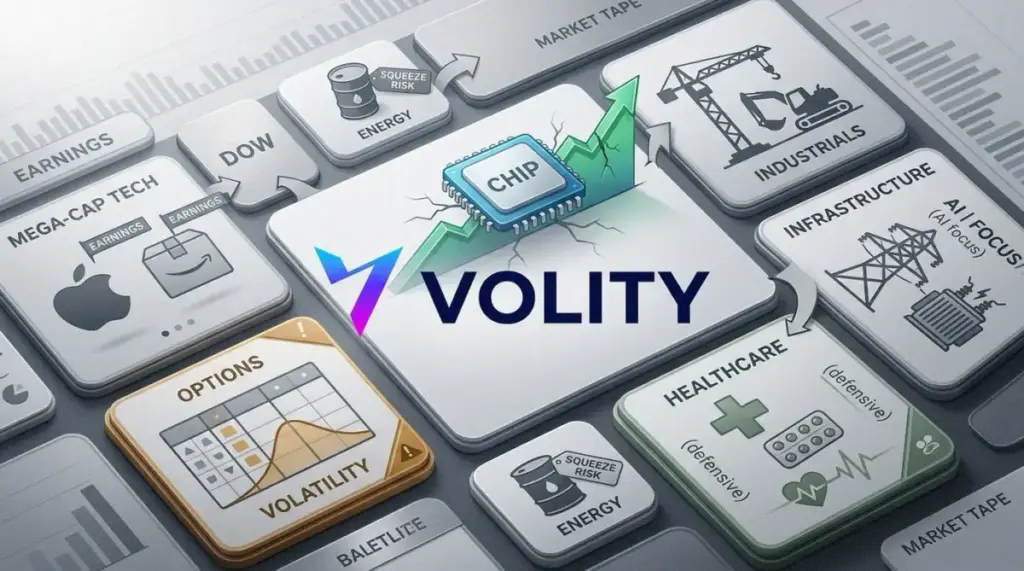
Wall Street has rediscovered an old habit: chasing whatever moves, then pretending it was always the plan. Intel’s surge has become the latest proof. Meanwhile, money has leaked out of the crowded mega cap trade and into industrials and defensives, therefore giving the Dow a sturdier tone even as parts of tech wobble.
Intel (INTC) was the headline act. The stock finished Friday at $61.72, up 4.7% on about 154 million shares.
That volume matters more than the percentage move. It signals real sponsorship, not just day traders swapping paper.
However, the rally now carries the brittle feel of “anything AI” trades. They work until, suddenly, they don’t.
April’s move in Intel has been so violent that even sceptics have turned chartist. Traders are now watching whether the stock can hold above its recent breakout area and stop dipping back into the old range.
If it does, the next leg tends to arrive via ETFs and options hedging, not patient long only buyers. Meanwhile, deal chatter has added oxygen, including talk of a future Apple relationship around 2027.
None of that is booked revenue today. Yet momentum rarely waits for invoices.
Even so, tech is no longer the only place to hide. Industrial names have quietly done what they are meant to do in an earnings season.
They beat expectations, guided steadily, and kept capital spending stories alive. Caterpillar (CAT) and a clutch of transport and process names, including AME, XPO and KEX, caught bids after solid first quarter prints.
Investors are tying them to AI buildouts in a less glamorous way: power, construction, logistics, grid kit. They sit in the sweet spot of “growth, but not frothy”.
Defensives are also back in fashion. Healthcare with dividends has become the go to parking spot for managers who want to de risk without admitting it.
Thermo Fisher (TMO) and AbbVie (ABBV) keep attracting steady flows, while the XLV ETF remains an easy expression for income minded investors who still want liquidity. Meanwhile, the pitch has evolved.
It is no longer only about ageing demographics. It is also about data, diagnostics, and AI wrapped around clinical workflows.
On the consumer side, Amazon (AMZN) has had a different kind of momentum pulse. Search interest has jumped, and that often shows up in the options market before it shows up in fundamentals. However, traders should remember that search spikes can also mark peaks in excitement. They are useful, not sacred.
The next big volatility test sits with Apple (AAPL). Options are already pricing an active move around earnings, and the setup favours strategies that benefit from a large swing rather than a correct guess. Meanwhile, expectations have lifted enough that merely “fine” numbers can still disappoint. In this tape, the market punishes ambiguity.
Energy is the uncomfortable corner. Oil has slipped about 1% even while geopolitical risk refuses to go away.
That has tempted short sellers back into the sector. However, crude near $100 a barrel can turn into a squeeze quickly if supply headlines hit at the wrong time.
Tight risk controls matter more than conviction.
By the numbers
- Intel (INTC): $61.72 close Friday, +4.7% on ~154m shares.
- Dow: up about 300 points on the day cited, helped by Q1 beats.
- S&P 500 Q1: ~15.1% blended earnings growth, with ~76% revenue beats.
- 10 year Treasury: around 4.5%, keeping rate sensitive groups honest.
- Oil: down about 1% near $100, despite persistent risk headlines.
Key takeaways for traders
- INTC: Treat it as a volume led momentum trade. A failed hold above the breakout zone can flip it fast.
- Industrials: CAT and peers may keep working if AI capex stays real, not just narrative.
- Healthcare defensives: XLV style exposure can reduce drawdowns if tech rotation deepens.
- AAPL and AMZN: Options markets look primed. Consider defined risk structures into prints.
- Energy shorts: Keep stops tight. Supply shocks can turn “easy” shorts into violent squeezes.
The tape right now rewards flexibility. Momentum traders should respect Intel’s volume signal. Yet the smarter move is to track where the next marginal buyer comes from, because that buyer is no longer guaranteed to be in tech.
For more on this topic see our deep-dives on NVIDIA Big-Data Analytics: Real-Time AI for Business Edge, Stocks to Watch: AAPL, SOFI and the Bank Red Flags Investors Track, and SolarEdge Stock Jumps as Jefferies Lifts Price Target on SEDG.
What our analysts watch: Three reads convert the rotation tape into a sized basket. The volume-confirmed momentum filter on INTC-style breakouts (a 4.7 percent close on 154 million shares is institutional sponsorship rather than retail momentum; the failure mode is a follow-through session with declining volume, which signals that the marginal buyer is exhausting and that the breakout is at risk of failing back into the prior range).
The industrials-as-AI-derivative read (CAT, AME, XPO, and KEX trade as AI-buildout proxies in the unglamorous rather than glamorous frame; the structural test is whether forward capex guidance on the next quarterly print converts the narrative into measurable revenue contribution rather than analyst projection). The defensive-healthcare bid as positioning rather than conviction (TMO, ABBV, and XLV are the parking spots for managers who want to de-risk without admitting it; the diagnostic is whether the bid is concentrated in dividend-paying defensives or whether it spreads to lower-quality healthcare names, with the latter pattern signalling broader risk-off rotation).
The StockCharts ChartSchool reference on sector rotation covers the cross-cycle framework, the ESMA investor protection publishes the 10-Q filings that anchor the disclosure read on each name, and the Nasdaq earnings calendar tracks the live print schedule. Volity offers U.S. and European equity CFD execution under CySEC oversight via UBK Markets (licence 186/12), with entities in Saint Lucia and Cyprus.
Frequently asked questions
Why does INTC volume on the breakout matter more than the percentage move?
Because the volume signature is the institutional fingerprint that distinguishes a breakout sustained by allocator demand from a breakout driven by retail momentum-chasing. A 4.7 percent close on 154 million shares signals that the marginal buyer is sized large enough to mark the close, which is the structural pattern that historically supports follow-through into the next two-week window. The same percentage move on 60 to 80 million shares typically fails because the marginal buyer is the discretionary fast-money cohort that exits on the next session unless the breakout extends. The disciplined sizing framework treats the volume threshold as the gating condition for the long, with a pre-defined invalidation level set just below the breakout zone.
What separates an industrials-as-AI-derivative trade from a generic industrials-recovery trade?
The forward capex guidance converts the narrative into measurable revenue. A generic industrials-recovery trade rests on cyclical mean-reversion (PMI bottoming, inventory destock ending, real-yield compression) and trades the multiple expansion that follows the recovery cycle. An industrials-as-AI-derivative trade rests on AI-buildout capex flowing into power, grid, transport, and process names that the industrial complex covers; the structural diagnostic is the customer-mix disclosure on the next quarterly print, with credible AI-customer commentary supporting the higher multiple and generic cyclical commentary compressing it. The disciplined response is to require AI-customer disclosure in the next two earnings calls before sizing the basket aggressively.
How should traders read the AAPL options-priced active move into the print?
The options-priced move size is the market-implied volatility expectation for the print window, which tells traders that the disciplined position structure is the defined-risk options trade rather than the directional cash position. A long straddle, long strangle, or risk-defined spread captures the magnitude of the move without requiring directional accuracy, which is the structural advantage when the implied move is large but the direction is ambiguous. The discipline is to compare the implied move against the historical realised move on the prior four prints; an implied move materially above the historical realised pattern signals over-priced volatility and favours short-volatility structures, while an implied move at or below the historical pattern favours long-volatility structures.
Does the 4.5 percent 10-year Treasury yield change the defensive rotation framework?
It does not change the framework but it shifts the position-sizing emphasis. A 10-year yield at 4.5 percent compresses the equity-multiple expansion that supports rate-sensitive defensives (utilities, consumer staples, REITs) while leaving the dividend-paying healthcare defensives (TMO, ABBV, XLV) relatively intact because the cash-flow durability outweighs the discount-rate sensitivity. The structural read is that the rotation continues to favour the higher-quality defensive complex (healthcare, select industrials with secular tailwinds) over the rate-sensitive defensive complex (utilities, REITs) until the 10-year breaks meaningfully below 4 percent. The disciplined sizing framework underweights the rate-sensitive defensives at current yields and overweights the cash-flow-durable defensives until the rate path shifts.
Related guides
- Best AI stocks to invest in
- How to buy Intel stock
- Stocks investing for beginners
- Best stock trading platforms in Europe
- Indices trading platforms
- Swing trading platforms
Volity operates a trading platform and also publishes educational and analytical content about trading. The content on this page is for educational purposes only and should not be considered financial advice. Volity may benefit commercially when readers open trading accounts through links on this site.
Our content is produced and reviewed under documented editorial standards; see our comparison and review methodology.