Investing in financial products involves risk. Losses may exceed the value of your original investment.
Solaredge stock jefferies is a core topic for traders in 2026. The complete guide follows.
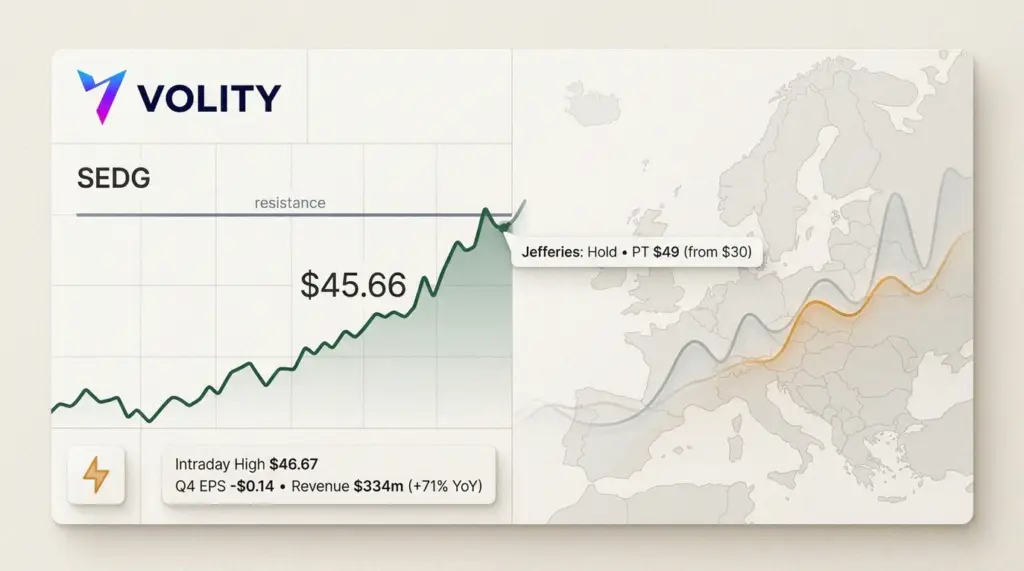
SolarEdge Technologies, ticker SEDG, caught a fresh gust on Friday after Jefferies upgraded the shares to Hold from Underperform. The bank set a $49 target, up from $30, and the stock promptly traded like it had been let out of a compression band.
By Thursday’s close, SEDG sat at $45.66, up 1.74%, after tagging an intraday high of $46.67. However, the real headline was the shift in tone. Jefferies argued that European energy price volatility could revive solar installations, which would matter for an inverter supplier that lives and dies by project timing and distributor restocking.
In other words, the call was less about a neat valuation trick and more about an old market habit. When power prices in Europe whip around, households and small businesses tend to re-run the maths on rooftop solar. Meanwhile, installers speed up quoting, and channel inventories can move from dead weight to scarcity in a single season.
Why this upgrade landed now
SolarEdge has already had a violent turn. The shares have risen about 152% over the past year, climbing out of the sector’s 2024–25 wreckage. Since late February alone, the stock is up about 29%, which means Friday’s upgrade hit a chart already leaning bullish.
Yet the rally has not been clean. Volume has drifted lower as price pushed higher, which often signals an advance led by positioning rather than fresh conviction. Friday’s reaction matters because it tests whether new buyers will appear at higher levels, not just short sellers leaving in a hurry.
Wall Street is still split
Despite the pop, the Street’s broader posture remains cautious. Across roughly 25 analysts, the mix sits around 1 Buy, 17 Holds, and 7 Sells, with an average target near $27.23. That is awkward arithmetic when the stock trades in the mid-$40s.
Still, the direction of travel has improved. Bank of America moved to Neutral with a $40 target on 10 March, after previously sitting at Underperform. Morgan Stanley has also sat at $40. Jefferies now sits at the top end with $49, which implies limited upside from Thursday’s close, but a potential momentum burst if the stock can clear nearby resistance.
Fundamentals: better, not fixed
SolarEdge’s latest quarter offered encouragement without delivering a clean turn. The company posted Q4 EPS of -$0.14 against an estimate near – $0.19, while revenue rose 71% year on year to about $334 million. However, profitability remains elusive, with margins still deeply negative and the return profile ugly.
Liquidity is not the immediate problem. A quick ratio around 1.48 suggests breathing room, while debt-to-equity near 0.82 looks manageable for now. However, investors still need a steady demand cadence and a calmer pricing environment for inverters, not just one lucky quarter.
Technicals: a tight fight near resistance
The chart is doing the heavy lifting. Shorter moving averages sit above longer ones, which keeps trend followers interested. Meanwhile, traders have been eyeing resistance near $48.40 and then $54.19. On the downside, a slip back through $43 would change the tone fast, because it would suggest the upgrade pop failed to recruit real demand.
Momentum indicators have started to cool from overbought levels. That is not bearish by itself. However, it raises the bar for follow-through, especially if the next push arrives without bigger volume.
By the numbers
- Thursday close: $45.66, up 1.74%
- Thursday high: $46.67
- Jefferies target: $49 (from $30)
- Q4 revenue: $334m, up 71% year on year
- Street mix: 1 Buy, 17 Holds, 7 Sells
Key takeaways
- If SEDG holds above $46.67, momentum traders will treat it as a breakout attempt.
- However, a drop below $43 would likely trigger fast de-risking after a steep run.
- Watch for a volume increase on up days, otherwise the rally can feel air-thin.
- European power price headlines may act as the next catalyst, for better or worse.
- Options traders should respect the stock’s high volatility and size positions accordingly.
Jefferies did not declare a solar renaissance. It simply suggested the European backdrop is less hostile than it looked, and that SolarEdge is geared to benefit from any restart in installations. Still, the market has already done plenty of repairing on its own. The next few sessions will show whether this upgrade adds fresh fuel, or merely provides a convenient place for late buyers to pay up.
For more on this topic see our deep-dives on Top Trades: AI Stocks Rally as Oil Slides, NFLX and MRVL Soar, Hang Seng Tech and China AI: Trading Alibaba and HK Tech Catalysts, and BMNR and PTON: Ethereum Treasury Plays and Breakout Setups.
What our analysts watch: We rank solar stocks by three criteria. First, channel-inventory weeks-on-hand from distributor data; below 8 weeks usually signals the bottom is in.
Second, net-metering policy changes in California, Texas and Germany, which are the swing markets for residential demand. Third, gross margin trajectory ex-warranty charges.
SEDG is leveraged to all three, which is why a single broker upgrade can drive double-digit moves; the float is heavily shorted and short-cover dynamics amplify good news.
Frequently asked questions
Why are solar stocks so volatile around analyst upgrades?
Residential solar names like SEDG and Enphase trade with extremely high short interest (often 15 to 25 percent of float). When sentiment turns, short-cover pressure layers on top of fundamental buying. Combined with thin sell-side coverage, even one upgrade can move the stock 10 percent or more. Investopedia explains short interest mechanics.
How do US tariff policies affect SolarEdge?
SEDG sells inverters and optimisers, which are partially imported. Section 201 and Section 301 tariffs on Chinese components add cost; Inflation Reduction Act incentives partially offset that with US manufacturing credits. The net result is highly company-specific. Filings on the SEC EDGAR system give the cleanest read on tariff exposure quarter to quarter.
Is residential solar still a structural growth story?
The structural thesis is intact: rooftop solar levelised cost continues to fall, electrification of heating and transport raises household electricity demand, and policy in the EU and US still subsidises adoption. The cyclical headwind is interest-rate sensitivity, since most residential systems are financed. The IMF covers green-investment macro flows in its sustainability publications.
How can I trade SolarEdge volatility on Volity?
Volity supports US equity and CFD positions on SEDG and clean-energy names through UBK Markets (CySEC licence 186/12) with our Saint Lucia and Cyprus entities. You can pair long SEDG with short Enphase or oil hedges to trade the relative thesis instead of the binary stock direction.
Related guides
- Stocks investing for beginners
- Best stock trading platforms in Europe
- Best trading platforms
- Swing trading platforms
- Risk management
Volity operates a trading platform and also publishes educational and analytical content about trading. The content on this page is for educational purposes only and should not be considered financial advice. Volity may benefit commercially when readers open trading accounts through links on this site.
Our content is produced and reviewed under documented editorial standards; see our comparison and review methodology.