Investing in financial products involves risk. Losses may exceed the value of your original investment.
Bitcoin etf flows is a core topic for traders in 2026. The complete guide follows.
Crypto market jumps as Bitcoin clears $80,000
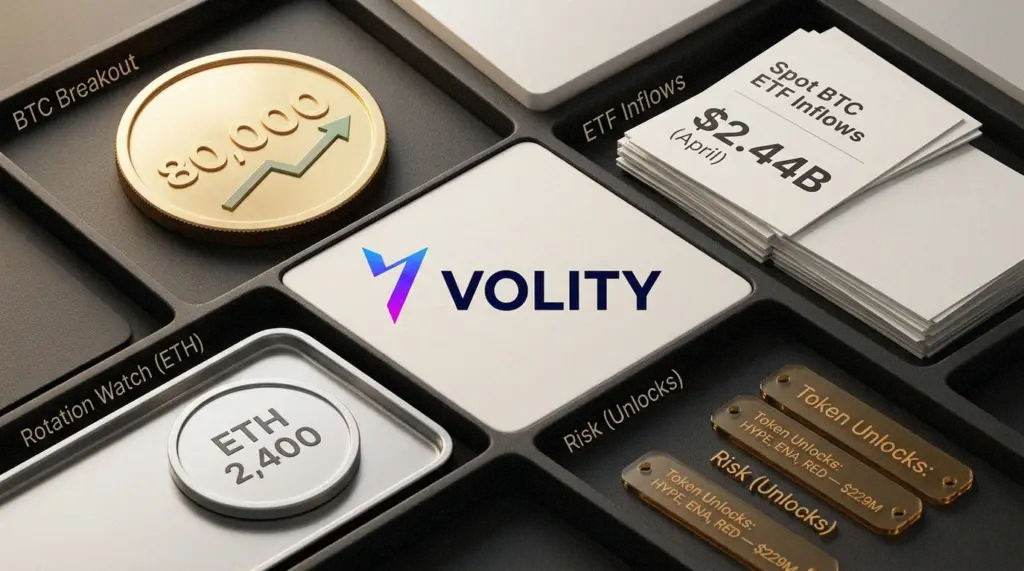
Bitcoin pushed through $80,000 on Monday, snapping up liquidity levels that had capped rallies since late March. However, the bigger story sat behind the tape. Traders tied the move to President Trump’s “Project Freedom” announcement, which markets read as a friendlier stance towards digital assets and lighter regulatory friction.
Bitcoin ended April near $76,110 and started May around $77,000. The break above $80,000 carried a psychological charge. It also undercut a familiar pattern of May softness that has hung over crypto desks since the 2021 peak. Meanwhile, derivatives funding stayed lively, suggesting buyers were not just spot bargain hunters but also leveraged momentum accounts.
Even so, the rally looked less like a single headline spike and more like a continuation of structural demand. US spot Bitcoin ETFs pulled in about $2.44 billion in April, almost double March’s intake. The market had fresh marginal buyers with a mandate to keep buying on dips, not to trade every wiggle.
Politics meets positioning
Trump’s “Project Freedom” landed into a market already leaning long. That matters because crypto rallies often need a narrative only after positioning tilts. However, narrative still moves the marginal buyer, especially when it hints at agency appointments, enforcement priorities, and the future tone of rulemaking.
Meanwhile, Ethereum traders watched for a technical turn. Some desks pointed to a potential MACD crossover on ETH, with $2,400 flagged as a key level. If Bitcoin holds above $80,000, therefore, ETH often benefits from rotation trades as risk appetite broadens.
Treasury-style accumulation spreads
Meanwhile, the corporate and institutional bid remained a steady drumbeat. Hut 8 refinanced a $200 million loan and highlighted $260 million of Bitcoin becoming unencumbered, which gives it more flexibility to hold coins rather than sell into strength. Elsewhere, Capital B disclosed $1.28 million from Blockstream’s Adam Back, earmarked for more Bitcoin accumulation.
One eyebrow-raiser came from Bitmine Immersion, which disclosed a purchase of 101,745 ETH and said holdings stood at 5.18 million tokens, with 83% staked. However, that scale would place it among the largest ETH holders on earth, so traders will want to see tight disclosure and custody details before treating it as hard supply removal.
Meanwhile, allocation talk kept creeping into mainstream portfolios. Morgan Stanley circulated guidance suggesting 2%-4% Bitcoin exposure, a level that once sounded fringe and now reads like model-portfolio plumbing.
Altcoins move, but cliffs remain
Altcoins joined the party, although the market still treated them like rental cars. Solana’s charts improved and traders floated $90 as a near-term test. XRP watchers talked up a $1.50 break as a gateway to $2.20. Ondo jumped about 13% on momentum flows, while Zcash chatter again turned to outsized upside targets that usually arrive just before volatility fans out.
Meanwhile, Dogecoin saw whale accumulation claims, with 160 million DOGE cited over 96 hours. That can support a squeeze, but it can also become exit liquidity if price stalls. Meme-coin traders watched order books closely rather than relying on on-chain headlines.
However, the calendar brings hazards. Token unlocks totalling roughly $229 million were flagged for HYPE, ENA, and RED. Unlocks often create a familiar pattern: strength into the event, then a sudden air pocket if fresh supply meets thin bids.
Stablecoins and payments keep building
Outside pure price action, stablecoin plumbing continued to expand. Western Union moved USDPT rails to Solana, aiming at faster cross-border payments. Rain added Mastercard for on-chain settlement tooling, backed by what it described as a $1.95 billion stablecoin stack. Meanwhile, Kraken pushed deeper into US derivatives after its Bitnomial deal, a sign that exchanges still see futures as the stickiest revenue line.
Gold-linked crypto also caught a bid. Tether Gold’s market cap topped $3.3 billion after reserves reportedly rose 36% in the first quarter. That came alongside a jump in gold trading activity, with Bitget citing record CFD volume of about $8 billion a day. The “hard money” trade ran on two tracks at once: bullion exposure and Bitcoin beta.
Courts, freezes, and compliance noise
However, the legal backdrop stayed messy. World Liberty Financial said it was taking Justin Sun to court over an alleged smear campaign. Arbitrum DAO faced scrutiny around a US court freeze involving about $71 million of ETH. Meanwhile, South Korean exchanges pushed back against a proposed 10 million won AML trigger that could generate 5.4 million reports, a compliance flood that would slow business even for well-run platforms.
By the numbers
- Bitcoin: $80,000+ after April’s close near $76,110
- US spot Bitcoin ETFs: $2.44bn of April inflows
- Hut 8: $200m refinancing, $260m BTC unencumbered
- Tether Gold: $3.3bn market cap, reserves +36% in Q1
- Token unlocks flagged: about $229m across HYPE, ENA, RED
Key takeaways
- Bitcoin above $80,000 turns former resistance into a sentiment trigger, but failed holds can unwind leverage fast.
- ETF inflows keep creating a dip-buyer baseline, which can compress drawdowns until a macro shock hits.
- Watch ETH near $2,400 for rotation signals, especially if BTC consolidates rather than spikes.
- Altcoin strength looks tactical, not devotional, so token unlock dates matter as much as charts.
- Legal and AML headlines can still freeze liquidity, therefore position sizing matters more than conviction.
For more on this topic see our deep-dives on Bitcoin and Ethereum Outlook: How Regulation Shapes Crypto Prices, Bitcoin Drops as Tether Mints USDT and Liquidations Hit Crypto Markets, and Bitcoin Price Rallies on ETF Flows: Reading Spot ETF Demand.
What Volity Editorial watches: Three flow signals separate sustainable rallies from leverage-driven head fakes. First, the IBIT-FBTC creation split, because divergence between issuers often precedes a regime shift in basis trade demand.
Second, the cumulative net flow versus 90-day average, which highlights whether the current bid is simply mean-reverting or actually escalating. Third, GBTC outflows, since that legacy bucket continues to act as a dry-powder ceiling on Coinbase Prime liquidity.
When all three line up bullishly, BTC tends to absorb supply quietly; when they diverge, expect sharper intraday wicks and crowded reversals.
Frequently asked questions
How are spot Bitcoin ETF inflows calculated?
Spot Bitcoin ETF flows are reported daily by each issuer (BlackRock, Fidelity, Bitwise, Ark, and others) as net subscription versus redemption activity. Aggregators publish consolidated totals in dollar and BTC terms. The U.S. Securities and Exchange Commission reviews each issuer’s 19b-4 filings, and the SEC’s EDGAR system carries the underlying creation and redemption disclosures.
Does a $2 billion ETF inflow week always lift Bitcoin?
Not always. Inflows can be offset by leveraged unwinds on offshore venues, by miner distribution, or by stablecoin outflows. The cleaner read is to compare ETF inflows against open interest changes on CME and Binance perpetuals. CoinDesk publishes daily ETF flow reconciliations that pair issuer prints with derivatives positioning data.
What does Project Freedom mean for ETF investors?
The Trump administration’s Project Freedom is a framing exercise rather than a single regulation. For ETF investors, the practical implication is a friendlier appointment posture at the SEC and a faster path for tokenised securities and crypto custody approvals. The Federal Reserve has separately signalled that bank custody of digital assets remains under supervisory review, which still gates the pace at which ETFs can scale into traditional retirement plumbing.
Should retail investors size Bitcoin like a Morgan Stanley client?
The Morgan Stanley 2-4% allocation guidance is a model-portfolio anchor, not a personal recommendation. Most retail portfolios that overweight Bitcoin during euphoric phases underperform a disciplined dollar-cost approach. Volity’s public footprint sits with UBK Markets under CySEC 186/12, with Saint Lucia and Hong Kong entities behind the wider group, and our analysts treat the 2-4% band as a useful sanity check rather than a target.
Related guides
Volity operates a trading platform and also publishes educational and analytical content about trading. The content on this page is for educational purposes only and should not be considered financial advice. Volity may benefit commercially when readers open trading accounts through links on this site.
Our content is produced and reviewed under documented editorial standards; see our comparison and review methodology.