Investing in financial products involves risk. Losses may exceed the value of your original investment.
Short squeeze ai is a core topic for traders in 2026. The complete guide follows.
Biotech roars, AI chips refuse to cool, and the tape rewards risk again
Risk appetite came back with a grin on Friday. Biotech ripped higher, AI semis held court, and short interest added petrol. Meanwhile, investors treated macro noise as background music, as long as revenues and guidance kept moving.
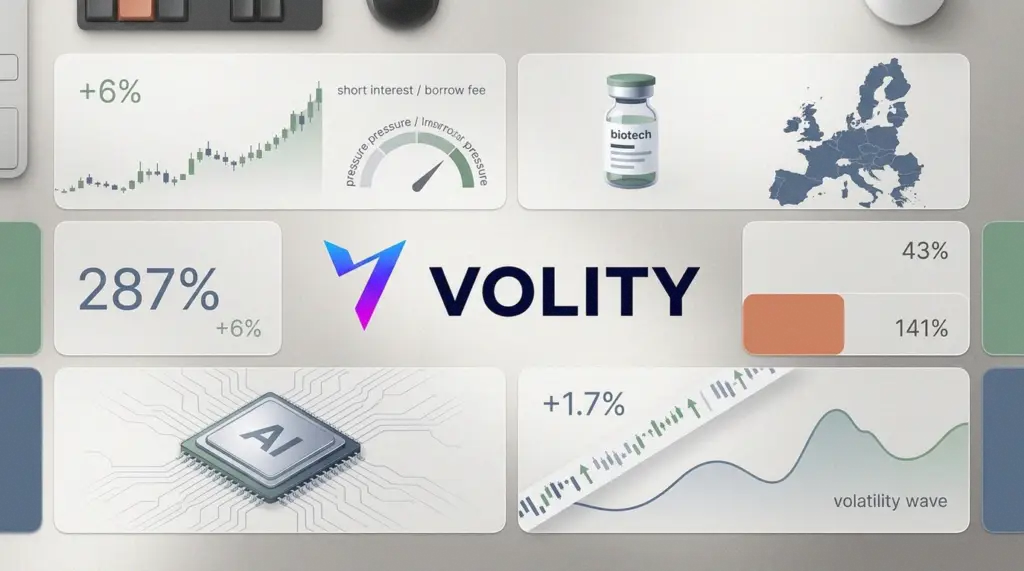
ImmunityBio, ticker IBRX, was the day’s clearest pressure cooker. The shares jumped about 6% to roughly $8.32, pushing the company towards a $7 billion market value. That move followed a quarter that traders will not forget quickly. Revenue rose by roughly $44 million, while the stock logged a headline-grabbing 287% quarterly surge.
However, the story is not only momentum. ImmunityBio’s cancer therapy Anktiva is now cleared across 33 countries, including the EU’s 27. That kind of regulatory perimeter tends to change how fast a biotech can sell, hire, and fund trials. The market started to price in a more durable commercial ramp, not just another hopeful pipeline name.
Then there is positioning. Short interest sits near 43%.
Borrow fees have been quoted around 141%. In plain English, bearish bets are expensive to carry, and they can turn into forced buying quickly.
Meanwhile, sell-side chatter has floated $14 to $15 targets. Those numbers do not move a stock by themselves.
Yet they can anchor intraday narratives, especially when the borrow is tight.
Broadcom, ticker AVGO, played the other half of the day’s script. The company posted quarterly earnings that kept the AI chip trade in motion.
Earnings per share printed at about $2.05, above a cluster of expectations around $1.88 to $2.03. More importantly, AI demand again did the heavy lifting, and the market treated any wobble as a buy-the-dip invitation.
However, the stock’s premium multiple means perfection stays priced in. That raises the cost of bad news later.
On the macro side, retail sales were strong, up about 1.7%. The Dow added roughly 200 points, or 0.48%. Cyclicals found friends again. Yet the more interesting action sat in single names where beats, raises, and positioning could spark quick extensions.
NetSTREIT, ticker NTST, drew income-focused attention after an earnings beat and a lift to its full-year outlook. Meanwhile, regional banks kept flashing tradable setups. Zions, ticker ZION, benefited from its own earnings momentum and higher price targets floating around $63+, which can act like a magnet in a strong tape. However, regional banks remain headline-sensitive, and the stops need to match that reality.
A few other pockets stood out. Plug Power, ticker PLUG, showed relative strength by holding steady while other industrial names sagged. AXT, ticker AXTI, faced dilution headlines after a large offering, which can create ugly first reactions and decent bounce conditions if panic exhausts itself. Elsewhere, some crowded or overheated names looked ready for the other side of volatility, including BB, MXL, and ADTN, where stretched RSI readings often invite sharp pullbacks.
By the numbers
- IBRX: up about 6% to roughly $8.32, market cap near $7bn.
- Anktiva: cleared across 33 countries, including the EU 27.
- IBRX: short interest near 43%, borrow fees quoted around 141%.
- AVGO: EPS about $2.05 versus expectations around $1.88 to $2.03.
- Retail sales: about +1.7%; Dow about +0.48%.
Key takeaways
- IBRX has a classic squeeze profile, so size small and respect fast reversals.
- AVGO remains the AI quality bid, yet any guide wobble can punish premium multiples.
- REIT beats like NTST can run in bursts, especially when rates behave for a week.
- Regional banks can trend on upgrades, but headline gaps still rule risk management.
- Overbought fades work best when the broader index stops making new highs.
For more on this topic see our deep-dives on Oil Shock Trading: Hormuz Risk, WTI Spikes and Cross-Asset Plays, UEC Stock Outlook: Debt-Free Uranium Play vs Pricey TEM Peers, and Argan (AGX) Stock: Earnings, Power Demand and Buy Case.
What our analysts watch: For squeeze candidates layered on top of AI chip leadership, we triangulate three datapoints. First, borrow fees and short-interest ratios from prime-broker feeds, because cheap borrow rarely squeezes.
Second, regulatory catalysts such as Anktiva clearing 33 countries, which can turn a momentum trade into a fundamentals trade. Third, the AI leader print, because if AVGO or NVDA wobbles, even a 43% short stock can fail to clear resistance.
Position size scales with how many of the three are aligned, never with conviction alone.
Frequently asked questions
What is a short squeeze, and how do borrow fees flag it?
A short squeeze occurs when rising prices force short sellers to cover, which drives prices higher in a reflexive loop. Borrow fees above 100% annualised, like the 141% quoted on IBRX, mean shorts pay a meaningful daily cost to stay in the trade. The Investopedia short-squeeze primer covers the mechanics.
Why is the AI chip trade so resilient inside risk-on tapes?
AI training and inference workloads still scale faster than supply, so hyperscaler capex on AVGO, NVDA, AMD, and custom silicon stays high. Index data from the Nasdaq 100 shows how concentrated the leadership is, which is why a clean Broadcom print often lifts the whole semis cohort even when smaller names lag.
How should retail traders treat squeeze candidates with 43% short interest?
Position size small, set hard stops, and accept that intraday reversals can erase a week of gains in minutes. The SEC investor bulletin on short selling explains why forced covering is messy. CySEC-licensed venues such as UBK Markets (CySEC 186/12) provide negative-balance protection on retail accounts, which matters when squeezes gap.
How do I avoid getting stuck on the wrong side of a dilution gap?
AXT (AXTI) and similar names with offerings can fall sharply on dilution headlines. Read the 8-K or prospectus before adding, watch for after-hours volume spikes that signal a placement, and avoid sizing up into a calendar event. Bounce conditions emerge once the offering clears, but only after panic exhausts itself, never before.
Related guides
- Best AI stocks to invest in
- Stocks investing for beginners
- Best stock trading platforms in Europe
- Day trading platforms
- Risk management
Volity operates a trading platform and also publishes educational and analytical content about trading. The content on this page is for educational purposes only and should not be considered financial advice. Volity may benefit commercially when readers open trading accounts through links on this site.
Our content is produced and reviewed under documented editorial standards; see our comparison and review methodology.