Investing in financial products involves risk. Losses may exceed the value of your original investment.
Uec stock outlook is a core topic for traders in 2026. The complete guide follows.
Uranium’s bid gets louder, and UEC sits in the sweet spot
Uranium stocks are back in the chat, and not just because traders fancy a thematic punchline. Demand signals keep stacking up. Meanwhile, utilities still need long term supply, and governments keep buying “energy security” like it is an index fund.
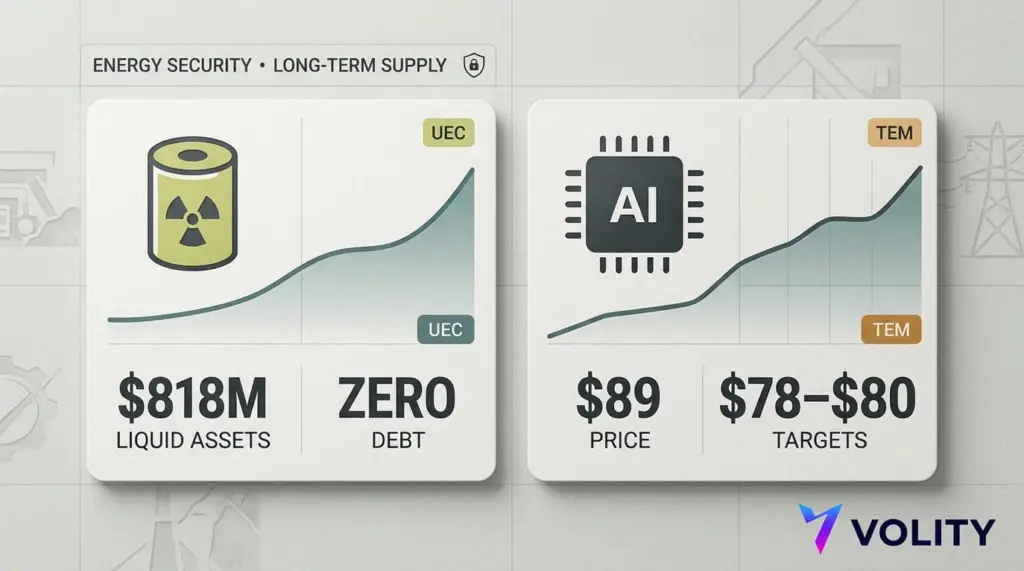
Against that backdrop, Uranium Energy Corp (UEC) has become a clean, liquid way to play the cycle. The shares closed around $14.48, and the story investors want is simple: balance sheet first, optionality second. UEC has no debt and roughly $818 million in liquid assets, based on its latest quarterly disclosures. It can wait, acquire, or ramp without the same refinancing drama that haunts weaker miners.
However, the market is not paying for perfection. It is paying for probability, and the main probability is a higher realised uranium price over time. For the wider case, see whether uranium is a good investment. UEC has cited recent uranium sales around $101 per pound in recent quarters, which helps anchor the bull case. Even so, spot and term prices can swing fast, and that keeps analyst targets scattered.
Targets are upbeat, but the spread matters
The high end targets near $26.50 still do the rounds, and they look great in a screenshot. Yet most current consensus figures sit closer to the high teens. Traders should treat the $26 handles as “cycle peak” thinking rather than a base case for the next quarter.
- TradingView average target: $19.11, high $26.50, low $15.00
- TickerNerd median call: $18.00, with a $15 to $26.50 range
- StockScan 2026 average: $15.86
- Public.com cluster: about $16.69
- StocksGuide cluster: about $16.83
At $14.48, those consensus bands imply anything from single digit upside to something closer to 30 percent. Meanwhile, the high target implies an 80 percent plus move, which only arrives if the uranium tape turns into a chase.
Still, UEC’s appeal is not just the target maths. It is the financing maths. With zero debt, UEC does not need to issue equity into a weak tape just to keep the lights on. That advantage matters most when uranium prices wobble and risk appetite fades.
What could go wrong, quickly
However, traders should not confuse “debt free” with “risk free”. Mining equities trade on timing, and timing is cruel. If uranium prices stall, the group can bleed sideways for months. Likewise, if broader markets slide, uranium names often get sold with everything else, regardless of fundamentals.
There is also a target trap. Some price targets are stale, and some are built on commodity decks that no longer match today’s forward curve. Any upside calculation should start with the date of the target, not the headline number.
Tempus AI stays a “buy”, yet the targets say “not at this price”
Tempus AI (TEM) offers a different kind of friction. The growth story is loud, and the analyst ratings often read like a cheerleading squad. Yet the targets have not kept up with the share price.
TEM traded around $89.23. Meanwhile, fresh target clusters sit closer to $78 to $80, which implies downside from here. MarketBeat shows a mix heavy on Holds, while other services cite a median target in the high $70s, despite a wide range up to $100. The consensus message is awkward: “we like the company, but we don’t like the entry”.
Revenue growth has been strong, including sharp gains in Genomics, plus higher pricing on certain tests and expanding pharma relationships. However, valuation sets the rules now. If TEM does not print fresh catalysts, buyers may demand a pullback into the $70s before they re risk it.
By the numbers
- UEC price: $14.48
- UEC liquid assets: about $818m
- UEC debt: $0
- UEC key target band: roughly $16 to $19 for many current averages
- TEM price: $89.23, with many targets near $78 to $80
Key takeaways for traders
- UEC: the cleanest bull case is balance sheet optionality plus a supportive uranium cycle.
- UEC: treat $18 as a practical consensus waypoint, not a victory lap.
- UEC: watch uranium price moves first, then equities follow with leverage.
- TEM: ratings look positive, yet targets hint the stock is ahead of itself.
- TEM: consider patience, since a pullback may offer the better setup than chasing strength.
Uranium’s rally has a familiar feel: slow fundamentals, sudden price action. UEC fits that pattern well, because it can survive the quiet weeks. Meanwhile, TEM looks like a stock that needs to earn its next leg higher in quarterly ink, not in analyst adjectives.
For more on this topic see our deep-dives on How to Use a Trading Journal Effectively for Trade Tracking, Crypto and Investment Playbook: How Active Traders Read Cleared Trades, and AI Patent Plays: Reading ARAI, Intel and the AI Stock Catalyst Cycle.
What our analysts watch: Three lenses dominate our reading of the equity tape. Sector rotation tells us where capital is moving (defensives versus cyclicals, value versus growth). Earnings revisions show whether analyst expectations are catching up to or trailing reality. Real yields and the dollar set the discount rate that valuation multiples respond to. When earnings estimates rise faster than the index price and real yields stabilise, the setup tends to favour patient longs.
Frequently asked questions
How much money do I need to start trading stocks?
Many regulated brokers now allow account opening with no minimum deposit and offer fractional shares for as little as $1. A practical starting balance for a long-only beginner is $500 to $2,000, enough to diversify across a handful of positions without paying meaningful percentage spreads. The FCA publishes investor education resources worth reading before opening an account.
What is the difference between stocks, ETFs, and CFDs?
A stock is direct ownership in a company. An ETF is a basket of stocks (or other assets) traded as a single security. A CFD (contract for difference) is a leveraged derivative that tracks the underlying price without conferring ownership. Each has different cost, tax, and risk profiles. ESMA imposes leverage caps on retail CFDs in the EU and UK.
How do I choose a trustworthy broker?
Verify regulation with a tier-one authority (FCA in the UK, CySEC in Cyprus, BaFin in Germany, ASIC in Australia, or your local regulator). Check segregated client funds, negative-balance protection, transparent fees, and a clean disciplinary record. Avoid any platform offering guaranteed returns or pressuring deposits. The FCA Financial Services Register is free to search.
Should I day-trade or invest long-term?
Most retail accounts that day-trade lose money over time. Long-term passive investing in diversified index ETFs has historically delivered competitive returns with far less effort and lower stress. Active day-trading can work, but it requires capital, an edge proven over hundreds of trades, and the time to monitor positions intraday. Start passive; layer active only after the basics are durable.
Related guides
- Stocks investing for beginners
- Best stock trading platforms in Europe
- Best trading platforms
- Swing trading platforms
- Risk management
Volity Editorial, Volity research: The Volity desk evaluates resource equities through a four-filter framework: balance-sheet survival capacity, realised-price differential against spot, project optionality and permitting clarity, and management discipline through prior cycles. UEC passes the first filter cleanly; net cash plus liquid assets fund multi-year operating runway through any cycle drawdown. The second filter is where the bull case lives, because realised pricing above one hundred dollars per pound supports cash margins that scale into a higher term-price environment. The remaining filters are scenario-dependent and warrant ongoing review.
Volity analyst FAQ
Why is uranium price rising in 2026?
The uranium term price is supported by a structural supply-demand mismatch: global utility procurement contracts have lengthened, secondary supply (Russian and Kazakh) faces geopolitical friction, and new reactor construction concentrates demand growth in jurisdictions that prioritise non-Russian sources. Government stockpiling adds an inelastic buyer to the cohort. The Nasdaq uranium price commentary contextualises the cycle.
What does debt-free balance sheet mean for UEC stock?
A debt-free producer with hundreds of millions in liquid assets retains optionality across any commodity-cycle drawdown. The structural difference versus leveraged peers is that UEC can wait for higher prices, acquire weaker producers at distressed valuations, or accelerate production into strength without the refinancing pressure that forces operational compromises. The Investopedia debt-free framework primer covers the broader implications.
How do uranium stocks compare with tech AI peers?
Both sit inside the energy-AI infrastructure narrative, but the cycle profile differs sharply. Uranium pays slow, durable cash flow tied to multi-decade utility contracts. Tech AI peers pay variable, faster-compounding revenue tied to capex cycles. Pricey AI peers (TEM and similar names) carry materially higher implied volatility and sentiment dependency. Most balanced energy-tech allocations hold both with explicit position-sizing rules. The IMF energy research contextualises the structural backdrop.
What are the main risks to UEC outlook?
The honest list runs through four items: a sustained term-price retracement below 80 dollars per pound that compresses cash margins, regulatory delays on permitting in key US projects, a thaw in geopolitics that releases secondary supply back into the market, and equity dilution if management chooses an opportunistic acquisition over organic growth. None of those risks is currently dominant, but each is real and should sit explicitly inside any position-sizing decision.
External references
- Nasdaq uranium outlook
- Investopedia debt-free primer
- IMF energy research
Volity operates a trading platform and also publishes educational and analytical content about trading. The content on this page is for educational purposes only and should not be considered financial advice. Volity may benefit commercially when readers open trading accounts through links on this site.
Our content is produced and reviewed under documented editorial standards; see our comparison and review methodology.